Are Zombie Projects Quietly Stealing Your Time & Revenue?

Between the repetitious banalities of meetings, messages, half‑finished tasks, and disengaged co-workers, you'd officially be dead inside if the relentlessness didn't get to you sometimes. On top of Shaun of the Dead-ding your way through your day, you’ve also zombie projects to deal with...
You may not want to openly admit it, but we all know when a project has "turned"; shuffling along long after its purpose has been quashed. Most teams can launch new initiatives with vigor, but far fewer can collectively clock when a project has quietly ceased to create value. These stalled efforts, AKA zombie projects, drain your attention, your time, and ultimately your budget while proffering little in return.
Understanding what zombie projects are is the starting point. So, take my clammy green paw as we explore how to spot zombie projects, why they survive longer than they should, and the real‑life examples of zombie projects that reveal the patterns behind them. You’ll also learn how time and activity data can surface hidden issues and how to decide when to pause, pivot, shut a project down entirely, or go on an epic culling spree!
Key Takeaways
- Stalled progress, habitual meetings, and work happening out of inertia rather than impact are reliable indicators that a project is no longer delivering value.
- Cultural politeness, distributed responsibility, and the bias toward continuation over closure all contribute to projects lingering long past their usefulness.
- Pausing, pivoting, or shutting down a project becomes far easier when teams use evidence‑based criteria and ask grounding questions before committing more time.
- Establishing explicit decision points and regularly revisiting project assumptions helps teams avoid the slow slide from “in progress” to “zombified.”
- When teams can see how time is actually spent, rather than how they think it’s spent, they’re far more equipped to intervene early and redirect effort toward high‑impact work.
What are zombie projects?

Zombie projects aren’t just “slow” or “tricky” in nature; they are, in fact, endeavors that have lost their direction but somehow lurch onward. On the surface, these projects still look purposeful: meetings still take place, tasks are being assigned, and then there's always a delusional soul somewhere insisting that there's still life left in it.
What makes zombie projects particularly insidious is how functional they can appear. They tend to blend into your day-to-day, feeding on habit and the collective reluctance/politeness to admit something isn’t working. And because they don’t dramatically fail or self-combust, preferring to lurk aimlessly in the corner of your team's consciousness, they’re all too easy to ignore.
Before you're willing to even address the festering elephant in the room, they’ve already silently drained weeks of effort and savaged budget you didn’t plan to lose. Moreover, zombie projects crowd out the projects that actually deserve your time and attention.
Real-life examples of zombie projects
So we've established that zombie projects don't riotously burst through the office door foaming at the gob. Instead, they quietly gnaw on your resources while everyone looks the other way.
Here are three examples to help people understand how they tend to present and how easy it is to back your workplace into a corner.
The “almost finished” feature that never actually ships
Picture it. A team carefully builds a feature that looked like a breakthrough just a few months ago, but user research has shown that demand for it has since dropped off. But since you’ve “put so much effort into it already,” the team keeps going through the motions, rewriting documentation and setting up weekly check-ins. The obvious truth is no one wants to admit; the feature is DOA. And yet, it continues to lumber forward out of habit and a sunk-cost hangover.
An internal tool nobody uses
Mid-level management suggests an internal dashboard that will “revolutionize reporting.” It launches, the team spends time getting to know it, and then team usage pretty much flatlines because people say they like new tools. In actuality, however, they don’t make it part of their process because it’s just something else they need to do.
Despite few people using it, this same tool is still updated, has its bugs fixed, and has a quarterly review. That said, no one wants to decommission it either because that would mean admitting it never delivered value…
Cross-team initiative with no definitive leader
A strategic initiative kicks off with a gusto, but then leadership changes. With that, priorities and accountability change, with those at the forefront fading away. Now, the project keeps limping along because so many teams are loosely affiliated with it, yet no one feels enough ownership to declare the thing dead. So, again, everything trundles on as normal while everyone tenuously involved hopes someone else will make the decision they’ve been avoiding.
Why zombie projects survive?

Understanding why zombie projects outlive their natural lifespan necessitates a bit of introspection on your part. In other words, you need to consider the psychological, structural, and cultural forces that facilitate a project to persist long after it’s worthwhile.
For example, launching something new is typically a very visible and celebrated affair. Stopping something, however, often requires justification, reports, and a willingness to challenge prior thought processes. This imbalance alone keeps many projects on life support.
So, admitting that a project is zombified requires teams to look at how decisions got made, who championed what, and which assumptions weren’t quite right. Given how awkward this can be, it often seems preferable to feed a project scraps of time than to have a potentially stilted conflab about whether it deserves to exist anymore.
And, as in our examples above, responsibility can be multiplied by distributing it. If a project affects many teams or leaders, no one feels wholly responsible. The result is a silent organizational bystander effect – everyone sees the problem, but no one is willing to take care of it.
When to pause, pivot, or shut down a project

Deciding what to do with a struggling project isn’t about making some grand proclamation (though who am I to deny you a little drama if that’s what you're into); it’s about making a clear, evidence-based decision before more time slips away. So, below are some indicators of what to do in terms of the best course of action.
Pausing your project
When the project goals still matter, but the team lacks an essential ingredient to move forward – information, alignment, capacity, or a critical dependency – then hitting pause on proceedings might be your best bet.
Taking a reprieve gives you a chance to reassess without having to reset entirely, and prevents the team from expending energy on work that is not yet positioned for the optimum outcome.
To help get you there, try asking yourselves the following questions:
- What outcome are we still trying to achieve?
- Do we have evidence that indicates we’re moving toward it?
- What would happen if we stopped tomorrow?
- Who is genuinely invested in the result?
- Does this project still align with the priorities we have today – not the ones we had when we started?
Pivoting your project
A project pivot makes sense when the original direction is no longer working, but the underlying challenge/opportunity is still worth pursuing. This often becomes clear when new data contradicts early assumptions, the needs of the user change, or the competitive landscape shifts.
Pivoting isn't failing; the ability to adapt is a strength. Knowing when best to pivot is a strategic adjustment to keep the project alive in a way that actually serves the business.
Shutting your project down
This could be deemed the hardest decision to make, but you could also view it as liberating.
Choosing to end a project is an appropriate course of action when it's no longer aligned with current priorities, does not have a viable path to impact, and/or continues to consume resources disproportionate to its potential value.
Again, knowing when to cut a project is a strength, it frees up that precious attention, budget, and energy for things that will drive those long-term goals.
The hidden cost of zombie projects

Zombie projects will continue chowing down on your hours simply by existing, silently diverting attention from work that could actually move the needle toward growth.
As usual, the cost shows up in the following ways: Fragmented schedules, recurring meetings that are effectively pointless, and the mental load of context‑switching into something no one fully believes in anymore.
This is where your time and activity data become invaluable. Tools – (saying it with me now), like Memtime – automatically capture how work unfolds throughout your day. They make it possible to see the true footprint of a zombie project without you having to do anything, like remember a timer.
It even breaks things down by day or by week, in a time zoom of your choosing (15 minute increments are my go-to):
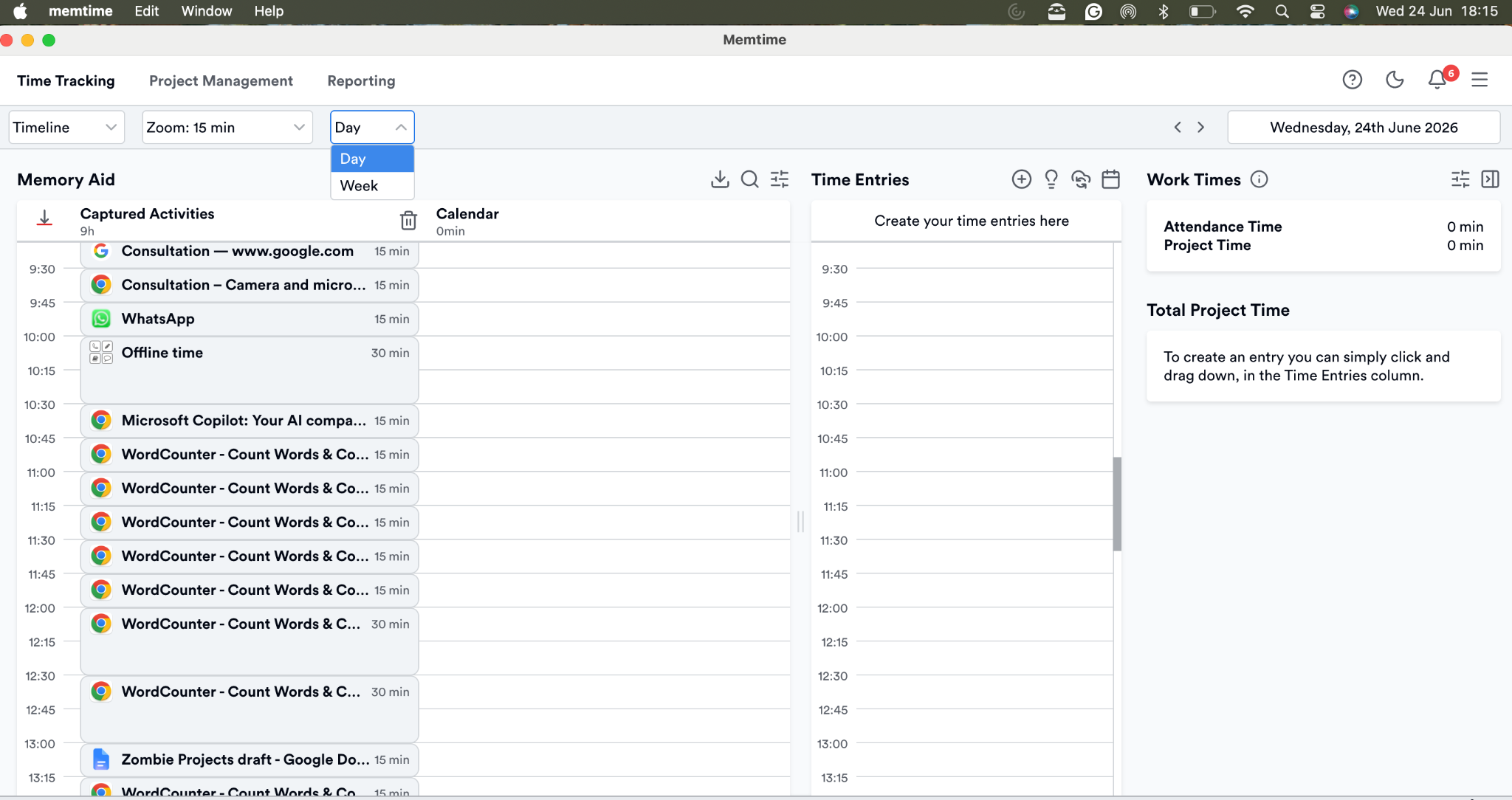
Instead of relying on an uneasy gut feeling or optimistic assumptions, you can see exactly how many hours are being funneled into a project that delivers scant measurable value. Armed with this data, you'll be able to quickly see patterns: habitual meetings that deliver no results, tasks that are repeatedly reopened, or weeks when progress stalls despite ongoing effort.
By surfacing these hidden costs, time data gives you and your team the clarity needed to make more informed decisions – whether that means pausing, pivoting, or shutting a project down entirely. Zombie projects thrive in ambiguity; you need transparency to finally stop them in their tracks.
So, if you want to start pinpointing those zombie projects and start the culling today, then have we got a 14-day free trial for you!
FAQs
How do zombie projects affect team morale?
Zombie projects create a low‑grade sense of futility across teams. When people repeatedly invest effort into work that never lands, momentum erodes and engagement drops. Over time, this normalizes a culture where output feels disconnected from outcomes, making it harder for teams to stay motivated on the projects that do matter.
What early signals suggest a project is drifting toward zombie status
Early indicators often show up in behavior rather than metrics: meetings where no decisions are made, tasks that get reopened without a clear rationale, or stakeholders who stop asking about progress. These subtle shifts usually appear weeks before the project is formally recognized as stalled.
How can leaders reduce the likelihood of zombie projects forming
Leaders can minimize zombie projects by setting explicit exit criteria at kickoff, scheduling periodic assumption checks, and creating a culture where stopping work is treated as responsible stewardship rather than failure. When closure is normalized, drift becomes far less common.
What role does psychological safety play in ending stalled projects
Teams are far more willing to call out stagnation when they trust that raising concerns won’t be met with blame. Psychological safety enables honest conversations about misalignment, outdated goals, or flawed assumptions – conversations that are essential for preventing long‑term drift.

Sheena McGinley
Sheena McGinley is a columnist and features writer for the Irish press since 2008. She’s also a business owner that is conscious of how time tracking can foster progress. She wrote for SaaS companies and businesses that specialize in revenue optimization by implementing processes. She has the unique ability to digest complex topics and make them easy to understand. She shares this precious skill with Memtime readers. When she's not making words work for people, Sheena can be found taking (very) brisk dips in the Irish Sea.