Forgot to Track Time (Again)? What to Do and Why It Happens

Imagine this. It’s 9 am on a Tuesday. You sit down, coffee in hand, ready to be productive. You open your laptop, launch tools, and check your to-do list.
You’re a responsible adult; you’ve got everything covered. 💅
Cut to 3 hours later.
You’ve done real work; emails are answered, tasks completed, you’ve gone through several existential crises (as one does), and then it hits you… You forgot to track your time.
Yet again.
So, at this point, you wonder whether this is a “you” problem. Maybe you’re just bad at routines, or not disciplined enough.
Does this scenario sound familiar?
If it does, let me assure you: this happens more often than not. You’ve got nothing to worry about—you simply need to change your time tracking, and it’ll all fall into place.
But I’m getting ahead of myself.
Let’s first see why you can’t remember to track time and why it’s such a common issue. Then, let’s find you a way to put a stop to this problem.
Key Takeaways:
- Forgetting to track time is pretty common because your brain isn’t actually built for manual tracking.
- Your “future memory” gets overloaded when you’re focused or juggling tasks, so small actions like starting a timer often get dropped.
- Even when you intend to track time later, distractions easily wipe that intention from your mind before you act on it.
- That’s why the solution isn’t to try harder or be more disciplined, but to remove the need to rely on memory in the first place.
- Tools like Memtime solve this by automatically capturing your work in the background, so nothing depends on you remembering to start or stop a timer.

Forgetting to track time is basically inevitable
I fully stand by this heading. Your brain is not built for manual time tracking, and here’s why.
Our brains have a cognitive function called prospective memory. It’s responsible for remembering to do things in the future, like start the timer when I begin working.
Now, according to some research, like this one from EBSCO, prospective memory depends on cues and attention, meaning if there’s no strong trigger reminding you to act, the intention just goes out the window. That’s why the more tasks you juggle, the worse your prospective memory performs, and the more routine something is (like time tracking), the easier it is to overlook. Similarly, the more focused you are, the more likely you are to forget unrelated steps and actions. You get the drill.
On top of that, there’s also classic cognitive psychology research, like this one on distraction and omission errors, showing that when attention is divided, people frequently commit omission errors—they simply fail to perform intended actions altogether.
So, ironically, being productive makes you worse at remembering to track that productivity.
Now, let’s say you actually remember to start tracking. And you’ll do it “right after you finish that one quick task”.
Oh man, you know that’s a lie. You won’t start tracking, and it’s all because of, again, your prospective memory.
Research on prospective memory shows that such memory is vulnerable to distractions and interruptions. When your attention shifts, the information you were holding in mind can degrade or fully disappear. Studies also show that divided attention makes it harder to retrieve intended actions later, meaning that even simple intentions (like starting a timer) often fail.
So, by the time you finish that “quick” task, your brain has already deleted the reminder to track time.
Your attention is a limited resource
There’s one more thing to take into account.
Your brain doesn’t experience time like a stopwatch but constructs time perception based on attention and memory.
Studies in neuroscience (like this research published in Nature Scientific Reports) show that when your attention is fully dedicated to a task, your awareness of time and anything unrelated to that task drops significantly. Another review explains that time perception is an active cognitive process shaped by attention and memory, which basically means that if your attention isn’t on the clock, your brain simply cannot track time accurately.
That’s why when you’re in deep work, you lose track of time, which is great for productivity, but not so much for time tracking.
If this were a rare issue, I’d tell you. We’d call it individual forgetfulness and let your brain marinate in it.
But it’s not.
Just check this Reddit thread:
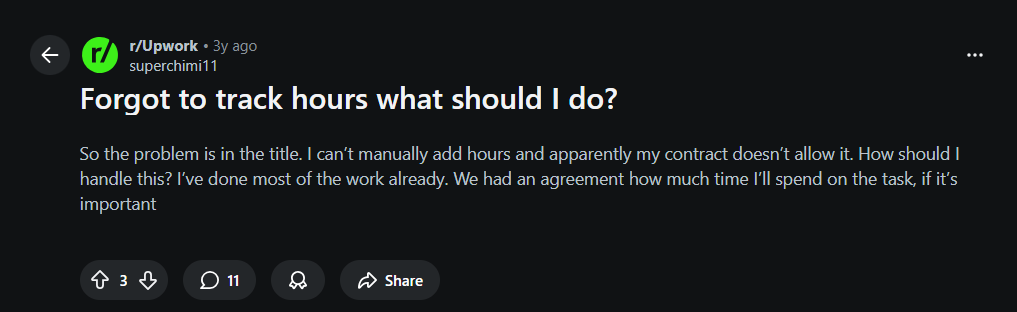
People forget to start tracking, and they often realize it hours later. This isn’t some niche scenario; it’s incredibly common, especially among freelancers and remote workers who use manual timers.
The downsides of forgetting to track time
Forgetting to track time is just a minor, passing inconvenience. Like, not catastrophic at all.
Technically speaking, no one will alert the authorities if you forget it, but that doesn’t mean this forgetfulness doesn’t affect you, your team, and the entire company. And the consequences stack up fast.
#1 You start guessing your hours
Logically, this is the most immediate effect.
You try to reconstruct your day by thinking, “Okay, I started around… 10?”, “That task took… maybe an hour?” and “Lunch was… brief, I guess?” These are all estimates. Pure guesses.
And the worst part is, even if you’re reasonably accurate, small errors add up over time, so your data becomes less and less reliable.
#2 Your data becomes useless
Time tracking is supposed to help you understand where your time goes, how long tasks take, and, preferably, which projects are profitable.
But how can you understand and calculate those when half your entries are estimates, not real data?
So, because you’re basing your decisions on garbage, messy data, you face consequences like underpricing your work, overcommitting to a schedule, and misjudging your productivity.
And by the way, ditto for when you’re not charging by the hour.
Even if you’re working on fixed-price projects or a salary, bad time data still messes things up. You lose visibility into how long tasks actually take, which means you can’t accurately scope future work, price projects properly, or see where time is slipping away.
That “quick task” that secretly takes 3 hours? You’ll keep underestimating it.
That project you thought was profitable? It’s probably quietly eating your margins.
Even when time isn’t directly tied to billing, it’s still driving ALL your decisions, so if the data is off, everything built on top of it is too.

#3 Your team feels the impact
If you’re part of a team, your missing time doesn’t exist in isolation. That time affects project timelines, resource planning, and reporting.
Now, to be fair, one person forgetting occasionally isn’t a disaster. But it’s never just one person; this forgetfulness happens to the best of us.. So, if each team member slightly distorts their data, you get why deadlines are rarely met, and accountability is blurred. Yikes.
#4 Your company loses money
Relying on Frankenstein data is how companies get themselves into financial issues.
Untracked time often means unbilled hours, underreported work, and mispriced projects, all of which lead to significant revenue leakage. A company should be earning more than it actually is (but isn’t, due to gaps in tracking and billing).
Think about it. It all starts with missing billable time.
If people forget to track time, the work often never gets invoiced.
A developer forgets to log 2 hours.
A designer estimates instead of tracking.
A consultant forgets about a meeting entry.
Individually, these are harmless, but collectively they add up to dozens or hundreds of lost billable hours (and dollars!) every month.
And it gets worse from there.
When logged time is based solely on estimates, people tend to round down (“I’ll just log an hour”), skip small tasks, and forget context switching time. So, the company’s data tells one story (like this project took 40 hours), when the reality is different (it actually took 55). And the 15-hour gap is absorbed as unpaid labor, never showing up in revenue, but appearing in costs (salaries, overhead, etc.).
Now let me go even further.
If a company’s records say a project took 40 hours, that company will price the next one accordingly. But since it actually took 55, the company has overlooked a loss in their business model. That’s how companies repeat the same cycles of underestimating timelines, underpricing projects, and overpromising to clients.
So, what can you do about it?
Well, first, you need to stop falling for traditional advice like “Just build a habit” or “Set reminders”. These don’t work because they’re asking you to rely on the system that failed you in the first place - your memory. And your memory is busy doing other things, like helping you do your job.
So, the real solution is to remove the need to remember to track time. Full stop.
Say hello to Memtime
Memtime is our automatic time tracker designed specifically to solve this problem. It works silently in the background, capturing all your activity.
You turn on your computer. Memtime turns on.
You shut it down. Memtime shuts down.
And when your computer is on but you’re not actively working, Memtime tracks that time as an “offline time”.
If this sounds a bit intrusive, allow me to explain how Memtime truly works.
Memtime quietly records everything you do on your computer (apps, docs, websites, calls, and meetings), and organizes it all into a chronological timeline, the Memory Aid. You can view your day in chunks, from 1 to 60 minutes.
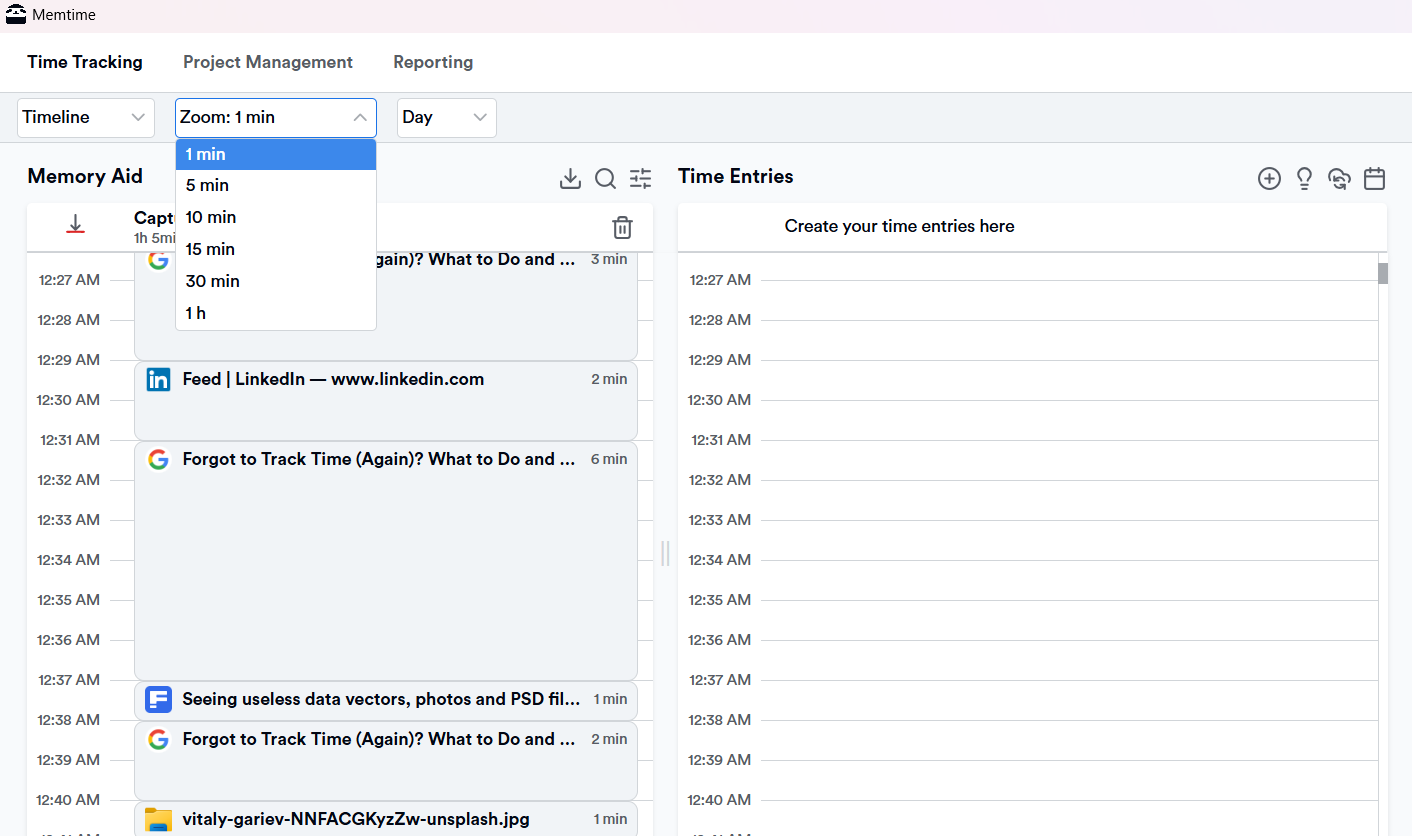
Now, just because your activity is captured doesn’t mean it’s visible to anyone. In fact, your raw activity data (think URLs and file names) is invisible to anyone but you. Plus, all that data is locally stored on your computer, privately and securely (there’s no cloud storage).
The only way someone can see what you worked on is if you turn these tracked activities into time entries for tasks, projects, and clients and send them to your connected project management or billing app.
But that’s not all Memtime can do. It can also:
- Automate your time entry creation. You can turn captured activity into project time in a few clicks, or let Memtime do it for you. You can set rules so Memtime suggests time entries for you, so anytime Memtime suggests, you simply accept, edit, or decline that suggestion.
- Get you 2-way sync with 100+ tools. Memtime allows 2-way integration, meaning you can import your projects and tasks into Memtime and export time entries back to them.
- Get you detailed reporting. You can create reports, project summaries, productivity insights, and breakdowns of where your time was spent (by app and website).
So, how does it sound?
Having a tool that automatically captures all your work would make life a lot easier, wouldn’t it?
If Memtime is starting to sound like your cup of tea, it’s worth seeing it in action for yourself—just to make sure it works the way you expect. Try it for 2 weeks for free.
Why Memtimme works
We built Memtime to align with how your brain naturally functions. With Memtime:
- You don’t rely on memory. You don’t have to remember to start or stop anything, so prospective memory failures are no longer an issue.
- You get your focus back. Memtime runs in the background while you concentrate on your work; nothing is interrupting your flow.
- There’s no lost data over time. Because activity is captured in real time, there’s no risk of forgetting or reconstructing your day later.
It’s that simple.
Wrapping it up
Manual time tracking is the worst. It assumes that you will remember everything, act when you should, and divide your attention whenever you can.
But research - and your own experience, for that matter - suggests otherwise. So, the fix isn’t more discipline but a new system.
Something like Memtime. 🙂
So, go ahead and try it. And if you end up not liking it, send me a mug with “Memtime s*cks” on it, and I’ll drink from it for a month. I swear!
FAQs
Why do I keep forgetting to track my time?
Because your brain isn’t really designed for manual time tracking while you’re focused on actual work. When you’re deep in tasks, your attention gets fully absorbed, and small actions like starting a timer simply don’t stick. That’s why tools like Memtime exist to completely remove that mental burden.
Is this just a discipline problem?
No, not really. This happens even to the most organized people. It’s more about how attention and memory work than motivation or habits.
What’s the real downside of forgetting to track time?
You end up guessing, and those guesses slowly turn into messy, unreliable data. That affects everything from productivity insights to project planning and even pricing decisions. Using something like Memtime helps keep that data accurate, with zero effort.
Can’t I just fix this with reminders?
You can try, but reminders still depend on you noticing and acting at the right moment. When you’re busy, they’re easy to ignore or dismiss without thinking. That’s why a passive system like Memtime works better; it just runs in the background.
What’s the simplest way to fix this problem long-term?
Stop relying on memory altogether and shift to automatic tracking. That way, your focus stays on work, not on logging it. Memtime is built exactly for that, as it quietly records your activity so you don’t have to think about it.

Aleksandra Mladenovic
Aleksandra Mladenovic is a copywriter and content writer with six years of experience in B2B SaaS and e-commerce marketing. She's a startup enthusiast specializing in topics ranging from technology and gaming to business and finance. Outside of work, Aleksandra can be found walking barefoot in nature, baking muffins, or jotting down poems.