Which Tasks to Delegate? Use Data, Not Intuition
It's Monday morning. You look at your task list, and – surprise, surprise – the vast majority of it you don't "feel" like doing… So, to ease yourself into things, you go off what "feels" high-value or (frankly) gives you the least amount of “ick” in that moment. Equally, choosing things to delegate based on immediate instinct might "feel" right at the time, but your intuition can sometimes be misleading.
It won't come as a surprise that efficient delegation only works when you fully understand how your time is spent. After all, constant context‑switching, email loops, revisions, and client follow‑ups create invisible drains that never actually appear on your task list. So, effective delegation starts with visible measurement, not guesswork.
As such, this article breaks down how to identify the right things to delegate at work using data rather than intuition, showing you how to uncover those pesky hidden time drains and decide what to hand off. We'll also give you some real‑world examples so you can more readily spot how you can delegate more effectively.
Key Takeaways
- The best assignments to delegate are those that don't require your knowledge or strategic acumen. In other words, assignments that another member of your team can totally do instead.
- Delegation works well for repetitive or process-driven tasks – like scheduling, reporting, and regular administrative duties. Why? because the structure is predictable.
- It is possible to assign supporting tasks, like research, briefing preparation, slide creation, or basic editing, that add to your output but do not depend on your skill level, without lowering the final product's quality.
- The time-consuming nature of coordination and follow-up tasks makes them perfect for delegation, allowing you to concentrate on more high‑leverage activities.
- In addition to helping you, delegating tasks such as managing vendors, leading small projects, or drafting proposals can help team members develop and strengthen their skills while reducing your workload.

How to decide which tasks to delegate
Broadly speaking, deciding which tasks to delegate tends to start with two key things:
- You fully understanding the value of your time.
- You being aware of the expertise level required for each piece of work.
With that in mind, the goal of delegation isn’t merely to move tasks off your spinning plate, but to ensure your attention is directed where it creates the biggest impact. As such, and I know this sounds obvious, but begin by looking at the purpose of each task before you decide.
It also helps to consider the "opportunity cost" at play here. By that I mean, if a task prevents you from focusing on work that only you, as a person in a position to delegate, can do – be it decision making, long-term planning, or forging/nurturing client relationships – it’s a sign that someone else should probably take it on. Similarly, if a task could be completed just as effectively by someone with less seniority, it’s definitely worth handing over.
To help you more readily identify what those scenarios might look like in your day-to-day, let's address what tasks should be delegated and what tasks should not be delegated.
What tasks should be delegated?

Clearly, the tasks that give you the most ick! If only… Unfortunately, it’s not that easy, especially from the outset. Instead, you’ll need to build toward offloading them in time. Why? Well, as a wise man once said, what you have, as a leader, "is a very particular set of skills". Indeed, they could be skills that you "have acquired over a very long career…"
In short, the tasks that you can immediately delegate are those that don’t require your specific expertise, judgement, or strategic oversight. While these responsibilities still matter, they can be completed just as effectively – or dare I say even more efficiently – by someone else.
Yes, park those control/micro-managing issues at the door. Instead, you need to focus on the fact of the matter: delegating the below forms of tasks frees you to focus on more high‑value work while developing the skills of your team.
As for what these tasks might look like? You probably already know the answer: they tend to be the things you enjoy busying yourself with, so you can avoid "proper work."
Delegating these categories ensures your time is spent on strategic priorities while your team gains ownership, confidence, and capability.
What tasks should not be delegated?
You guessed it, if certain tasks require a specific skill set or sensitivity level, then you should probably retain oversight of them. Some scenarios are too delicate, strategic, or reliant on your judgment to delegate to another team member ad hoc.
In fact, delegating these responsibilities without due process/long-term consideration could introduce risk, confusion, or a decline in overall quality – and that can jeopardize your working reputation.
So, if you need a hand getting your head around what those situations might look like, here are a few atypical examples that should sound familiar to you:
Keeping a proverbial toe in those kinds of scenarios, while maintaining aspects of your managerial role, guarantees clarity/transparency, while safeguarding key relationships, and upholding the caliber and integrity of your work.
How to delegate tasks effectively
Delegating tasks effectively begins with understanding the true shape of your workload. Most people delegate reactively (i.e., when they feel overwhelmed), but the most effective approach is proactive and data‑driven. You need to know exactly where your time is going before you give anything away.

A time audit is the simplest way to get that visibility. You can find out how your day is actually spent by monitoring your work over a brief period of time. This often reveals hidden drains that quietly consume hours: email triage, document revisions, admin loops, scheduling, and client follow‑ups. These tasks rarely appear on a task list or work plan, yet they fragment your attention and reduce your capacity for strategic work.
Once you’ve captured the data, look for patterns of recurring interruptions. If you’re repeatedly pulled into the same approvals, questions, or troubleshooting, that’s a sign of a process that can be documented, streamlined, and then delegated. Interruptions are one of the biggest productivity killers, and delegation is one of the most effective ways to reduce them.
Use a clear handover structure so you can delegate with intention, or you might say: like a boss (apologies). It could look a little something like this:
- Define the outcome and what success looks like in this instance
- Make it clear what constitutes a decision and if/when they should check with you
- Give them all the necessary background information so they know the "why" rather than just the "what."
- Decide on the deadlines and quality standards.
- Create a feasible feedback loop to improve the procedure.
And, like I said, if you’re a business owner and looking to try a new venture, you can always work toward making yourself redundant so you can then pursue new things!
Wrapping up
Only when delegation is based on reality rather than your intuition, instinct, or "guts" will it be effective. When managers rely on guesswork, the wrong tasks are often assigned, senior employees become mired in low-value work, and leaders see only the finished product, not the unseen work that went into it.
Fragmented work makes this even harder. Your day is swallowed by time consuming revisions, email loops, administrative work, and client follow-ups, all of which obscure the very duties that ought to be assigned. This is why measurement, not sentiment, is necessary for effective delegation.
Here's where I point out that Memtime can be a genuinely beneficial and non-intrusive component of your workflow. It provides you and your team with an unbiased, clear view of how each day unfolds. This way, you can spot any hidden drains, identify recurring patterns of low‑value work, and understand which responsibilities are pulling people away from high‑leverage activities – you know, the work that properly propels your business forward.
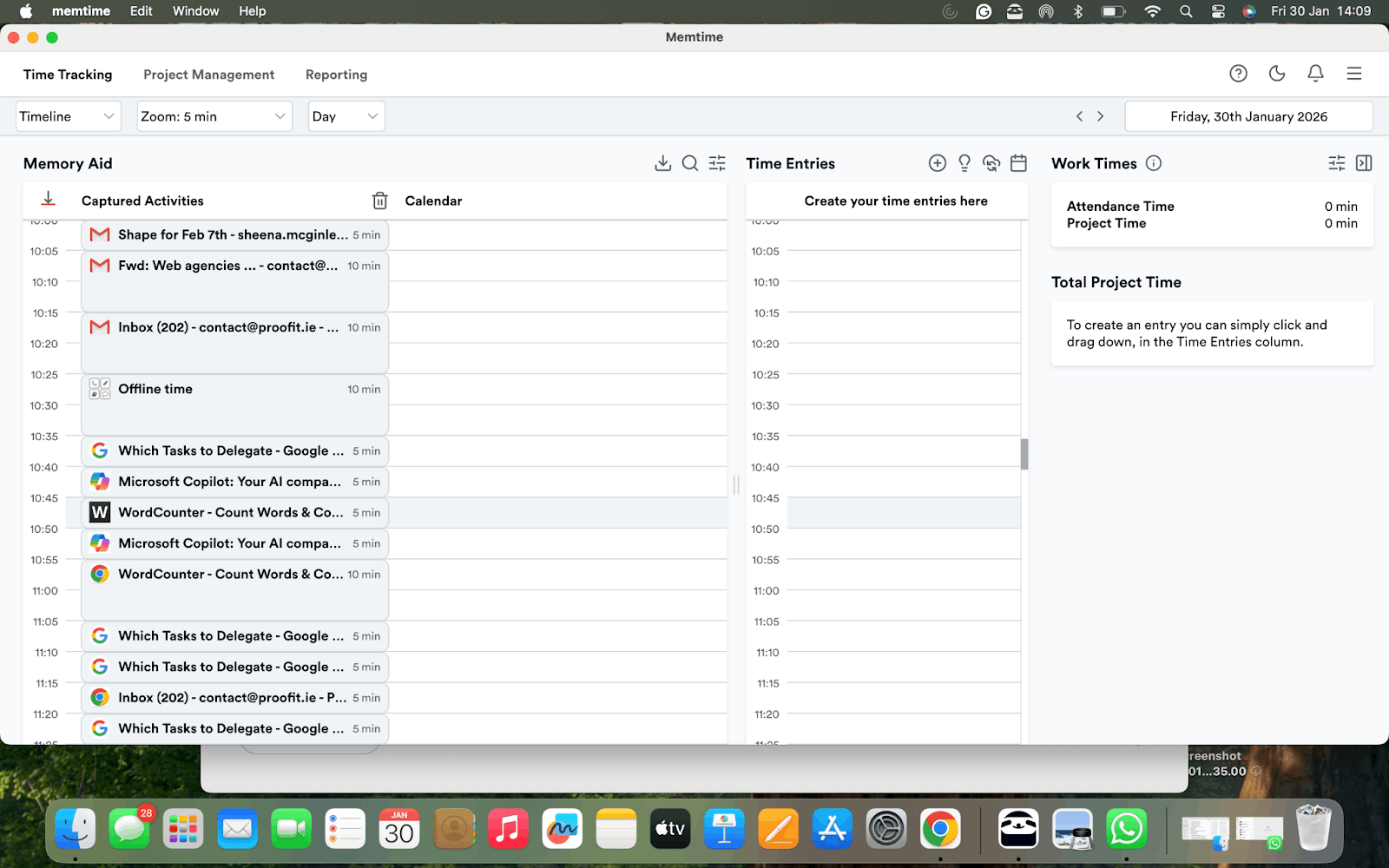
Moreover, Memtime can improve the delegation cycle itself. Before assigning tasks, managers can see how long they take, and workers who receive those tasks can monitor how long they take to finish. It is simpler to assess whether delegation is successful, whether workloads are balanced, and where procedures need to be improved, thanks to this transparency.
In reality, Memtime becomes a silent yet effective ally that helps you make better decisions, protect your team's time, and ensure everyone is focused on the tasks with the greatest impact. Enroll in our zero-strings 14-day free trial to see how it can silently improve your day without all the faff:
FAQs
What should I do if a delegated task comes back below standard?
You should clarify expectations, tighten the brief, and check whether the person you chose to delegate to had the full context or resources they needed. In these instances, most issues come from unclear handovers, not a lack of ability on their part.
How can I delegate without feeling like I’m losing control?
Set clear outcomes and routine check‑in points. This way, you can stay informed without teetering into the realm of micro-managing every step.
What if my team is already stretched and I have no one to delegate to?
The best thing to do here is to seek out low‑value tasks across your team that can be readily removed, automated, or redistributed before adding new responsibilities. In short, automate, automate, automate.
How do I make delegation a consistent habit?
Review your workload regularly and use time management tools like Memtime to identify patterns, time drains, and tasks you should remove from your schedule before they become bottlenecks.

Sheena McGinley
Sheena McGinley is a columnist and features writer for the Irish press since 2008. She’s also a business owner that is conscious of how time tracking can foster progress. She wrote for SaaS companies and businesses that specialize in revenue optimization by implementing processes. She has the unique ability to digest complex topics and make them easy to understand. She shares this precious skill with Memtime readers. When she's not making words work for people, Sheena can be found taking (very) brisk dips in the Irish Sea.