Time Optimism Sounds Great Until It Costs You Money & Sanity

As a freelancer, you have to be optimistic about your time; you wouldn’t be driven to take the leap careerwise otherwise. The same goes for being a business owner; optimism is mandatory. Are you a team leader answerable to both your team and your superiors? Well, that’s just a whopping “YES” sandwich right there.
Given I’ve been all of the above throughout my career, my motto used to be “Say ‘YES’ to everything in the moment – then figure it out later.” That’s grand if it happens once or twice, but it shouldn’t be one’s modus operandi. Had I known then what I know now, I would’ve saved myself a lot of stress, money, and time that’s literally never coming back.
For those unaware of the term time optimism - it means being habitually blinded by blue sky thinking to the point of missed deadlines, late nights, and projects that somehow take twice as long as expected (damn that flat right you promised). So, join me as we explore what time optimism is, how it differs from time blindness, why it costs more than you think, and how to replace wishful scheduling with realistic planning.
Key Takeaways
- Time optimism causes people to underestimate the hidden work surrounding a task, such as preparation, communication, revisions, interruptions, and context switching.
- Repeatedly underestimating how long work takes can reduce profitability, particularly for freelancers and consultants working on fixed-fee projects.
- Time optimism differs from time blindness because it affects expectations rather than time perception, although the two can sometimes overlap.
- Comparing estimated time with actual time spent is one of the most effective ways to identify time optimism, helping reveal recurring gaps between assumptions and reality.
- Accurate time tracking data can improve scheduling, pricing, and workload management, replacing hopeful guesses with evidence-based decisions.

What is time optimism?
In its simplest guise, time optimism is the tendency to assume/wish future tasks will take far less time than they do in reality. It's not necessarily poor planning or even overconfidence. More often, it's the result of being laser-focused on the task itself – which means overlooking everything that happens around it.
The same thing happens with meetings that run over, quick admin tasks that multiply, or favors that look harmless on your calendar but quietly consume an afternoon.
Repeated often enough, these small miscalculations can lead to mounting strain, longer working days, and shrinking profits as your hours start to pile up.
Time optimism vs. time blindness
Some folks conflate the two when they're very different beasts (as is overpromising, by the way).
- Time optimism is the inclination to believe that future tasks will require less time than they actually do.
- But time blindness is the inability to sense the passage of time or to accurately estimate how much time has passed, and it's often associated with having ADHD.
The good news is that time optimism is often easier to correct, because it’s based on assumptions rather than perception itself. If you regularly compare your estimates against the real time it takes to do work, you will begin to see patterns emerge. You could discover that client revisions usually take an hour, meetings seldom finish on time, or “quick” admin work is not nearly as expedient as you'd like to think.
That’s where time tracking tools are hugely additive, replacing hopeful guesswork with objective data. After all, it's very tricky to argue with cold, hard facts...
Real-life time optimism examples
Oh, let me count the ways. I’ve lost count of the number of times I’ve been wildly optimistic about the level of time and effort involved in my “yes.”
In fact, I would say the vast majority of impromptu work I inanely said “yes” to (while my gut groaned, “Ugh, nooooooo, not again”) was on the hopes of “future work.” Unfortunately, that wasn’t always the case. Often, people will say anything when they’re desperate to get something done… So, despite working the entire weekend while looking after two kids, did my time optimism result in “future work” from this body? It did not. It did, however, teach me a valuable lesson: to have more self-worth.

Underestimating projects is one thing, but time optimism often presents in everyday decisions, like cramming in one more task, quickly accepting another request on its face without considering everything involved, or believing you'll miraculously find extra hours later. So, other, more insidious real-life examples of time optimism include:
- Looking at your inbox and thinking, "Meh, I'll clear those emails in 10 minutes," only to emerge 45 minutes later after clicking attachments, crafting clear responses, and generally addled after surviving the wormhole that is one’s inbox.
- Immediately accepting a seemingly small revision request because it "won't take long," then spending 90 minutes locating files, reviewing previous work, making changes, and responding to queries.
- Taking on an extra task because your calendar looks quiet, forgetting that the blank spaces are already earmarked for admin, planning, invoicing, or work that hasn't landed yet.
- Promising a turnaround based on best-case assumptions rather than real-world conditions, like accounting for potential tech failures, people taking longer to respond than expected, and life in general.
- You habitually convince yourself that next week will somehow be less busy, despite having thought that exact same thing for the past six months.
Now that you’re questioning your life choices, let’s really feel amazing by looking at the ways entertaining this level of time optimism can negatively impact your work.
How time optimism hurts your work
Perhaps the biggest impact with time optimism is that it can warp your relationship with time itself. When every task is expected to take less time than it actually does, your calendar will soon cease to reflect reality. How are you meant to plan for anything if time is literally a construct?
As alluded to earlier; time optimism can also make it harder to set boundaries and therefore can hit your self esteem if left unchecked. If every request seems manageable at first glance, you're more likely to overcommit, agree to unrealistic deadlines, or take on work that doesn't justify the effort involved.
Worst of all, it creates the sense that you're the issue. In reality, the problem often isn't productivity at all. It's that the original estimate never reflected the proper amount of work required.
Time optimism vs. time realism: How Memtime can help
In short, we remember the hour spent writing the report, but tend to forget the 20 minutes spent searching for files – not to mention the interruptions and often endless revisions. Over time, those forgotten minutes add up and create a gap between how long we think work takes and how long it really takes.
Again, while time optimism is built on assumptions, time realism is purely evidence-based. And you can't get more real than minute-by-minute time tracking data (yet another seamless segue, BOOM). By automatically tracking your activity, Memtime gives you an objective record of how your day went.
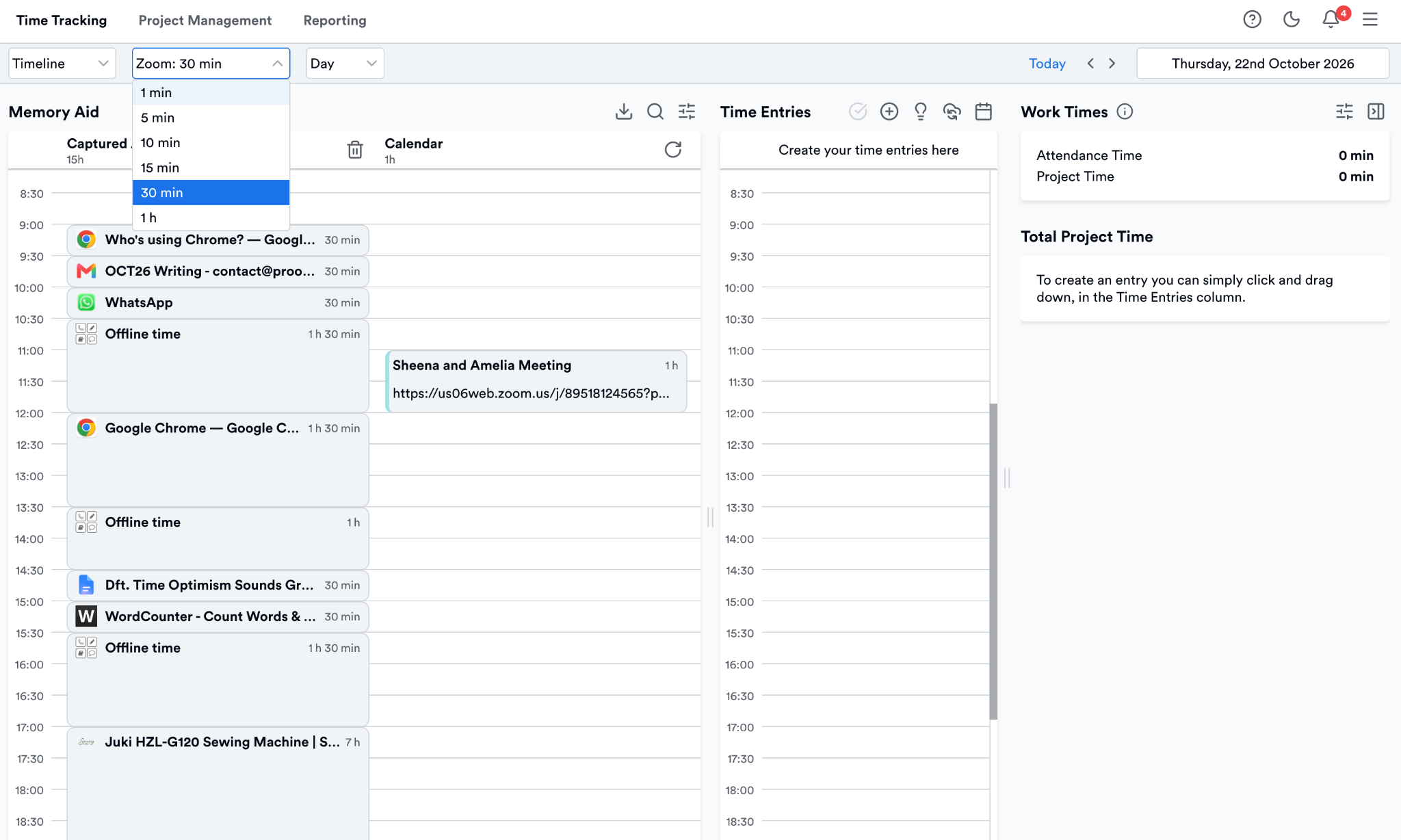
Instead of estimating how long client work, meetings, admin, or revisions usually take, you can see the reality for yourself. The result isn't to make you pessimistic about your time. It's to make you a realist instead of purely an optimist.
Once you have accurate data, you're better equipped to set deadlines, price work, plan your schedule, and confidently say "no" when your calendar simply doesn't have the capacity. Because while optimism has its place, realism is what keeps your workload, finances, and sanity intact.
So, if you want help keeping your profits and your stress levels in check, try Memtime on us for a full 14 days to see how it can transform how you work – and hopefully start recouping not just your time, but also your money.
FAQs
What is the difference between time optimism and the planning fallacy?
Time optimism and the planning fallacy are closely related, but they are not identical. The planning fallacy describes our tendency to underestimate how long projects will take, even when we have evidence from similar past projects. Time optimism is broader. It covers the day-to-day habit of assuming we can fit in more work, respond faster, or complete tasks sooner than reality allows.
Why do people consistently underestimate how long tasks take?
Many people estimate only the core task and overlook everything surrounding it. Preparation, communication, interruptions, research, revisions, meetings, and context switching are all time consuming. Because these activities often feel incidental, they're frequently excluded from estimates, despite being necessary parts of getting work done.
How can I improve my time estimates?
The most effective way to improve your estimates is to compare them with concrete results. Tracking how long different types of work take over several weeks can reveal patterns that are easy to miss. Once you fully comprehend how long tasks typically take in practice, it becomes easier to plan realistic schedules and deadlines.
Can time optimism lead to burnout?
Yes. While optimism itself is not a problem, repeatedly overestimating your available capacity can contribute to long working hours and the chronic stress that comes with it. Over time, consistently trying to fit more work into your schedule than time realistically allows can increase the risk of exhaustion and burnout.
What are the warning signs of time optimism?
Common signs include regularly running behind schedule, working later than planned, underpricing fixed-fee work, overcommitting to requests, and frequently believing that time will magically make itself available. If your plans consistently require ideal conditions to succeed, time optimism may be influencing your decisions more than you realize.

Sheena McGinley
Sheena McGinley is a columnist and features writer for the Irish press since 2008. She’s also a business owner that is conscious of how time tracking can foster progress. She wrote for SaaS companies and businesses that specialize in revenue optimization by implementing processes. She has the unique ability to digest complex topics and make them easy to understand. She shares this precious skill with Memtime readers. When she's not making words work for people, Sheena can be found taking (very) brisk dips in the Irish Sea.