Client Keeps Asking for Revisions? Here’s How to Handle It Like a Pro

Ah, the “revisionist” client. They’re a bit like the “scope creep” client, but arguably more insidious in terms of time theft. Yes, I know that sounds harsh, but we need to call a spade a spade here. For the record, I don’t mind clients requesting revisions when it’s something I’ve missed or misinterpreted, but when you’re being called to rework entire sections anew (more on that later), you need to face what can seem like a tricky issue. But it doesn’t have to be – especially when you have data to back you up.
So, if you find yourself with a new or a regular client consistently requesting changes, I have some tried and tested tips on how to reduce client revisions and help you navigate what can often be deemed unpredictable waters. Let’s face it, if they ask once, it’s highly likely you’ll be asked again. Therefore, you need to implement strict boundaries around putting a limit on those endless revisions. Afterall, client revision requests ultimately erode your time and your bottom line.
Key takeaways
- Frequent requests for revisions can indicate more serious problems. If left unchecked, they quickly become invisible, unpaid labor due to their unclear scope, lack of visibility, or weak boundaries.
- Many clients present scope changes as minor adjustments, whether on purpose or not. You can save time and avoid unintentional undercharging by noting the difference as soon as possible.
- Setting boundaries is crucial. Establishing a clear revision cap early on encourages clients to combine feedback rather than making constant adjustments.
- Collaboration is enhanced rather than hindered by boundaries. Project focus is maintained and burnout is avoided by setting deadlines, charging for work that is outside the scope, and saying no.
- Boundaries become enforceable when you keep track of your time. You can accurately bill and steer clear of awkward client conversations by using tools like Memtime, which show you how long revisions actually take.

Help! My client keeps asking for revisions
I’m truly sorry to hear that. I’ve been there many (many) times. And, more often than not, I did nothing. Why? Well, because it was “Just this one time”, or “They’re my most regular client, and I don’t want to lose them.” The next thing I knew, these routine revisions (and they became routine) morphed into invisible, unpaid work, and therefore a recipe for chronic undercharging.
What these requests might look like? Observe three examples:
- The “variation on a theme” client: "I am aware that this section has already been finalized, but could you please revise it once more? Could you also try three different versions while you're at it so I can compare?”
- The “blame it on the team” merchant: "I'm sorry, but my team and I would like to take a different approach after seeing it. Could you rewrite it while maintaining a similar style to the one we altered last week?”
- The Daft Punk enthusiast: “One more time, please. I'm still not feeling the tone; perhaps make it shorter but with more information, and more formal but also lively and engaging.”
While I’ve had lots of clients over the years who were fond of revisions for one reason or another, one in particular far surpassed the rest in terms of requests.
Not only did he go on Google doc comment sprees at 4am in the morning, but he also demanded that entirely new sections be written, which didn’t technically fall under the category of “revisions”. In reality, he had just thought of a new section to add beyond what had been initially discussed (which is totally fine – if you’ve built in a buffer for it). Naturally, this resulted in all previous and subsequent sections requiring revisions for flow, only for him to then rewrite the entire thing himself during another 4am spree.
After this happened three times (my personal cut off point), I said, “You seem to be ultimately writing these whitepapers yourself; do you need me in the process?” To which he responded, “No, you’re wrong, I just have a very clear vision in my head, and it’s quicker to do it myself…”
It turns out he just needed someone he could repeatedly say “No, you’re wrong” to. And that spoke to a deeper issue I wasn’t qualified to tackle, so we parted ways, but not after learning a very important life lesson.
How to set boundaries (around revisions)
It’s never too late to set boundaries. Say it with me, ‘cause you need to believe it to implement it. “It’s never too late to set boundaries.”
Endless revisions are usually one of three things: they’re either born from a lack of visibility, an undefined project scope, or a latent boundary problem. Given my example above, I’d also wager it’s often a result of a narcissism issue, but best park that under our “boundary” umbrella.

The point is, while there’s no “one size fits all” solution to this, here are a few practical tips you can consider when mitigating revision creep:
Calculate the cost of "small tweaks"
The majority of clients are genuinely unaware that a 10-minute change rarely takes 10 minutes. It disrupts the flow, involves context switching, and frequently necessitates going over the entire work again. Let them know early on that there is a true cost associated with every "quick fix."
Charge for out-of-scope modifications
Clients become rather more specific about what they truly want when they realize that every additional revision results in a fee. This is because the invisible labor is no longer invisible.
Make a revision timeline
You’ll find that revisions grow to occupy any available space. You can avoid the slow creep of "Oh, we'll get back to you next week," which prolongs projects and increases unpaid labor, by giving each revision a deadline.
Bring “thinking time” into your proposal
If your client is made aware that thinking time will be factored into your process (as it should), then they’ll be far less likely to request revisions.
Show them the compounding effect
One small adjustment may seem insignificant, but ten small adjustments spread over three weeks? An entire workday can be consumed under the guise of "minor adjustments.” When you explain this up front, clients will be quicker to comprehend that boundaries are a protective measure.
How many revisions to give a client
In all honesty, the answer to this question is purely down to you and the relationship you have with your client. For instance, you might have a regular client that rarely requests revisions so, when they do, you know they’re necessary, and you’re keen to facilitate them ASAP. Then, there are “the others…”

These clients seem to be under the impression that endless revisions are part of some sort of collaborative process. In actuality, they’re an indicator that such clients aren’t fully aware/cognizant of the end result/goal they’re looking for. As such, they want to see various results to see what they prefer. The thing is, like our “Variation on a theme” client, they’d rather say that’s a “revision” instead of paying for three different types of copy up front.
Regular beloved client, or not, you need to introduce a revision cap. Three times is my limit for new clients as we’re just getting to know each other. All subsequent revision rounds for new projects/work are then capped at two rounds, which are factored into the invoice once triggered.
When there is a clear limit defined from the outset, clients are more inclined to prioritize their potential revisions instead of drip-feeding their feedback. In short, they stop treating you like an on-demand editing machine and begin organizing their ideas when they realize they only have two rounds.
What to do if a client changes requirements
Revisions and requirement shifts can feel similar when you're the one performing the work; however, they’re fundamentally different. Treating them as the same is precisely how freelancers wind up performing unpaid labor. Here’s the distinction:
- A revision is a change made within the predetermined parameters: It involves tightening language, modifying tone, changing examples, and smoothing out the structure of what already exists. It's not reinvention; it's improvement.
- The scope itself changes when the requirements do: A shift in requirement includes changing the target audience, the strategy, the format, the deliverables, or the overall direction. It’s moving the goalposts and frequently entails rethinking the work from the ground up rather than merely refining what already exists.
The issue is that scope changes are frequently presented by clients as "small revisions," which is why early differentiation is such a powerful boundary.
Speaking of boundaries (seamless segue, as ever); using Memtime can eliminate the uncertainty and emotional awkwardness associated with addressing revision creep with a client. Instead of silently depleting your schedule, all that hidden revision time becomes visible because Memtime automatically tracks every minute you spend on files, programs, and even emails:
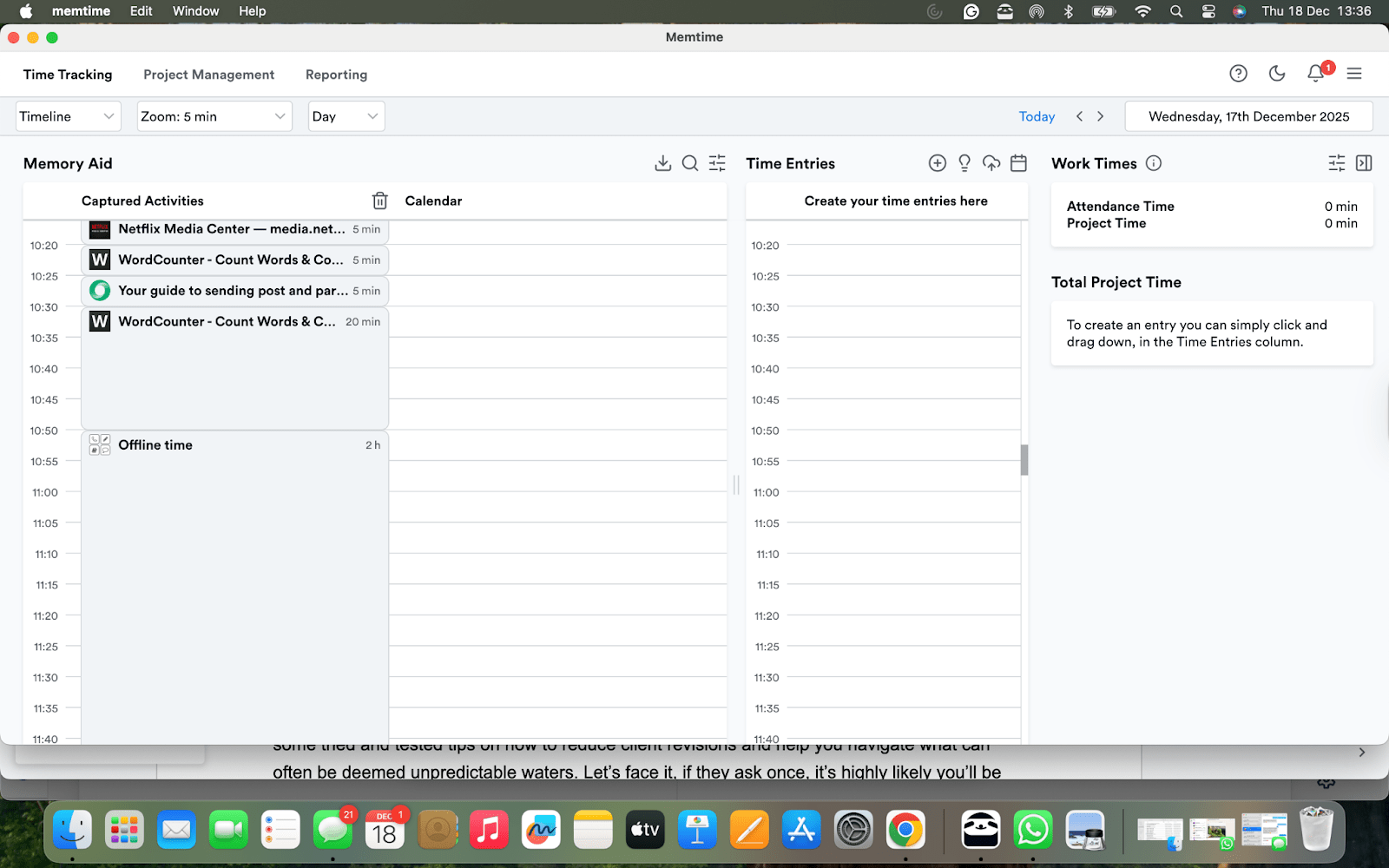
As a result, you can accurately bill or reinforce boundaries using data so you can demonstrate how long "quick tweaks" actually take, instead of dancing around tricky conversations. It makes it much simpler to safeguard your workload and maintain projects on schedule by changing the dynamic from subjective ("I feel like this is taking too long") to objective ("Here's the actual time spent").
To see it work for yourself and start reclaiming your time today, give yourself the gift of Memtime for 14 days. It’s free, and we won’t even ask you for your credit card details:
Why do customers continually request changes?
Frequently, it's because the client is unsure of what they want, the scope was not clearly defined, or they are unaware of the time cost of "small tweaks."
How can I determine whether a request is a scope change or a revision?
While scope changes modify the direction, audience, format, or deliverables, revisions improve what already exists. It is not a revision if it necessitates reconsidering the work.
How many rounds of revision should independent contractors provide?
Although there isn't a set standard, most independent contractors limit revisions to two or three iterations in order to keep projects from taking too long.
What should I do if a client keeps drip‑feeding feedback?
Introduce a revision cap, "thinking time", and a clear timeline. This encourages clients to consolidate their notes instead of sending endless micro‑edits.
How can I address revision creep without awkward conversations?
Use objective data. Time tracking tools like Memtime show exactly how long revisions take, making it easier to bill accurately or reinforce boundaries without emotional back‑and‑forth.

Sheena McGinley
Sheena McGinley is a columnist and features writer for the Irish press since 2008. She’s also a business owner that is conscious of how time tracking can foster progress. She wrote for SaaS companies and businesses that specialize in revenue optimization by implementing processes. She has the unique ability to digest complex topics and make them easy to understand. She shares this precious skill with Memtime readers. When she's not making words work for people, Sheena can be found taking (very) brisk dips in the Irish Sea.