Attention Residue Is Stealing Your Progress: What to Do About It

Listen, with the world the way it is right now, who hasn’t got stuff on their minds?! Speaking in the purely business context, however, “attention residue” is the carryover that results from momentarily pausing a task, changing contexts, or leaving something unfinished. In short, it's a surreptitious tax on your productivity.
If this isn’t chiming any immediate bells, trust me, you know it; it's when a portion of your focus remains fixed on the prior task even after you move on. It hijacks your decision-making, prolongs the pivotal brain warm-up time, and, as a result, often requires you to reread and reorient before actual progress can begin.
Due to this residual effect, even after full days of "working," you may find you have precious few tasks finished, longer project cycles, and a feeling that your output isn't equatable to your effort. The issue is exacerbated by fragmented work, which builds up layers of task residue that make every transition that bit trickier than the last.
In this blog, we'll tackle the issue of attention residue, how it can present itself, and the hidden costs of scattered work, and offer doable strategies to minimize residue and restore meaningful focus!
Key Takeaways
- As the brain needs to reconstruct context each time it’s interrupted, attention residue subtly slows execution. This results in cumulative delays that, inevitably, lower your throughput.
- Incomplete reasoning carries over into the next task, so task switching exacerbates residue throughout the day. This makes it trickier to regain your momentum and/or complete focus.
- Even though it doesn’t show up on calendars or task boards, fragmented work brings hidden productivity costs (quality drops, decision friction, coordination overhead, and emotional exhaustion) that significantly impede progress.
- Traditional productivity techniques are unable to address attention residue effectively because they focus on workflow logistics rather than on the mental effort required to return to work after each interruption.
- The need for repeated context reconstruction can be decreased, and cognitive continuity can be maintained by adopting structural work habits such as grouping related tasks, safeguarding uninterrupted blocks, and closing small loops.
- By showing the actual time lost to restarting work, Memtime insights make residue quantifiable. This allows teams to reorganize workflows around longer, more stable segments, thereby increasing delivery speed.

What is attention residue?
Like I said at the top, attention residue is the mental carryover that lingers after you stop (suddenly or otherwise) working on one task, before trying to focus on another. In short, your ability to fully engage with the new task is hindered when you put off tasks or leave unfinished ones dangling in mid-air.
Your brain has to reconstruct context rather than make a clean switch, which prolongs its warm-up time and slows your decision-making, increasing the need to reorient before making progress. These minor delays all add up over the course of your day, decreasing throughput and making even hectic days seem oddly ineffective.
Here are but a smattering of scenarios depicting the pesky time thief in action:
- Half-written emails: When you stop writing an email in the middle of a meeting, your mind keeps repeating what you intended to say, which makes it difficult to participate completely.
- Interrupted analysis: A co-worker asks a “quick question” while you're going over your data, and it takes you a few minutes to get back into the groove of what you were interpreting.
- Context switching: When you transition from a strategy discussion to a budget review, your mind is still processing the prior point of order, especially in meetings.
- Writing or coding sessions: When you stop or are interrupted in the middle of a problem or paragraph, you have to retrace your reasoning or reread your work to reconstruct context
- Skimming project management tools: You take a quick look at several open tasks without closing any loops, leaving bits and pieces of each one running in your head.
How task residue builds up when you switch work
Residual by name, residual by nature. As such, it should come as little surprise that task residue accumulates each time you switch jobs because you carry snippets of incomplete reasoning with you.
Your brain retains those remaining cognitive threads as you address a new context. Over the course of the day, this overlap builds into layers of residue that naturally hampers your ability to concentrate intently and make any semblance of clear progress.
Teams frequently try to address this by implementing stricter focus rules, clearer task lists, or improved prioritization. However, these methodologies don’t uncover hidden costs, such as the effort lost between sessions, the ramp-up needed to regain momentum, or the time needed to re-enter effective work.
In other words, your execution speed cannot significantly increase without adequate insight into these patterns.
The hidden costs of fragmented work on productivity
Fragmented work carries costs that don’t show up in your calendars or status updates, or your task boards (and certainly not your invoices), yet this invisible work still quietly erodes your team’s real productivity. Even when each interruption feels minuscule or incidental, the cumulative effect is a steady lag on your flow and meaningful progress.

Before those costs become visible, they tend to present in predictable patterns, like...
- A decline in quality: As fragmented attention diminishes your depth and precision, more mistakes typically follow, which, in turn, then need reworking.
- Decision friction: This is characterized by slower decision-making, more second-guessing, and a greater need for others to clarify context for you.
- Coordination overhead: Equally, you and your team start needing extra check‑ins, status resets, and repeated explanations to get everyone back on the same page. These are a time suck.
- Loss of deep work capacity: Fewer uninterrupted stretches for complex thinking lead to merely surface-level solutions instead of the necessary thinking time.
- Compounding delays: Repeated (albeit small) stalls tend to ripple across departments, which, in turn, slow down entire project timelines.
- Overall emotional toll: Annoyance, mental exhaustion, and the feeling of being constantly stretched thin, yet making little to no progress in the process.
Why traditional productivity fixes don’t solve attention residue
Traditional ways to boost productivity don't typically address attention residue because they only address the logistics of moving work around – not the cognitive disruption caused by task switching itself.
Context switching can often be viewed as a discipline problem by leaders, with management assuming that “better habits” can eliminate drag. But the problem isn't how people act; it's how hard it is for them to put things back together after every switch.
As long as teams only deal with the logistical cost of fragmentation, not the cognitive cost, traditional fixes may appear to work on a surface level, but they won't speed up execution in actuality.
How to reduce attention residue and reclaim your focus
To avoid attention residue and the fallout that comes from your attention being repeatedly reefed out of context, you need to start structuring your work differently.
The most effective changes include creating longer, more coherent work sessions. I know no one wants to work longer sessions, but it should reduce the number of times people must reassemble their mental context. Three practical shifts that support this include:
- Grouping similar tasks: Group tasks that use the same knowledge, tools, or mental model so that transitions don't require a complete reset.
- Protecting uninterrupted time blocks: Consider setting aside focused stretches for tasks that require staying on track. Keep them safe from meetings, pings, and quick requests that interrupt that key cognitive flow.
- Closing small loops before shifting: Before starting on something else, ensure you close any small loops by finishing micro-steps that would otherwise stay open, like sending a follow-up or outlining the next step. This will help you have fewer "open tabs" in your mind when you commence tackling the next task.
These simple changes can reduce cognitive friction caused by fragmented work and sustain momentum throughout the day.
Memtime strengthens this shift by making the underlying patterns visible. Without having to lift a finger or compile a report yourself, you and your team can get an objective record of how/where your day actually goes, rather than depending on conjecture about why progress slows.
You are able to see:
- How long it takes to recalibrate and regain focus after taking a break.
- The amount of time needed to reconstruct the mental frame for that work.
- Where work repeatedly stops and starts across the same tools and environments.
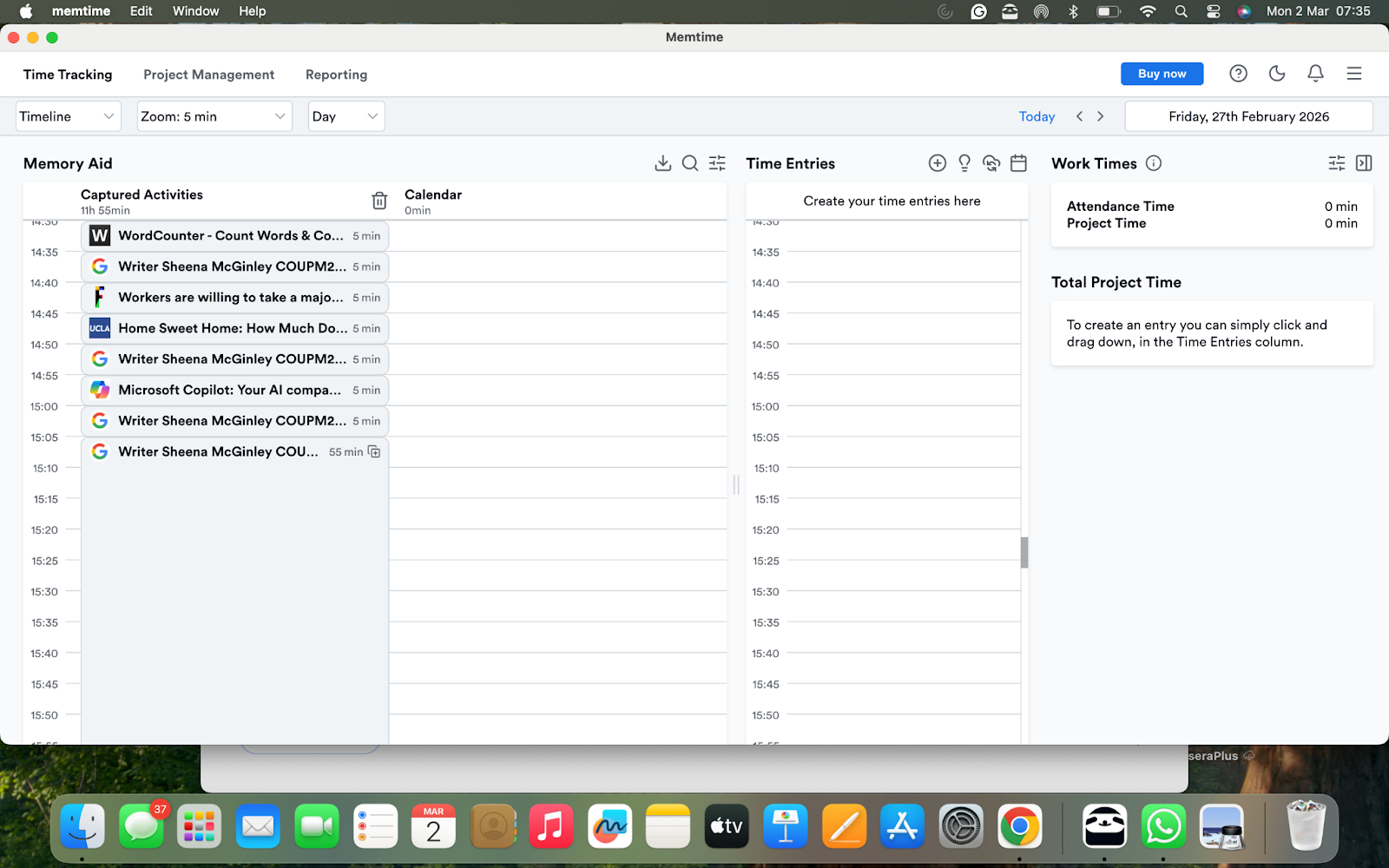
With this context, attention residue can be transformed from an imperceptible lag into a visible and therefore quantifiable entity. Armed with this data, your teams can rethink workflows to tighten handoffs, reduce mid-task interruptions, and organize work into more stable, larger chunks.
By addressing the cognitive friction that conventional productivity techniques ignore, Memtime helps individuals and teams to improve progress and delivery by bringing attention to the actual cost of fragmented work. If you’re looking for a handy link to get started with Memtime today in the form of a 14-day free trial, your wish is my command!
FAQs
Why does attention residue feel worse on busy days?
Because high-switch days result in stacked layers of unresolved context, each new task requires more reconstruction than the previous one. Even though the workload isn't necessarily heavier, your cognitive bandwidth is simply more distributed, making progress appear slower than the schedule suggests.
Can attention residue occur even when tasks are small?
Yes. Even microtasks leave context traces that your brain must remove. A 30-second break can leave enough residual thought to postpone returning to more in-depth work, especially if these interruptions happen frequently.
Why do teams underestimate the impact of residue?
Dashboards, project tools, and calendars don't show residue. Because the delays are gradual and imperceptible, teams attribute slow progress to discipline, workload, or prioritization rather than cognitive drag.
How does making residue measurable improve performance?
When teams see the real time lost to restarting work, they can redesign workflows around fewer resets, including longer work segments, more stable focus blocks, and clearer handoffs. A cognitive problem becomes an operational problem that can be systematically fixed once it is made visible.

Sheena McGinley
Sheena McGinley is a columnist and features writer for the Irish press since 2008. She’s also a business owner that is conscious of how time tracking can foster progress. She wrote for SaaS companies and businesses that specialize in revenue optimization by implementing processes. She has the unique ability to digest complex topics and make them easy to understand. She shares this precious skill with Memtime readers. When she's not making words work for people, Sheena can be found taking (very) brisk dips in the Irish Sea.