Non-Promotable Tasks: How Much of a Workweek Goes Unrewarded?

Sometimes, it feels like the workweek in its entirety goes not just unrewarded but wholly unseen, but it doesn’t have to be that way (more on that momentarily).
A lot of what fills your week isn’t the kind of output that gets recognized. You know the tasks; it’s the non‑promotable stuff that keeps teams moving, like smoothing handoffs, answering ad‑hoc questions, keeping internal processes moving, and always stepping in when something needs organizing.
While this non‑promotable work is useful and very necessary, it rarely benefits the person doing it. That’s not news, however; the important part is how strongly it can influence companies’ interpretation of workload and performance.
As such, in this article we’ll break down what non‑promotable work is, why it piles up, everyday examples, who takes on more of it, and how it affects businesses, so you and/or your company can see the whole workweek more clearly.
Key Takeaways
- Non‑promotable work hijacks your bandwidth because, while it keeps teams ticking over, it never shows up as the kind of output that can move the person saddled with it forward.
- These tasks often land on the same people – those being the team players/people pleasers who rarely feel able to say no – until the load becomes part of their identity.
- Invisible support shapes whole industries, with legal, marketing, design, remote teams, and financial roles all relying on work that’s essential but never credited.
- Women tend to carry more of this work than men, thanks to long‑standing norms around helpfulness and volunteering, which chip away at time for high‑impact projects.
- Companies misread capacity without real visibility, and tools like Memtime help managers see the hidden load people carry, without forcing employees to manually track hours, which is ironically another non‑promotable task.

What non-promotable work is
Non-promotable work refers to the mundanities that support a team or organization but don’t contribute directly to someone’s advancement.
These responsibilities aren’t about low-value work – they’re largely essential to how a workplace functions – but they simply don’t translate into promotable output. Just a few surface examples that come to mind include mentoring, onboarding, internal logistics coordination, committee work, and the joy of note-taking (if AI isn't doing it) – so all the sexy stuff.
Glibness aside, these tasks keep operations buzzing away, but they rarely show up in performance metrics, and as they’re not tied to promotions or measurable achievements, they often sit outside the formal structure of projects and goals. It's this disconnect that makes it easy for both employees and managers to wildly underestimate how much time they consume and how significantly they affect someone’s real capacity.
Why non-promotable tasks pile up for employees
Non-promotable tasks are likely to accumulate because they tend to fall to those who are the most reliable, most available, or – frankly – the least likely to say no. These tasks are typically unassigned, informal, time-sensitive, and so the person who steps in once is expected to step up again (and again).
Social dynamics matter, too. People who are “good team players”, or at least perceived as collaborative and personable, are often tapped for these assignments even if it isn't part of their formal job description. Then, over a surprisingly short amount of time, these small, seemingly noncommittal commitments accumulate into a steady stream of obligations that naturally compete with promotable work.
Non-promotable tasks and women workers
A quick observation for the purposes of this piece, if you’ll indulge me…
Before my daughter’s parent‑teacher meeting, she mentioned that several classmates would be helping parents find where they needed to be. When I arrived, all the females from her form were escorting families to different floors or dutifully pushing tea trolleys for teachers, while the boys hung back, play‑fighting and chatting.
Disheartened by the scene before me, I asked: “Were the boys not asked to help?” She responded, “They didn’t volunteer,” her eyes not looking up from her homework. She was the only girl not doing the largely thankless work.
While dispiriting for her to witness, it was reassuring to know she didn’t feel obliged to step in. So I’m doing something right; my constant drumbeat about societal drag on gender equality isn’t going unnoticed.|
As such, it may come as no surprise to few that female employees are more likely not only to volunteer, but also to be asked to take on non-promotable work. For more background, see research by Linda Babcock, Brenda Peyser, Lise Vesterlund, and Laurie R. Weingart in their book The No Club: Putting a Stop to Women's Dead-End Work.
It finds that women are disproportionately asked to take on non‑promotable work. Moreover, women are more likely to agree to it, even when men and women are equally qualified for the task. The books also find that these tasks mount over time, reducing women’s capacity for promotable, high‑impact work and contributing to persistent gaps in advancement and recognition.

Non-promotable task examples in everyday work
Perhaps you’ve been saying “yes” to things out of habit without realizing what a lot of these compounding factors look like. To become a recovering people pleaser, you need to acknowledge the situation you find yourself in.
Non‑promotable work shows up consistently in knowledge‑based fields, especially in roles where client work is the typical source of recognition. Have a look at how non-promotable work might crop up across the fields of legal, consulting, marketing, and even my fellow remote warriors.
Financial advisers: Client‑care extras
Advisers often prepare informal check‑ins, chase down missing documents, or create courtesy summaries for clients who prefer simplified explanations. These tasks strengthen relationships but don’t directly contribute to measurable performance metrics.
Legal: Case‑adjacent support
Junior attorneys often field internal research requests, prepare courtesy summaries for partners, update shared precedent libraries, or handle administrative follow‑through after client calls. Obviously this sort of work keeps things moving but doesn’t necessarily earn you a credit on a case.
Marketing: Behind‑the‑scenes coordination
Marketers often update shared calendars, manage asset versions, gather stakeholder feedback, or fix small operational snags that aren’t part of the campaign strategy yet still need attention.
Remote teams: Informal communication bridging
Someone becomes the unofficial “connector,” summarizing discussions across time zones, translating decisions for teammates who missed a meeting, or keeping distributed colleagues aligned in the event of tools or processes falling short.
How non-promotable work affects companies
OK, so we’ve addressed what non-promotable work is, how to spot it across some key industries, and how it can fall to certain personality types/gender norms, but what impact does it have on a company overall? Welp, it can distort how companies understand performance, capacity, and resourcing.
This often leads to uneven opportunities for development over time, holds back those carrying the extra burden, and renders organizations exposed when those doing this kind of work invariably burn out and/or leave.
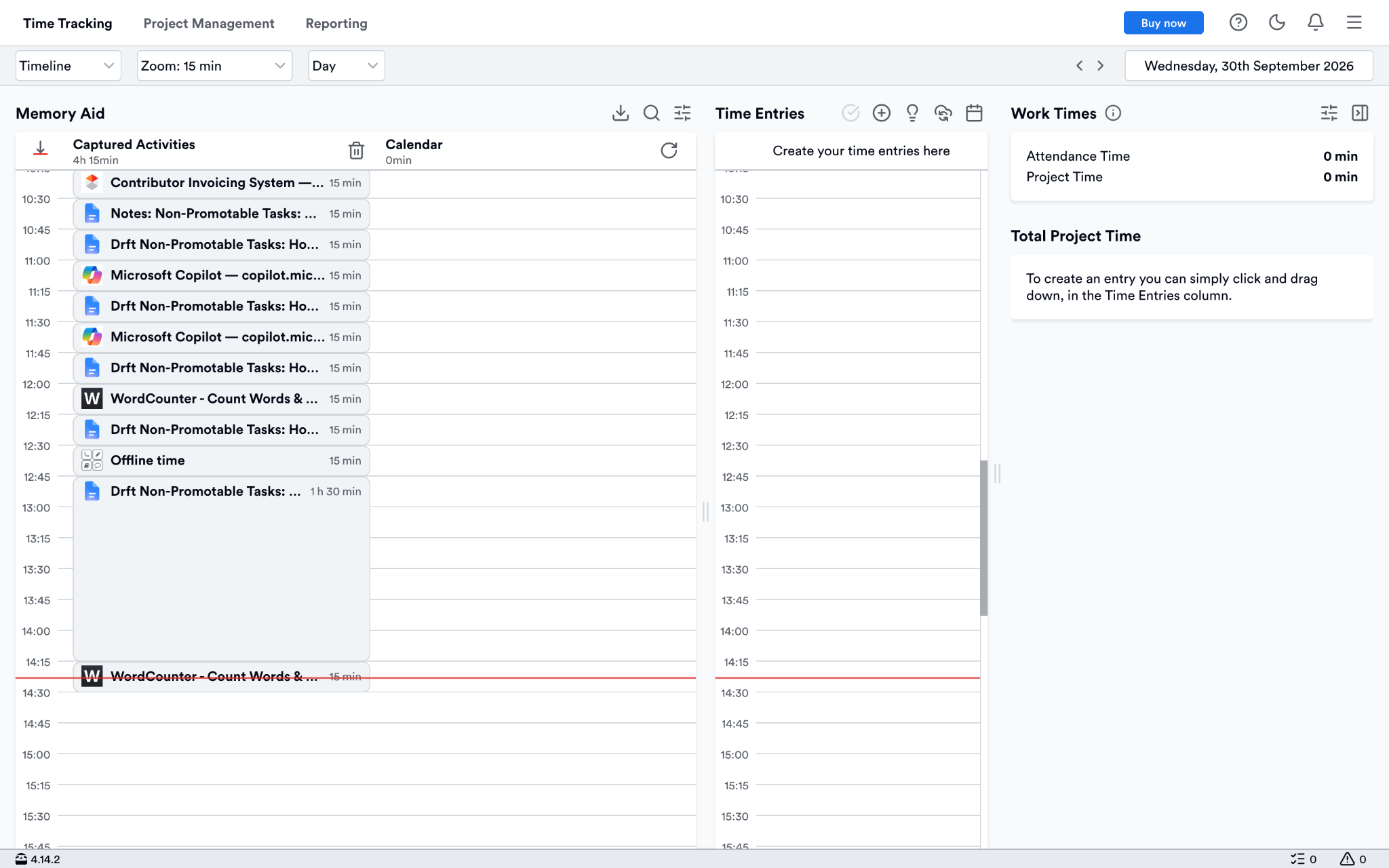
Time tracking tools, just like Memtime, help managers see when workload only looks balanced on paper, surfacing the secret organizational work people carry – without asking employees to manually log hours, which is often a non‑promotable task in itself. In fact, most employees don't care much about tracking their hours and tend to log enough to avoid negative attention, which naturally leads to incomplete data.
Getting clarity around this makes it easier to rebalance responsibilities, preserve focus time, and ensure promotable work doesn’t get quietly crowded out by everything else that “just needs doing.” So give our 14-day free trial a try and see how Memtime can make the full workweek visible – including the work that normally slips under the radar:

Sheena McGinley
Sheena McGinley is a columnist and features writer for the Irish press since 2008. She’s also a business owner that is conscious of how time tracking can foster progress. She wrote for SaaS companies and businesses that specialize in revenue optimization by implementing processes. She has the unique ability to digest complex topics and make them easy to understand. She shares this precious skill with Memtime readers. When she's not making words work for people, Sheena can be found taking (very) brisk dips in the Irish Sea.