Why Client Onboarding Costs More Than You Think

Because there’s so much to it! Admit it, client onboarding is much more than a cursory introductory call or a quick meeting/coffee. So it should be seen for what it is: an important delivery phase that can shape your margins.
Understanding what client onboarding involves can reveal why so many teams underestimate the effort needed here. Once you're more aware of the hidden cost of client onboarding and the real‑life tasks that inflate that cost, the gap between planned and actual work will hopefully become less easy to ignore – that’s the goal, anyway. The real opportunity lies in improving onboarding to protect your profitability.
So, if you want to price more confidently and stop losing money at the start of every project, why not keep reading. Sure, you might as well; aren’t you already here!
Key Takeaways
- Client onboarding is a delivery stage that sets the tone for early margin. Try not to view it as merely a casual introductory phase.
- Teams underestimate onboarding effort when planned time blocks don’t reflect the scattered reality that depletes your profit before you even get delivery off the ground.
- There’s industry-specific friction to add to the load. Different fields encounter their own onboarding blockers that extend setup time and inflate cost.
- Standardization and automation can reduce operational drag by eliminating repetitive friction and predictable onboarding. Your real-time data can also enable cleaner scopes and healthier pricing.

What is client onboarding?
Client onboarding… you might think it’s unique to each client or business (and it is, to a degree), but it all boils down to the same thing: it’s the phase where a business moves from a signed agreement into delivery.
Often called a “kickoff call”, it involves a range of key setup tasks. In practice, however, it should be a structured transition from ‘Howdy there, new client’ to "Let's get some proper work done, shall we?" This means orchestrating team alignment (which can be a protracted process), gathering info, configuring tools, sorting access provisioning, and reviewing documentation. It also involves defining a mutual understanding of project scope, delivery expectations, and workflows.
Sounds like a lot, doesn’t it? Welp, that’s ‘cause it is. As such, it's best not to view onboarding as simple admin/housekeeping, but as the foundation underpinning the future engagement. Yep, it's that important.
For context, this is a typical onboarding flow, which usually moves through four parts:
- Prep work: This is where you collect the specific inputs the team needs, making sure the internal lineup is clear, and defining the project brief.
- Kickoff meeting: A conversation to confirm the prep work, along with the goals, timelines, and essentially who’s doing what.
- Setup: Consider this the most practical parts; organizing access, tools, establishing workflows, and any initial configuration.
- Early support: So allocating extra time for checking in, clearing up questions, and making sure the client can actively see things moving.
So, to reiterate, knowing what client onboarding is (that being a structured delivery process, not a passing formality) is pivotal to appreciating its potential cost. And most businesses will underestimate it without a clear line of sight into that effort. They’ll incorporate loose pricing before taking the profit hit – and that’s all prior to the project even starting.
The hidden cost of client onboarding
Everything that isn’t captured in the compact, idealistic scheduled parts of the client onboarding process could be considered its hidden cost.
Most service businesses assume onboarding takes a few hours because that’s what gets planned, logged, or cobbled together from memory – and we all know how incomplete recollections can be. In practice, the cost of client onboarding burrows into fragmented work.
And for anyone mentally mouthing "Yeah, but what does that look like?", we'll get to real-life examples in the next section, but it's safe to say none of them seem worth logging on a standalone basis. Cumulatively, however, they gnaw into your margins.
This is evident in fixed-fee models, where unaccounted hours are absorbed by the business – not the client. Anyone pricing onboarding on optimistic assumptions, not the operational reality, will end up paying more in the long run – simply because they can’t see the real effort involved.

With any given client, how you approach onboarding can dictate your ongoing relationship. For instance, if you and your team end up pouring more effort into the onboarding process, you’re more likely to start with fewer capacity/buffers and, consequently, less room for strategic work.
Failing to effectively price your onboarding can also impact how clients perceive the overall progress of the project. Say your onboarding process drags on longer than expected, your team can feel pressure to speed up early deliveries to "catch up”, which can mean more strain. These downstream effects don’t show up in initial remits or proposals, but they can wind up driving the project's trajectory after onboarding is long over.
Real‑life onboarding tasks that can add up fast
Beyond the universally recognized scattered tasks – like the access requests that rebound, deciphering outdated client materials, persistent internal clarifications, and the inevitable follow‑ups – here are some industry‑specific variations that can quietly expand cost‑to‑serve.
- If you’re part of the accounting industry, you may have to chase missing financial records, wait for multi-factor authentication from directors (who may, or may not, be available), and reconcile chart-of-accounts differences before the real work can commence.
- In marketing agencies, access issues piling up across ad platforms can be a common issue. Then you can expect analytics to require untangling, and don’t get us started on the “helpful brand guidelines” landing in dense PDF pages that all take time to decipher.
- Moreover, consultancies see that inconsistent scope documents can lead to rounds of internal alignment. KPI lists can be delivered incomplete, and differences in terminology often become their own form of capacity drains.
- Environment setup for software implementation teams can experience delays thanks to security reviews, outdated documentation, and “simple” configuration checks to find custom fields that can change the entire setup.
- Between bounced conflict checks, no clear decision-makers/reviewers, and conflicting background documents that require more calls and partner alignment, onboarding clients in the legal field can be a potential minefield.
- Incomplete device inventories across IT-managed services can lead to serial-number hunts, while access provisioning requires staggered approvals, and “quick” network audits can reveal undocumented hardware. All have the potential to turn minutes into hours.
Improving onboarding to protect your margin
The question isn’t whether onboarding should be paid or unpaid; it’s whether you actually know what it costs you and whether you’re recovering it properly across smaller and larger clients alike. That’s where standardizing, automating, and accurately tracking onboarding work becomes essential.
- Standardization reduces the ad‑hoc detours that inflate cost‑to‑serve.
- Automation removes repetitive friction across access requests, setup workflows, and routine follow‑ups.
- Accurate tracking finally reveals the true delivery footprint – the access requests, internal handovers, documentation review, chasing information, alignment calls, and follow‑ups that teams forget to log.
Unsurprisingly enough, Memtime can slot nicely into your onboarding process. After all, the crux of it is this: in the absence of real-time data, onboarding is priced on rose-tinted assumptions. Conversely, when you and your team are armed with reliable real-time data, you can then refine fixed‑fee scopes, introduce onboarding fees or setup fees (based on concrete data), and protect margin before your project even begins.
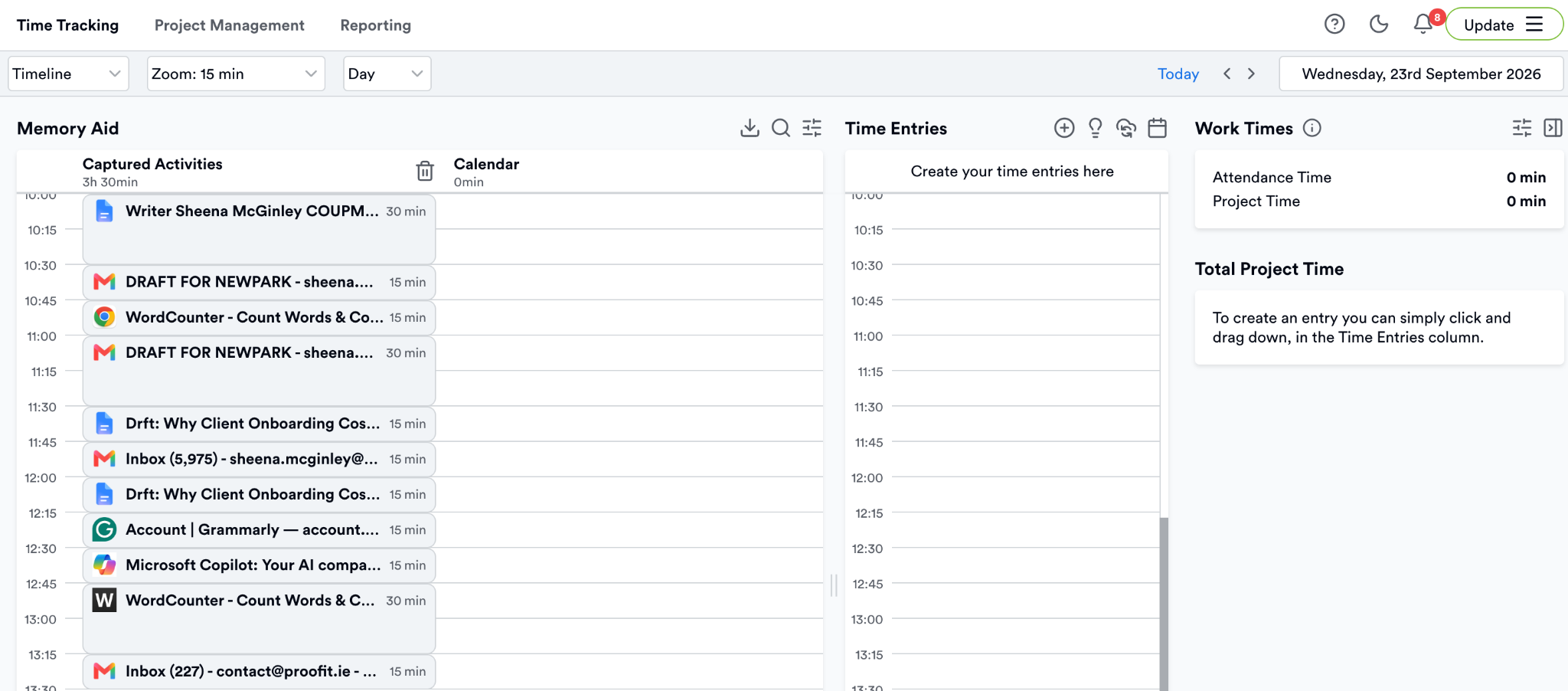
Memtime automatically records all the work that happens during onboarding; the document generation, meetings, calls, access setup, and every incidental WhatsApp in between, so it can give you a clear timeline of where your team’s hours are going. Memtime gives you the full delivery footprint, so the numbers you use for your next quote mirror the true cost of onboarding rather than guesswork.
If you’ve made it to the end of this here article here – particularly in this frantic, attention-economy environment – HUZZAH – you clearly deserve a 14-day free trial! That way, you can experience firsthand how much Memtime can do for you while you’re busy onboarding and getting the job done.
FAQs
How does onboarding shape long‑term client expectations?
Early interactions set the tone for communication style, responsiveness, and delivery pace. When onboarding is structured and consistent, clients adopt clearer expectations that reduce friction later on in the process. So, start as you mean to go on.
Why does onboarding often trigger early scope creep?
Clients frequently refine or expand their needs once work begins. Onboarding is the first moment those shifts surface, and without firm boundaries, small adjustments can warp into all manner of unplanned work.
How does client readiness impact onboarding cost?
When clients arrive with incomplete materials, unclear end goals, or outdated documentation, teams spend extra time plugging those gaps. This variability directly affects cost‑to‑serve and can stretch onboarding far beyond planned hours.
Why is internal coordination a hidden margin risk during onboarding?
Multiple departments often touch onboarding, and misalignment between them creates duplicated checks, repeated clarifications, and inconsistent handovers. These internal inefficiencies quietly inflate delivery cost.
Why should pricing models account for onboarding variability?
Different clients generate wildly different onboarding workloads. Fixed‑fee pricing needs either a buffer or a defined onboarding component to avoid absorbing unpredictable effort that erodes margin.

Sheena McGinley
Sheena McGinley is a columnist and features writer for the Irish press since 2008. She’s also a business owner that is conscious of how time tracking can foster progress. She wrote for SaaS companies and businesses that specialize in revenue optimization by implementing processes. She has the unique ability to digest complex topics and make them easy to understand. She shares this precious skill with Memtime readers. When she's not making words work for people, Sheena can be found taking (very) brisk dips in the Irish Sea.