The Invisible Work Problem: How Hidden Hours Add Up
The invisible work problem is real.
Imagine this. You clock out at 5 PM, shut your laptop, stretch, and think, “Ah, finally done for the day.”
But, hold on.
Did you really stop working?
That tiny email thread you replied to at 7 PM, the quick little debugging session you did from the couch, or the mental work you did while grocery shopping? All invisible yet all real work. It’s such a time-suck that nobody talks about, yet everybody experiences and feels it.
And that’s exactly why we’re talking about it. There’s a reason why you feel exhausted even when your timesheet says you barely worked. Invisible work is draining, silent, and not that easy to pinpoint.
So, in this article, we are going to rant about it (just a little bit), help you spot it, understand it, and stop letting it run your life. You are not some unpaid intern or a greenhorn. It’s time you get your hours and energy back.
Let’s roll.

Key Takeaways:
- Invisible work is all the extra tasks, mental load, and behind-the-scenes effort that drain you but never appear on your timesheet.
- It shows up in every industry, from debugging and mentoring to editing docs and emotional labor, and rarely gets credit.
- You might be drowning in invisible work if you feel burnt out, undervalued, or confused why your logged hours don’t match your exhaustion.
- When invisible work isn’t tracked, it leads to poor planning, unrealistic expectations, uneven workloads, and big financial waste at the company level.
- The fix is making your hidden work visible: acknowledge it, redistribute it, track it, and advocate for recognition.
- Automatic time tracking tools like Memtime help capture everything you actually do, so you finally have proof, clarity, and control over your time.
- When your invisible work becomes visible, you get more balance, fairer workloads, and credit for the effort you’ve been giving all along.
What is invisible work?
Shortly put, it’s all the stuff you do that doesn’t show up in your timesheet or job description, but still drains your brain, time, and often your energy.
Sociologists call this invisible labor. The term “invisible labor”, comes from a 1987 article about invisible work by sociologist Arlene Kaplan Daniels, and refers to unpaid work that goes unnoticed and unacknowledged.
Basically, it’s work that’s unseen, undervalued, or simply ignored, even when it’s essential to get things done. Invisible work doesn’t come with a checklist or a bonus. But it’s present, repetitive, thankless, and relentless.
Think about all those invisible tasks, like mentoring, refactoring code, or cleaning up messy docs. All these often fly under the radar.
Real-life examples of invisible work
Invisible labor is more than an academic concept; it’s visible (pun intended) and very real in dozens of industries and workplaces.
Here are some real-life examples from our fellow Redditors.
Software and engineering
Over on r/ExperiencedDevs, one senior engineer opened up and said that a lot of their efforts go towards invisible work. As they mentioned, that type of work often goes unplanned and doesn’t show up under feature development. That invisible work is taken for granted, not attributed to them, yet they still do it.

Other engineers also gave their perspective on invisible work.
A Senior Staff Software Engineer added:
What I do is track all my work on my own kanban board (I use Trello, our scrum teams use Jira). Our scrum teams do quarterly planning and I pay attention to where I'm needed most in assisting which teams during this planning, which provides me objectives and key results that eventually will not be "invisible."
And another user mentioned:
I attempt to make my work visible. In standup I'll mention when I help somebody. In planning, I ask "how much support do we expect X to need from the team?" where X is a developer that needs my time to complete his ticket. I really hate when I'm given invisible work in order to unblock or assist someone else. I create zero-point stories/tasks that highlight invisible work I'm doing that is important but not on anyone else's radar.
You get the picture.
The TL;DR is that these devs are doing critical, high-value work that prevents bugs and uplifts teammates, but most of their work doesn’t make the “feature list” or the annual review soundbite.
Their efforts go unnoticed until (or if?) someone takes a peek under the hood.
Writing and creative work
Invisible work doesn’t hit just coders. Writers feel it, too, in waves.
On r/writing, there’s a thread titled What “Invisible Work” Looks Like for Writers:
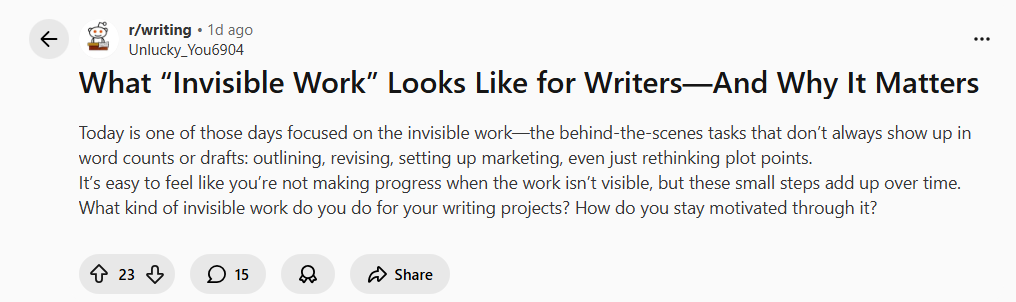
The main question was How do you stay motivated through it?
And a writer admitted:
I have a writing process and a publishing process, so I know where I am at all times and know how far I have to go before it's all done, including costs.
So, does this mean that the solution to the invisible work problem is standardizing processes? Could be; let’s see.
Why does invisible work happen?
Partly, because you allow it to happen.
But it’s not all on you, so please don’t blame yourself. There are a few other reasons why it happens:
- You assume it to be “part of the role”. In many jobs, emotional labor or mentoring is just assumed. That’s why you think this invisible work shouldn’t be tracked—there’s no need to track it if it’s not mentioned in the job description.
- You have no tools or mechanisms to capture it. Many workplaces don’t bother with finding the right tools to capture invisible work. If it’s not a ticket or a doc, it’s invisible.
- Leaders are not that interested in visibility. Team leads and managers often don’t realize how much “background support” work is happening; they are more focused on the outcomes, rather than the processes.
- The work culture is based on a lack of trust and micromanagement. According to a Forbes article, invisible work is a symptom of managers not trusting their people to manage their own time.
What are the signs it’s happening to you?
How do you know if you’re quietly drowning in invisible work?
Well, there are some obvious red flags, like:
- You feel like you’re constantly doing things that aren’t officially part of your job. If you’re always picking up extra tasks, supporting others, solving problems, or tidying up messes no one assigned to you, there’s your sign.
- Your effort isn’t recognized. Whether in performance reviews or team meetings, the things you spend time on never really show up.
- You burn out, but no one seems to notice. Because your invisible work doesn’t show up as a deliverable, people may not understand why you’re exhausted.
- Your timesheets (if you have them) don’t reflect reality. And that’s why your billable hours or logged hours always come up short.
- You tell yourself invisible work “doesn’t count”. That little voice inside your head that says, “Oh, that was just helping out and keeping things organized, that’s no big deal” counts. It all counts.

What are the costs of invisible work?
With invisible work, damage sneaks in quietly. You know how it goes: at first, it’s just “one small extra task”, then another, and another… until you (and your company) start paying the price.
Here’s a list of hidden costs that you and your company are paying.
Your costs
Invisible work steals your time, takes your mental energy, confidence, and growth opportunities. Here’s how:
- You become burnt out and chronically stressed. Doing work that no one sees, tracks, and acknowledges is exhausting. You start feeling like you’re doing everything and getting credit for none of it, which leads to emotional fatigue and irritability.
- You get no recognition or appreciation. When the value of your work isn’t visible, neither is your impact. You feel undervalued.
- You have lower chances for career growth. Promotions, raises, and opportunities often rely on what’s documented, reported, and praised. Invisible work doesn’t show up in any of those categories. If your colleagues’ tasks are more visible, they’ll be more suitable for promotion.
- No work-life balance. Invisible tasks usually don’t fit into a standard 9-5 workday—they spill into evenings, weekends, and commutes.
- You get resentful and start quiet quitting. When you disengage emotionally and mentally, chances are you will eventually do it physically.
- You carry an emotional load. Keeping track of everything, remembering who's waiting on what, anticipating problems, it’s all cognitive juggling. And it feels so heavy.
Your company’s costs
Organizations also pay for invisible work. And the bill is often huge.
Here’s what I mean by that:
- Poor estimation and project planning. When invisible work isn't documented, project timelines are just pure fantasy. Every task will take longer than expected because half of the work isn’t visible on paper.
- Improper capacity planning. If employees spend 30-40% of their time on untracked tasks, managers think people have more bandwidth than they actually do and tend to assign unrealistic workloads to them.
- Inefficient resource allocation. Invisible work means that leaders don’t know who is overloaded or who is doing critical work in the background. This lack of knowledge leads to bad staffing decisions.
- Unequal work distribution. That’s why high performers end up doing more hidden labor as they’re “reliable”, while others do far less. This imbalance creates resentment and eventually turnover.
- Huge financial losses. Invisible work suggests lost billable hours, time that can’t be invoiced, underestimated project work, duplicated work, and lower productivity overall. It’s very expensive.
- High employee turnover. When employees do tons of important work that goes uncredited, the job market starts looking really attractive to them. And replacing a single employee often costs 1-2 times their annual salary. 🤷
So, what’s the solution here?
The solution is obvious: make the work visible.
But it’s easier said than done. So, here’s a 4-step process that can bring invisible work into the light. You can go through these steps yourself, or suggest to your manager that you all do it company-wide.
Step #1: Acknowledge it.
List out everything you do in terms of invisible work, not just the flashy deliverables.
Step #2: Redistribute.
All your mentoring duties, emotional labor, or cleanup tasks should be visible in this step. Ask your manager to make them more formally assigned.
Step #3: Track your time.
You can’t manage what you don’t measure. Automatic time tracking is of great help in this step.

Step #4: Ask for recognition.
Once all your work is visible and tracked, it can be rewarded fairly. You can get more recognition, promotion, or pay. After all, work is work.
Automatic time tracking, your ally for turning invisible work into visible
The “issue” with the previously mentioned 4-step process is that you need to acknowledge your invisible work and list out what uncredited work you are actually doing.
Again, it’s easier said than done.
You’re likely bouncing between tasks, juggling multiple tasks at once, barely catching your breath, let alone noticing all the invisible work you’re doing.
That’s why you need a tool that can do it for you.
And one of the smartest ways to deal with invisible work is through automatic time tracking. Such a tool can capture exactly what you’re doing and when, and make the invisible visible.
Memtime is one of those tools.
It’s our fully automatic time tracking app for desktop (Windows, macOS, and Linux).
Memtime quietly runs in the background, capturing all your computer activity, including emails, files, browser tabs, meetings, you name it. It can even capture your calls (iPhone, Zoom, Google Meet, Teams, and VoIP phone systems like Pascom, Sipgate, or FRITZ!Box).

Here’s how Memtime can help you:
- It passively tracks ALL your computer activity. No need to manually start/stop timers; Memtime sees what you're doing and logs it.
- It guarantees your privacy. All activity data is stored locally on your device, not in the cloud, so your private stuff stays private.
- It gives you a detailed private timeline. Memtime has a Memory Aid, which is a timeline that lists what you did and for how long.
- It integrates with hundreds of your project and billing tools. Thanks to the tool’s 2-way sync, you can import projects and tasks into Memtime, and export time entries into the systems you already use.
Memtime is the GOAT because:
- It doesn’t add to your workload.
- It keeps your data stored locally.
- It gives you evidence, not feelings.
- It works with your other tools, like project and billing apps.
Invisible work may be sneaky, but with Memtime, you can be sneakier. 😉 And get clarity, proof, and control.
Sign up for our 2-week free trial to finally stop losing your hours.👇
How to solve the invisible work problem with Memtime (step-by-step)
Let’s do a little experiment. Imagine you signed up for our free trial, used Memtime for a week, and got data. REAL data, and you’re sick of what you discovered. You’re ready to tell your manager what’s going on and finally get the recognition you deserve and a piece of mind.
Here’s how you would do it.
You installed Memtime.
It quietly captured all your computer activity.
At the end of last week, you reviewed your timeline.
You found 2 hours of “other work” you had no idea you spent on mentoring via chat.
You decided to convert those hours into tasks.
In Memtime, you can connect your time with projects and tasks. So, you've decided to add a new task, titled Mentorship or Cleanup, and export time entries to that particular task in Jira, Xero, or any other app you use.
Now, you want to show it to your manager.
You walk into your next 1:1 like, “Hey, I want to talk about the invisible work I’m doing, and here are real data points”.
Your manager finally sees what you’ve been doing behind the scenes.
They review your reports and timeline and say, “Oh wow, you’ve been spending 8-10 hours a week on support work we never accounted for.” (Managers love data; it gives them something they can act on.)
They adjust your workload in concrete ways.
Real adjustments look like removing or reassigning particular tasks, reducing your project load, or adding buffer time to your schedule. You get the picture.
And suddenly, you get protected focus hours; you’re no longer expected to magically squeeze 12 hours into an 8-hour day. You get breathing room, while others carry their fair share. Everyone wins!
Plus, because all your work is visible and measurable, it also becomes rewardable. You get credit for the work you’ve actually done and hit deadlines without burning out.
You stop feeling behind, guilty, or overwhelmed.
Your time is finally valued. 🎊
Make invisible work count
I’ll repeat this one more time: invisible work is REAL. And ignoring it doesn’t make it go away; it just makes you more resentful, overworked, and underappreciated.
If you use Memtime, you can get visibility without micromanaging yourself. You make the invisible visible, give yourself leverage, and finally get credit for all the effort you put in.
Your work matters, and it deserves to be seen, valued, and honored. Even if it’s invisible at first glance. 🙂
What exactly counts as invisible work?
Invisible work includes all the untracked tasks you do, like mentoring, problem-solving, cleaning up docs, and emotional labor. It doesn’t show up on your timesheet, but it still eats your time and energy.
Why is invisible work such a big deal?
Because it quietly piles up and makes your day longer without you realizing it. Over time, it leads to burnout, stress, and feeling undervalued.
How do I know if I’m doing too much invisible work?
If you’re exhausted but can’t explain why, that’s usually the giveaway. Feeling unrecognized or constantly helping out is another strong clue.
How can I make my invisible work more visible at work?
Start tracking everything you do and share it with your manager during planning or check-ins. Once it’s written down somewhere, it becomes real and easier to redistribute.
Can automatic time tracking really help with invisible work?
Yes, definitely. It captures your actual activity without you needing to remember anything. That data becomes proof of what you really worked on and helps you advocate for a fair workload.
Is invisible work my fault for taking on too much?
No, it usually happens because of unclear expectations or company culture, not because you’re doing something wrong. But you can take back control by making your work visible and asking for recognition.

Aleksandra Mladenovic
Aleksandra Mladenovic is a copywriter and content writer with six years of experience in B2B SaaS and e-commerce marketing. She's a startup enthusiast specializing in topics ranging from technology and gaming to business and finance. Outside of work, Aleksandra can be found walking barefoot in nature, baking muffins, or jotting down poems.