The Forgetting Curve Costs Your Business More Than You Think

Let’s play a quick game. If you get this question right, I’ll get you 1 month of Memtime for free; I’m serious.
Here’s the question:
What did you eat for breakfast last Wednesday?
…
Take your time…
…
Yeah… nobody remembers that stuff. And that’s actually the whole point of this article. 🙂
If such a simple, personal question like “What did you eat on any given day?” makes you pause, imagine what happens when the question is “What did you work on Tuesday afternoon?” or “How long did that client meeting truly run?”. Yikes.
It seems as though your brain has some blind spots, and there’s a 140-year-old psychology finding that explains why this happens—it’s called the forgetting curve.
Now, if you run a service business, especially one where people bill hours or plan projects, the forgetting curve is most likely decreasing your revenue as you’re reading this article. And that’s what I want to talk about today.
If every single person on your payroll forgets the same way you forgot breakfast, imagine how many tasks simply vanished from their brains. Multiply that across every employee, and every week of the year, and you can see how this universal quirk of human memory affects your profit.
So, let’s see what the forgetting curve really is, how it shows up in businesses, and what you can do about it before it devours your profit.
Let’s roll.
Key Takeaways:
- The forgetting curve is a real psychological phenomenon that Hermann Ebbinghaus discovered in 1885. It shows that people forget roughly 40% of new information within 20 minutes.
- A 2015 study replicated Ebbinghaus’ findings using modern methods, confirming the forgetting curve still applies 140 years later.
- Service businesses that bill hourly are hit hardest, since forgotten work time directly translates into unbilled hours and lost revenue.
- Undocumented time costs revenue and corrupts historical data, leading to inaccurate project estimates on future work.
- Time distortion, tied to deep focus or the flow state, makes people even worse at judging time during their most high-concentration work.
- Automatic time tracking tools like Memtime address the forgetting curve by recording activity in the background, removing your need to rely on memory.

Is the forgetting curve real?
Oh yes, VERY real.
It dates back to the 1880s, when a German psychologist Hermann Ebbinghaus ran a wild experiment on himself (he was the only test subject). It lasted 7 months, and the goal was to study his memory as empirically as physicists did in their experiments.
Ebbinghaus memorized lists of nonsense syllables, like ZOL and DAX, and then tested how much he could recall at different intervals afterward.
The results were rough:
- Roughly 40% of what he’d learned was gone within 20 minutes.
- About 55% had faded after an hour.
- By the end of the first day, around ⅔ of it had disappeared.
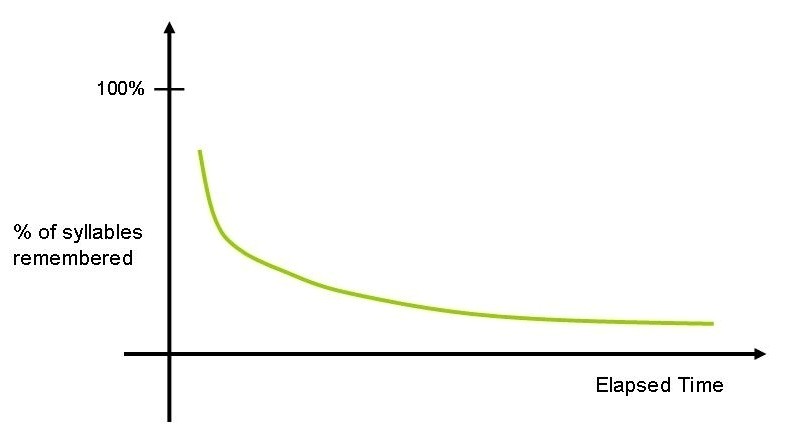
Now, these aren’t some rough estimates from a secondhand summary; they’re Ebbinghaus’ own recorded data, published in Memory: A Contribution to Experimental Psychology (1885). You can read the full original text here.
His findings show that your brain starts dumping new information almost the second you learn it. I’m talking minutes.
And I know what you’re thinking—“it’s just some outdated theory in a random psych textbook that nobody cares about”.
Um, that’s not entirely true.
In 2015, researchers Murre and Dros ran a full replication using modern methods and confirmed Ebbinghaus’ core findings, publishing their results in PLOS ONE. Meaning, nearly a century and a half later, Ebbinghaus’ math is in fact mathing. The forgetting curve doesn’t care that you’re busy, important, or that you think your memory is sharp. It applies to everyone with a brain.
Now, one important caveat.
Ebbinghaus used meaningless syllables on purpose to strip out context. Real work-related information can technically stick around longer than nonsense syllables do. The slope is a little gentler, but it’s still a curve, and it still drops. More importantly, it drops fastest in the first few hours, when most of your team is deep in their actual workday.
What the forgetting curve looks like at work
Let’s translate all this research into a Friday afternoon.
That Friday you had:
- A client workshop.
- 6 meetings.
- 3 client calls.
- 14 Slack threads.
- A dozen quick questions from your team.
And it’s time to fill out your timesheet.
So, what do you remember? Well, from that day, you can mostly recall the big stuff: the 2-hour client workshop, a couple of important back-and-forths, and that one client call that ran longer than expected.
What do you forget? The previous 4 days and almost everything else from that Friday. Like the 9-minute client call that eventually turned into scope creep, then the 4-minute Slack exchange that solved a client’s problem before it balled up into a bigger one, and the 20 minutes you spent re-explaining something because a doc got sent to the wrong person. You get what I’m saying.
Now, let’s just say that you forgot exactly those 9 minutes + 4 + 20. A total of 33 minutes.
Doesn’t seem like much, does it?
Wrong!
Multiply 33 minutes across every employee, every week of the year, and you’ll start biting your nails pretty quickly. One person losing half an hour a week is nothing worth noting (in theory). A 20-person team losing over 11 hours a week combined—that’s definitely worth noticing. Now apply that across 50 working weeks per year, and you get approximately 550 hours of work that happened but was never logged or billed.
And from that, the logic is pretty simple:
Undocumented time → Lower profit + Inaccurate project estimates (I’ll break it all down)
And probably the worst part is that you’re losing precious time thanks to the way your brain works. Ebbinghaus proved it in 1885, and your team re-proves it every single week, whether anyone’s tracking it or not.
How does undocumented time translate to lost profit and inaccurate estimates?
Undocumented time truly leads to lower profit and poor estimates.
Here’s how that happens, step by step:
- First, work happens. One of your teammates hops on a call, answers a client’s Slack message, fixes something, and so on. Good for them.
- Then, the work doesn’t get logged. And not on purpose, but because it felt too small to remember, or the moment to log it came and went. This is the forgetting curve doing its most.
- Then, undocumented work becomes unbilled work. The work simply isn’t included on the invoice because it was never recorded in the first place.
- Then that unbilled work hits your revenue. One missed 15-minute task does nothing on its own. But when you multiply it by every teammate, every day, every week of the year, those small, forgotten moments take away a good chunk of revenue.
- At the very end, that lost revenue shrinks your margin. You still pay the salary for the hour that was done but didn’t collect anything for it, and that’s how the margin goes down.
It’s a simple chain, really, and here’s what it looks like once you attach real numbers to each link.
Clio’s 2024 Legal Trends Report, which ran over 7 million anonymized time entries from thousands of law firms, found that the average lawyer bills just 2.9 hours out of an 8-hour day, having a utilization rate of around 37%. When you do the math, that’s more than 5 hours a day, per attorney, that either weren’t billable to begin with or never got logged.
Even for the hours that do get billed, the same report found lawyers only collect about 93% of what they invoice, and that’s after the time was successfully logged.
Clio’s benchmarking data also shows utilization rates for solo and small firms barely moving in almost a decade, even though billing rates and revenue climbed. The hours worked and the hours captured never seem to line up.
And that’s that on profit.
But what about bad estimates?
Well, the same missing hour that never made it onto an invoice also never made it into your historical data. So, when you look back at how long a similar task took last time, you actually see whatever fragments someone remembered to write down.
If a task took 6 hours but only 4 got logged, the historical data is completely wrong. So, when you build your next estimate off that, of course the project runs over. When you start thinking that “projects always seem to take longer than expected”, remember the forgetting curve, ‘cause it’s probably the one to blame.
When you mix all these things together, you get one universal truth: the same forgotten hour that costs you revenue is the exact same hour that messes up your estimates.
What makes the forgetting curve problem even worse
Okay, so now you know your brain simply forgets things. That’s the main issue.
But I would argue that there’s one more layer that adheres to that forgetfulness, and it’s your own misjudgment of how long things took while we were actually doing them.
Psychologists call this time distortion, and it’s tied to the flow state—that state of deep focus where time seems to disappear. One study measuring the gap between people’s subjective time estimates and objectively recorded time found measurable distortion, especially when a task demands steady attention. In plain English: the more absorbed you are in work, the worse your internal clock gets.

So, this paradox translates to this: your most valuable, focused work, like deep strategy, complex problem-solving, and creative output, is the kind of work where your sense of time is least reliable. The hours you’d most want to track carefully are the ones your brain is worst at measuring in the moment.
Now, combine this finding with the forgetting curve, and you get a one-two punch that leads to TKO.
First, you don’t perceive time accurately while it’s happening.
Then, shortly afterward, you forget most of the details.
Basically, you’re doomed. We all are. 🙂
How to beat the forgetting curve
You can’t exactly fight biology, but you can find a way to work with it. For example, you can:
- Lower the gap between doing and logging tasks. The forgetting curve is steepest in the first hour after something happens, meaning the longer someone waits to record a task, the more of it is already gone. Logging tasks close to when they happen can improve accuracy.
- Reduce how much your team has to remember. Remember when you were a student and always jotted down notes? It helped you stay focused and learn faster because you didn’t have to reconstruct information hours or days after you first heard it. The same concept applies here: the less your team has to remember consciously, the more accurate your data will be.
- Make everything visible. Find a system that automatically surfaces the tiniest time fragments. Like a tool that shows a 3-minute client call or a 2-minute Slack exchange.
- Separate doing the work and remembering the work. Find a tool that acts as a separate memory system, listing all the tasks you worked on so you can check afterward.
All in all, the goal is to find a way to outsource your memory, so your brain can focus on doing the work. It’s time to let your brain off the hook.
Outsourcing memory with automatic time tracking
Human memory is a bad system for capturing time. I hope that’s clear by now.
So, the solution is to stop asking the brain to do it. 🙂
And that’s what automatic time tracking is for.
An automatic tracker runs (quietly!) in the background and records what you did throughout your day, including the smallest 2-minute check-ins. It saves all your activity as a record you can review and confirm later.
All this means there’s nothing to reconstruct from scratch, because nothing was ever forgotten in the first place. The tiny tasks also show up, as the system doesn’t decide what feels worth remembering and what doesn’t.
That’s how doing the work and remembering the work become 2 separate jobs: one is yours, and the other belongs to the tool.
Say hi to Memtime
Memtime is one of those automatic time trackers.
It runs quietly in the background and automatically captures your activity across apps, docs, browsers, meetings, and even calls. At any point, you can glance back and see a visual timeline (Memory Aid) of what you actually did.
And if Memtime seems like some surveillance-y AI gimmick, to that I say:
- It’s not a monitoring tool. All your activity data stays stored locally on your own device; not even us at Memtime can see it.
- Memtime isn’t built with AI. And we like to keep it that way (mostly for privacy reasons).
Think of Memtime as an outsourced memory that you’ll enjoy NOT using, since there’s really nothing to use in the first place. You turn on your computer, and Memtime is already quietly working in the background, capturing as you go.
It’s the most honest way to beat your brain and the forgetting curve.
Wrapping it up
The forgetting curve is real. It’s wired into how our human memory works, and it’s been tested, replicated, and confirmed for well over a century.
But just because it’s not your fault per se (it’s just your brain braining), doesn’t mean it’s not costing you money. Every day your business relies on people accurately remembering how they spent their time, so that you can bill and plan your profitability on top. If that process of remembering is unreliable (read: utterly untrue), you’re in a pickle. To say the least.
So, don’t force yourself and your team to remember everything—do the opposite. Let them work and outsource the remembering with automatic time tracking.
There!
Problem solved.
FAQs
What is the forgetting curve?
The forgetting curve is a psychological concept showing how quickly memory fades over time without reinforcement. It shows that most forgetting happens fast, within the first hour or day after learning something. In a work context, it means small tasks and interactions get lost from memory almost as soon as they happen, well before someone decides it’s time to log their hours.
Why do people forget things so quickly after learning something?
You can blame it on how human memory works. Memory naturally prioritizes what feels important or emotionally significant, and discards details that seem routine. Small, repetitive tasks don’t seem as “worth remembering”, so the brain drops them almost immediately.
What’s the difference between the forgetting curve and time distortion?
The forgetting curve explains why we forget what happened. Time distortion explains why we misjudge how long something took while it was happening. Time distortion is strong during flow states, when deep focus makes hours feel like minutes. Together, these two create a compounding problem: people don’t perceive time accurately in the moment, and then forget the details shortly after.
How can businesses reduce revenue loss caused by the forgetting curve?
The most effective approach is to shorten the gap between doing a task and logging it, meaning reducing what employees have to remember, and using tools that automatically capture small tasks also helps prevent lost time. So, technically speaking, the goal isn’t to train employees to remember better, but to remove the reliance on memory altogether.
Does automatic time tracking work better than relying on memory or manual logging?
Yes, definitely. Automatic tracking removes the need to reconstruct a day from memory, which is how most inaccuracies happen. Automatic tools capture activity as it happens, including small tasks people often forget or dismiss as not worth logging. This creates more complete, accurate records for billing and future project estimates.

Aleksandra Mladenovic
Aleksandra Mladenovic is a copywriter and content writer with six years of experience in B2B SaaS and e-commerce marketing. She's a startup enthusiast specializing in topics ranging from technology and gaming to business and finance. Outside of work, Aleksandra can be found walking barefoot in nature, baking muffins, or jotting down poems.