Rush Fee Explained: How Much to Charge for Urgent Work

When you hear the term "Rush fees", most people likely make an assumption along the lines of “Isn’t that just a premium add-on for clients in a hurry?” Rush fees are much more than that, however; they’re a pricing mechanism that reflects the real business cost of urgent work.
Rush fees should factor in schedule reshuffles, the necessary overtime, weekend work, all the pivoting, and the resulting “opportunity cost” of delaying other commitments.
So, let's have a proper gander at the humble yet pivotal rush fee. You’ll see what counts as a typical fee of this nature and how factors like expedience, project size, and work rates should frame your pricing.
We'll also cover how to explain a rush fee to a client in a professional, no-nonsense manner. You need to adequately convey when a last-minute work fee is justified, and outline a simple rush fee calculator concept.
All these factors combined help you price urgent work with more visibility and therefore don’t erode your long-term profitability!
Key Takeaways
- Rush fees should reflect the real business impact, not just the urgency. They should cover any schedule changes, extra work, and the potential impact on you for putting off other client commitments.
- A rush fee is justified when urgency disrupts your normal workflow. This might look like having to pull work forward, reducing review windows, or having to guarantee turnaround within fixed hours or days.
- Clear client communication is essential. You should frame the fee around operational impact rather than inconvenience, and indicate how accelerated delivery affects every aspect of business like resourcing, scheduling, production hours, etc.
- Three pricing models dominate across industries: a flat fee, percentage‑based markup (commonly 25 to 50%), and premium hourly rates for evening or weekend work. More on that below.

What is a rush fee?
Simply put, a rush fee is a pricing mechanism that should compensate for the additional business costs created by work that requires speed. As expected, it’s applied when a client needs a deliverable faster than your standard turnaround time.
As a direct result of committing to this accelerated schedule, you'll need to reorganize existing commitments, work extra hours into your evening or during the weekend, absorb overtime, or even delay other paid commitments.
Unlike a simple markup, a rush fee should reflect the operational disruption caused by urgency, which obviously includes compressed timelines, reduced flexibility, and that higher opportunity cost. In practice, a rush fee can take several forms, such as a:
- Flat fee
- Percentage‑based markup
- Premium hourly rate
That said, the underlying purpose of a rush fee is the same. It's to help you mind your margins when you commit to completing a project ahead of what's been queued.
When to charge a rush fee
A rush fee becomes most pertinent or relevant the moment a client’s proposed deadline requires you to treat their project as an exception rather than part of your normal pipeline. The clearest indicator is whether the client request forces you to advance work that wasn’t scheduled to begin yet, at the potential detriment of your other queued work.
By way of a checklist, the conditions for a rush fee are met when you either:
- Pull a project forward in your queue
- Interrupt your planned sequence of delivery
- Allocate resources earlier than you intended
Another major indicator is when your client’s timeline removes your ability to offer standard options, such as typical review windows, staged approvals, or your usual production cadence. In any of these cases, the fee isn’t just about getting the job expedited – it’s about compensating for the loss of choice and flexibility.
Moreover, you should apply a rush fee if a client asks for guaranteed turnaround within a fixed number of hours or days, since this level of certainty itself should carry a measurable cost.
Rush fee models and typical percentages
As I mentioned above, there are typically three ways to price rush fees: a flat fee, a percentage-based markup, or a premium hourly rate.
Each model depicts a different form of operational disruption, from shortened timelines, potential weekend working, and the resulting lessened flexibility, all of which can lead to lost capacity and growth impact. No matter the model, the aim is to come up with a fair rush fee that works for everyone. It has to have a real business impact and keep you from setting one that is too low.
Percentage-based markup
This is one of the more common options for agencies, consultants, accountants, and software teams. A standard rush fee is 25% to 50% of the base project price. Exceptionally urgent work – we’re talking legal filings, tax deadlines, emergency technical support, other equally pressing requests – can exceed 75%. The model scales naturally with the size of the project, and is easy to justify when urgency affects multiple stages of delivery.
Premium hourly fee
This premium model is used where urgency leads to overtime, evening work, or a weekend work rate. Premium rates often go to time and a half or double time, and provide a simple way to price out expedited production without having to refigure the whole project.
Flat fee model
This option is useful for the smaller, well-contained tasks. This is particularly the case where the disruption is one of timing rather than complexity, when a single surcharge is easily justified and communicated to the client.
Which brings us seamlessly to....
How to explain a rush fee to a client
Unsurprisingly, providing an outline of a rush fee to your client is about being transparent from the outset.

Not only do clients need to be aware of the fee being applied, but they obviously also need to know why, and the best way to frame it is to focus on outlining the operational impact – not just the urgency aspect.
Your detailed explanation should include a plan for your proposed accelerated delivery, outlining how you will redirect resources, compress review windows, and potentially have to work evenings/weekends to meet the new deadline. This showcases the rush fee as a viable business expense, rather than merely a penalty for inconvenience.
In terms of transparency, it also helps if you make the fee a part of your regular process. For instance, you could say that your normal turnaround time is to ensure quality and scheduling, and that a fee for rush work is to compensate for the disruption of moving the project ahead of other commitments. As such, it's worth mentioning it as an option when you commence your client relationship – so it doesn’t come as a surprise.
For starters, be factual and get straight to the point. It’s also incredibly important to be confident in your tone (after all, they’re hiring you for your expertise, so confidence across the board is expected). Moreover, clients value fact-based reasoning, alongside a consistent pricing model and a fee presented as part of a structured, professional workflow.
If you’re wondering what this might look like in email form, here’s an example:
How to calculate reasonable rush fees
Again, a rush fee isn’t an arbitrary penalty just for funsies. It’s shaped by three concrete factors that determine how disruptive the accelerated timeline really is.
- The first factor is urgency, specifically how far the client’s request deviates from your standard turnaround. For instance, condensing a five‑day process into a 48 hour window will carry different operational costs than shaving off one day. Moreover, if meeting the deadline requires work outside your normal hours, the fee should reflect that.
- The second factor is the size of the project. Larger projects naturally create more scheduling displacement, and should therefore make a reasonable rush fee higher to reflect this. Again, having to work evenings/weekends should play a pivotal part in what your end rush fee should be.
- The third factor is considering the impact on your existing commitments. Suddenly prioritizing a certain project can often delay other paid work, which can affect your client relationships overall, so this impact should be priced in.
As such, here’s a basic framework comprising these three key factors that you can use to help calculate your rush fee:
Rush fee = (rush fee percentage × project value) + additional overtime cost
So, let's say a €1,000 5-day project needs to be delivered within 48 hours, so you apply a 40% rush fee. The work also requires an additional €180 of evening work. It would be calculated as (0.4 × 1,000) + 180.
Your resulting rush fee should then be €580. This simple formula can help you keep the fee tied to measurable disruption rather than conjecture. You can try it yourself with your numbers in the calculator below:
And you'll never guess what makes this process even easier... yep, accurate time tracking that doesn't impact upon/add to your working day.
Automatic time tracking tools, just like Memtime, give you precise records of how much evening, weekend, or overtime work an urgent request required, making your rush fee fully transparent and defensible if a client ever needs further clarity on where your time went.
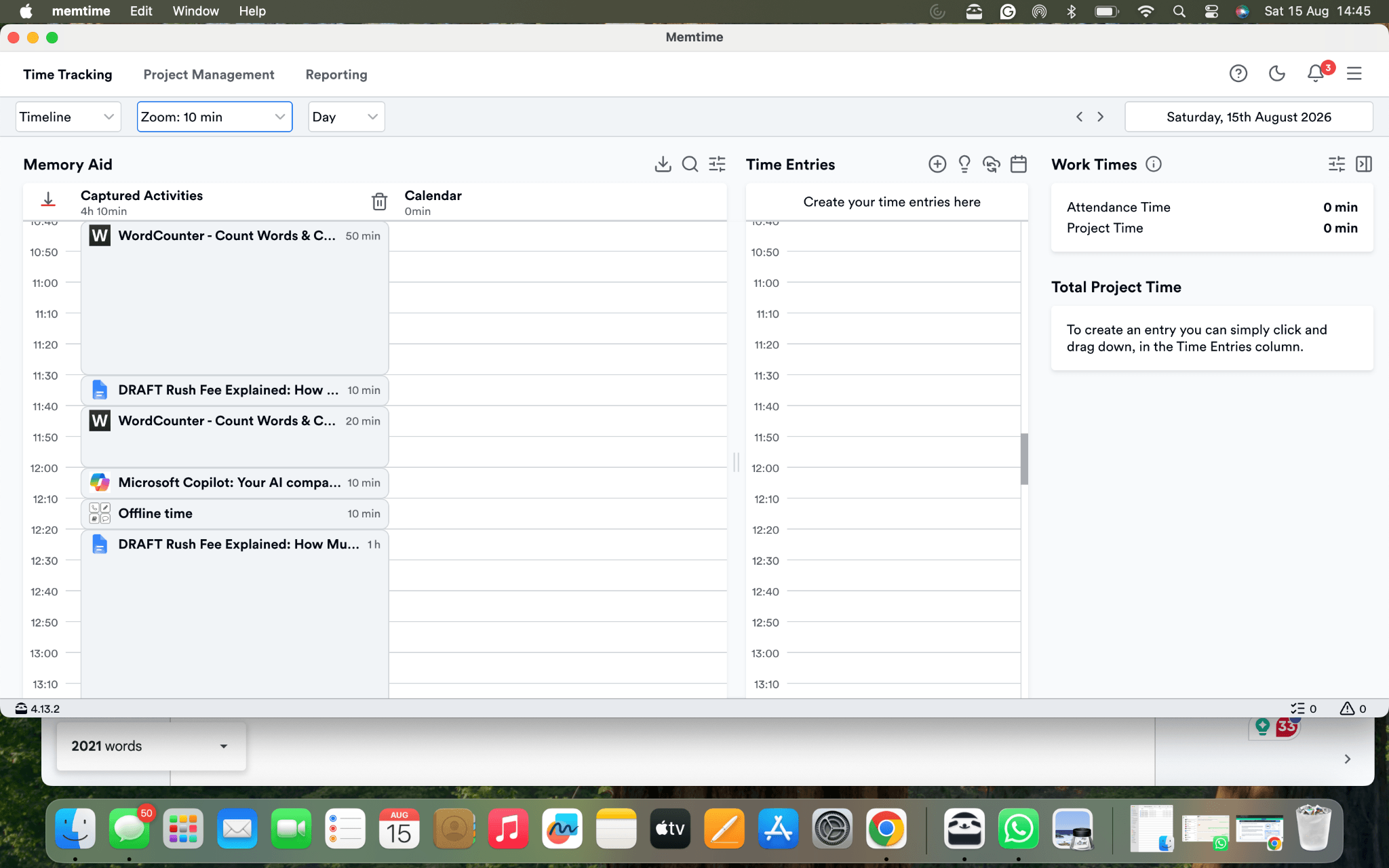
If only there were a way to try this for free to see how it can positively impact your process over a decent time period – let’s say a 14 day free trial on us?
FAQs
How do rush fees affect client expectations?
Rush fees tend to reset expectations about communication and responsiveness. When a client wants faster delivery, you can assume that the feedback loops will be shorter and decisions will need to be made more quickly. That’s the kind of thing to avoid delays that eat away at the urgency they’re paying for.
How do I know if my rush fee is too low?
A rush fee is too low if urgent projects consistently feel unprofitable, require evening or weekend work that isn’t priced in, or displace other paid commitments without compensating for that opportunity cost. If your fee only covers extra hours rather than the wider operational disruption, it’s almost certainly underpriced.
Do rush fees apply to retainers and/or ongoing contracts?
Yes. Retainer clients should still incur a rush fee if their request infringes on your schedule. Retainers include availability, not guaranteed acceleration. So urgent work that requires you to reshuffle your schedule, or deprioritize other key commitments, should be billed at a premium.
Should rush fees differ for repeat offenders?
If a client continues to make last minute requests, you could consider increasing the urgency factor or establish a standing premium. This constant disruption has a cumulative cost to your operations, and raising the fee helps you to protect your margins and promote more predictable planning.

Sheena McGinley
Sheena McGinley is a columnist and features writer for the Irish press since 2008. She’s also a business owner that is conscious of how time tracking can foster progress. She wrote for SaaS companies and businesses that specialize in revenue optimization by implementing processes. She has the unique ability to digest complex topics and make them easy to understand. She shares this precious skill with Memtime readers. When she's not making words work for people, Sheena can be found taking (very) brisk dips in the Irish Sea.