Recall Bias at Work: Why Productivity Data Is Often Wrong
Most of us think we have a pretty good handle on how our workdays unfold. But the moment we try to write it down – be it a timesheet, a project update, or a quick recap for leadership – the details tend to become unfortunately fuzzy.
This isn't because we’re inherently careless, but because modern knowledge work is the usual blur of meetings, Slack pings, seemingly incidental client requests, and half‑finished decisions. Our human brains simply can’t replay all of that accurately enough.
This is where recall bias sidles in; while we remember the big things, we tend to minimize the rest of the pesky time confetti that makes up our day. We underestimate the admin work, the interruptions, and overestimate the deep work. And when that happens, productivity and time tracking accuracy start to lag – dragging estimates, planning, and profitability decisions with them.
Understanding recall bias explains why so much “data” about work doesn’t actually reflect the work itself. So, join us as we learn how recall bias presents itself, how it distorts the data teams rely on, and what you can do to make your productivity insights far more accurate!
Recall bias meaning in modern knowledge work

Recall bias means that when people try to remember their workday, their brains quietly compress and regurgitate it differently. In modern knowledge work, this distortion is amplified by the sheer fragmentation of the day – online and in-person meetings, email threads, micro‑requests, and the resulting context switching.
By the time you sit down to recall the order of how things unfurled, the messy, nonlinear flow of work gets replaced with an inevitably shorter, often cleaner narrative that feels true but isn’t complete.
That’s why recall bias shows up so forcefully in everyday operations in the following ways…
- Timesheets: People forget micro‑tasks, admin work, and small client requests that really snaffle up your time.
- Productivity conflabs: Memory overweights deep work, underweights interruptions, and self‑reports are unreliable.
- Project estimation: Optimistic estimates and scope creep occur due to misremembered task durations.
- Workload planning: A lack of data indicating effort can result in managers inadvertently overloading teams.
- Profitability analysis: Unreported effort results in hidden overtime and margin leaks.
- Client billing: Lost client interactions lead to fewer billable hours and (worse) errors in billing.
Like I've said many times before, this isn't laziness or dishonesty on anyone's behalf – it's merely how human memory reconstructs complicated days.
How recall bias at work distorts productivity data

As soon as you unintentionally waft into the realm of recall bias, the numbers that organizations rely on start to drift in ways that seem subtle but can have real implications. Most teams think their productivity data is representative of actual effort, but if most of it is reconstructed from memory (which is a poor historian), your precious data will wind up reflecting how the day felt, not what actually happened.
Let’s talk real-life recall bias examples
Recall bias shows up in tasks that feel too quick, too informal, or too small and insignificant to matter. But that doesn't mean they don't siphon your time. Quite on the contrary, these seemingly inconsequential moments quietly disappear when someone later tries to reconstruct their day.
Let's have a look at just a few everyday examples that will feel familiar to you:
- Quick approvals: Giving what feels like a quick affirmative thumbs‑up on a document or design takes actual time, but is often forgotten because it's a frictionless moment.
- Micro‑edits: Jumping in to “fix a sentence” or adjust formatting for a colleague is remembered as seconds, not the 5–10 minutes it actually took.
- Context resets: Shifting from a strategic task to a people‑management issue and back again drains focus, yet the mental reset time rarely gets recalled.
- Small client nudges: Answering a quick question from a client or sending a status update is a small thing and is soon forgotten when it comes to totting up your timesheet.
- Internal follow-ups: Minutes spent chasing down a dependency, checking in on a deliverable, or clarifying a requirement rarely make it into your time logs.
- Resource searching: “Just looking something up” is how searching for the right link, file, or reference is described, so – yet again – it’s unaccounted for.
- Handovers: Preparing a quick update for someone else, or handing off a task, takes longer than people think. Why? Because admin tasks always take longer than you expect and never seem important enough to log.
So, how do you actually reduce recall bias?

When teams rely on reconstructed memory rather than real activity, the impact shows up everywhere. While the gaps seem small in isolation, together they create a distorted picture of how work occurred in actuality.
Here’s a little breakdown of how recall bias can impact operations:
- Inaccurate productivity data: The summaries and reports people rely on seem solid, but they’re built on only part of the day.
- Poor estimates: Past projects appear simpler than they were, so future timelines are set on these more optimistic assumptions.
- Hidden overtime: People work longer than they report, making workloads look manageable when they aren’t – at least for a sustainable amount of time.
- Scope creep: Small additions and micro‑tasks slip through the cracks, expanding projects without anyone noticing the extra effort.
- Profitability leaks: Unlogged work becomes unbilled work, quietly eroding your margins.
- Overloaded teams: Capacity planning becomes guesswork when the underlying data is incomplete.
- Flawed management decisions: Leaders wind up making calls based on incomplete information, not the real complexity of the work.
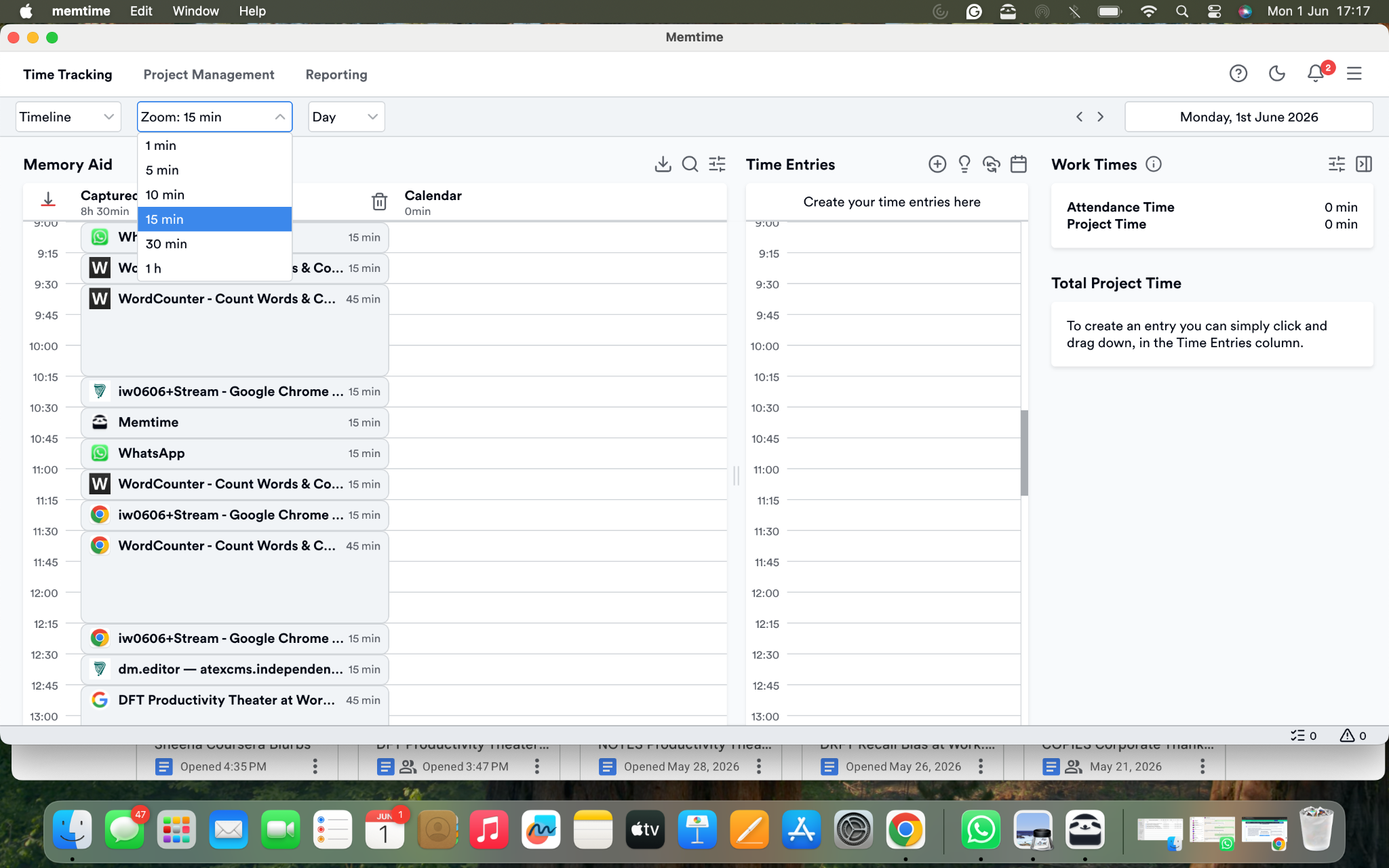
The moment your computer is switched on, Memtime’s memory aid automatically starts beavering away, doing what it does best – building a record of your day with zero input required by you. It notes which apps you’re using, the documents you open, the browser tabs you work in, plus the meetings or calls you join.
All of that activity is organized into a simple, chronological timeline – shown in 1-minute to 60‑minute blocks of time – so you can see your entire workday in a time increment of your choice, just like that:
In the end, Memtime holds a mirror up to reality. Armed with this clarity, organizations can plan better, protect capacity, price work fairly, and finally move beyond the guesswork that recall bias has normalized.
So, do yourself and your margins a favor, give Memtime a whirl for free for two whole weeks. No need to thank us, it’s our job 🤓.
FAQs
Why does recall bias hit knowledge workers harder?
Knowledge work is especially prone to distorted recall. Why? Because the constant switching between tools, tasks, and communication channels creates more “micro-moments” than the brain can retain.
What signs indicate a team is experiencing recall bias?
Repeated underestimations, unexplained overtime, mismatched workloads, and projects that quietly expand are just some of the indicators of memory-based reporting rather than the issue being purely operational in nature.
Can recall bias affect non‑billable work, too?
It sure can! Internal tasks like mentoring, planning, documentation, and coordination are the first to go out the memory window. Naturally, this skews how organizations understand true capacity.
What’s the simplest way to reduce recall bias without changing workflows?
Real activity data, not memory-based reporting, gives teams a more rounded picture of their day, without changing their behavior or – most importantly – having to do more additional admin.

Sheena McGinley
Sheena McGinley is a columnist and features writer for the Irish press since 2008. She’s also a business owner that is conscious of how time tracking can foster progress. She wrote for SaaS companies and businesses that specialize in revenue optimization by implementing processes. She has the unique ability to digest complex topics and make them easy to understand. She shares this precious skill with Memtime readers. When she's not making words work for people, Sheena can be found taking (very) brisk dips in the Irish Sea.