Irregular Work Schedules and the Hidden Cost of Productivity and Profit

September 2018. That's when my irregular work schedule became my reality. Partially through necessity, given the perennial plate-spinning pursuit of parenting.
For many of you reading, irregular work schedules are the norm, be it chosen for flexibility or driven by job demands. If you're an inadvertent or willing participant in an unpredictable work schedule, this article will examine the often-overlooked effects of working erratic hours and explain why they are more significant than most people realize. If left unchecked over time, your irregular hours can systematically gnaw away at your:
- Earning potential
- Health and wellness
- Long-term efficiency
So join us, as we look at the hallmarks of an irregular schedule, the long-term consequences, alongside practical tips to help you protect your time while navigating a work pattern that doesn’t fit the nine‑to‑five trad-life.
Key Takeaways
- Work schedule irregularities can take many different forms. One thing unites all of them, from night shifts to dispersed freelance hours: a lack of predictable structure that makes routines more difficult to maintain.
- Long before symptoms of burnout appear, unpredictable hours subtly undermine wellbeing by influencing sleep, mood, focus, and general stability.
- Because their workday frequently lacks natural boundaries, freelancers are particularly susceptible to losing track of time, underbilling, and having trouble shutting off.
- Flexible systems, not strict routines, are needed to manage varying hours. Short-term planning and externalizing administration are examples of small anchors that help regain control.
- By automatically recording work sessions, revealing true productivity patterns, and ensuring accurate billing, time tracking software such as Memtime relieves the mental strain of erratic schedules.

What is an irregular work schedule?
It basically refers to anything considered irregular or inconsistent in nature, which includes any pattern of hours that deviates from the regular Monday through Friday workweek. What does it look like? It can include night shifts, compressed weeks, on-call availability, rotating shifts, split shifts, or, more precisely, hours that vary from day to day.
In my case, my working week commences "Whenever I've not got one of my kids swinging out of me." As for what that looks like? It’s snaffling a few hours early in the morning, maybe a couple more in the afternoon, with the bulk of my hours happening after 9pm at night. Essentially, I can work whenever everyone has gone to bed, and that doesn’t always go to plan.
What do all forms of inconsistent work have in common? Yup, a glaring lack of consistency. Maintaining routines, scheduling personal obligations, and establishing a sense of stability in your week are made all the more tricky when your work hours change frequently.
While some people appreciate this flexibility or the variety an irregular schedule can bring to their week, others find the unpredictability draining, particularly over time. The first step to controlling its effects, establishing boundaries, and safeguarding your well-being while still fulfilling the fluctuating demands of your position is knowing what constitutes an irregular schedule. This brings us seamlessly to…
The hallmarks of an unpredictable work schedule
First up, it’s worth noting what industry you work in. You’ll find erratic schedules largely in sectors where demand varies, such as hospitality, retail, healthcare, logistics, and the creative or *ahems* freelance industries.
While the vast majority of the aforementioned industries will operate on having predictably unpredictable shifts, they are essentially a set pattern of hours via a roster. Creatives and/or freelancers, on the other hand, will experience more undefined hours.
If you’re a freelancer working an irregular schedule, you’re typically finding it hard to…
- Remember work sessions: Especially meetings that either ran short or ran over the allocated time
- Track time in general: Do you have a concrete idea of where the majority of your time actually fritters away to
- Account for your work: As a result, you’re under-invoicing
- Ever switch off properly: Nevermind schedule a vacation or anything resembling downtime
In short, without a clear view of your real workday, it’s way too easy to misjudge your productivity and capacity.
Consequences of irregular work scheduling
OK, so we’ve established that non-standard hours can be a source of freedom, but they also present difficulties that incrementally mount up. Latent fatigue, disrupted routines, and ongoing adjustment demands can lead to burnout. That’s the worst-case scenario, obviously, and it may seem overly dramatic to say, but burnout is a gradual build that can present itself in various ways.

Long before you feel completely spent, the effects of inconsistent scheduling begin to take hold. Rather than as a single, abrupt tipping point, the strain tends to show up as a seemingly incidental yet detrimental drip, drip, drip that progressively impairs your ability to function normally,
For example, you may observe changes in your energy, focus, or mood long prior to what you might consider “burnout.” These early warning signs are significant because they frequently serve as the first clues that your current routine is no longer helping you.
For many, the effects manifest as patterns such as:
- Disrupted biological rhythms: Irregular hours interfere with your circadian cycle, making it harder for your body to regulate sleep, appetite, and alertness.
- Emotional instability: This ranges from agitation to impromptu outbursts to an unusual sense of overwhelm – particularly when you wake up in the morning (assuming you slept through the night)
- Diminished mental clarity: You will need to do more work to complete tasks that used to seem far easier
- Costly errors: Similarly, erratic routines and resulting fatigue increase the likelihood of rework and corrections
- Unpredictable productivity: Output becomes inconsistent because your energy levels and focus fluctuate from day to day.
- Earning potential impact: Your irregular schedule is making it difficult to plan ahead or take on more, higher-value work.
- Overriding opportunity cost: The time lost that you could have spent pursuing higher-paying projects, client pitches, or skill development.
How to manage varied work hours
Accepting that your schedule won't follow a conventional pattern is the first step in managing varied work hours. As such, your systems shouldn't either. The objective is to create adaptable habits that will help you no matter when work comes up, rather than enforcing a strict framework.
A few minor anchors, like the bullets below, can have a significant impact.
- Regardless of when it occurs, a specific "focus window" is a brief period of protected time when you minimize distractions.
- A predictable pre‑work warm‑up, such as five minutes of planning or tidying your workspace, to signal the start of focused effort.
- Consistent eating habits that support energy stability.
- A quick reflection habit, noting what worked and what didn’t (Memtime can bring clarity here), so you can adjust your routine based on real patterns.
- Short, deliberate recovery periods as opposed to waiting for the "ideal" moment (they never come).
- A simple end‑of‑day shutdown ritual, helping your brain register that work is finished even if the clock says otherwise.
Externalizing as much as possible is another crucial strategy. When your hours fluctuate, your memory can become unreliable, and those pesky but necessary admin tasks become harder to track. Offloading the details allows the work itself to take up more mental space.
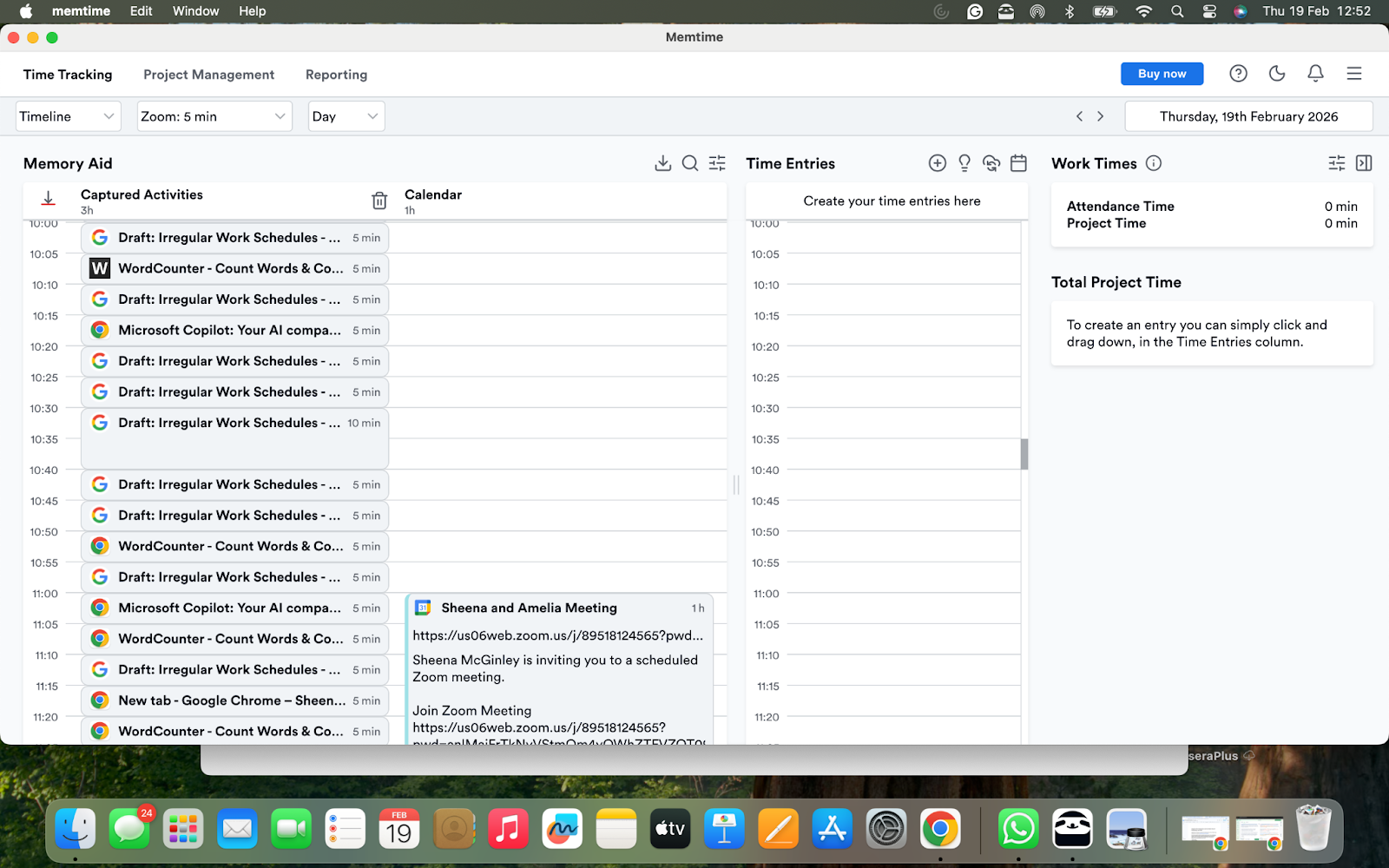
Time tracking software like Memtime is particularly helpful in this situation. Memtime benefits those with erratic schedules by:
- Automatically recording work sessions to ensure that nothing is overlooked or forgotten.
- Ensuring accurate invoicing, even in cases where work is completed at irregular or disjointed times.
- Exposing individual patterns of energy and productivity, which enables you to more deliberately plan your day when you have flexibility.
Wrapping up
Unpredictable schedules can affect your decision-making and ability to stay motivated and focused. Then, you’re on a fast track to strain on your sleep, your personal time, and your bottom line. The real challenge is staying sane, productive, and profitable while working in a non-standard way.
Memtime captures every minute of your work, regardless of when or how it happens. That means no more relying on memory, no more guessing at billable hours, and no more scrambling to reconstruct your week after the fact. It quietly builds a complete, accurate timeline of your day, so you can see exactly how your time was spent and invoice with confidence.
For anyone juggling irregular hours, that level of clarity is transformative – it removes the mental load, restores control, and helps you make smarter decisions about how and when you work.
As a reminder of how it rocks, Memtime:
- It runs quietly in the background while you work, so you don’t have to do anything.
- Builds an accurate, moment‑by‑moment record of the workday, giving you a factual account of what happened instead of relying on memory or guesswork.
- Exposes the real effort behind deliverables by surfacing the tiny tasks, context switches, and interruptions that usually tend to slip through.
- Provides a single, reliable dataset for all time‑related decisions, supporting clearer capacity planning, more grounded forecasting, and billing that reflects your true workload.
So, if you’re ready to simplify your workflow and finally get a handle on your schedule without feeling like you're on an endless treadmill, you can sign up for Memtime and start your no-hassle 14-day free trial:
FAQs
What makes irregular work hours hard to manage?
It becomes challenging to preserve routines, safeguard personal time, or keep track of what you've actually accomplished because – guess what – the timing keeps changing. Sleep, concentration, and your ability to unwind are all impacted by this unpredictability, which makes the entire schedule seem more taxing than it actually is.
Why do inconsistent work hours feel so draining?
Your internal rhythms struggle to stabilize when your sleep, eating, and working schedules are constantly changing. This impacts your mood, energy, and cognitive function.
How do irregular schedules affect freelancers differently?
Unlike shift-based industries, freelancers frequently do not have a rostered structure. It can be challenging to keep track of time, accurately invoice, or completely shut down when their hours are dispersed across early mornings, late nights, and erratic gaps.
What are the early signs that an irregular schedule is becoming unhealthy?
Usually, subtle issues are the first flags to show up, such as difficulty focusing, irritability, sleep disturbances, irregular output, or feeling overburdened by tasks that were previously manageable.
How can tools like Memtime help manage unpredictable hours?
Memtime automatically logs your computer activities so you can see exactly what you worked on and when. This helps you stay in control even when your schedule isn't consistent, avoid missing billable hours, and understand your true productivity patterns.

Sheena McGinley
Sheena McGinley is a columnist and features writer for the Irish press since 2008. She’s also a business owner that is conscious of how time tracking can foster progress. She wrote for SaaS companies and businesses that specialize in revenue optimization by implementing processes. She has the unique ability to digest complex topics and make them easy to understand. She shares this precious skill with Memtime readers. When she's not making words work for people, Sheena can be found taking (very) brisk dips in the Irish Sea.