Working From Home With Kids: How to Stay Productive (And Sane)
That lone soldier, sourcing snacks pre-Zoom meeting. That one foot, cramping in its relentless rocking of a bouncy chair to calm a screaming infant as a deadline looms. That red-eyed warrior, fresh from the parental trenches, as their child vommed throughout the night. Indeed, let me unfurl my credentials in the “working from home with kids” space. Context matters, and mine looks a bit like the below:
I was one of the parents chortling (read: cackling) when the world went remote in spring 2020. By then, I’d been working from home with my two toddlers since 2018, so when schools and offices shut down, my reaction was along the lines of: “Welcome to the hellscape, BAAAHAAHAAHAA!” There was, however, a camaraderie in the collective chaos.
I’ll be honest, before lockdown, I experienced a huge level of abject isolation looking after my babies. In Ireland, where I live, the 2019 Parents’ Leave and Benefit Act hadn’t been introduced, so support networks were thin, beyond you as a mother. So, without grandparents to lean on and with childcare costs higher than my salary, I left my in‑house writing job and went freelance. Here's a brief rundown of my findings over the years:
- More hours, less money, and a toll on my mental health followed.
- Things are easier now that my kids can communicate, although school holidays and sick days still bring chaos.
- Even with older kids, the cognitive slog of juggling work and parenting remains relentless.
The upside is that over time, I’ve cobbled together survival strategies – which I’m currently employing as my eldest has been home for the last week with COVID, and her sister now has a stomach bug (that’s the thing with kids, they love tag-teaming illnesses).
As such, I’m hoping these tips are especially useful for freelancers heading into the holidays, when time management with kids becomes its own special challenge.
Key takeaways
- Constant interruptions, shifting between tasks, guilt, lack of workspace, and unpredictable schedules make remote work with kids uniquely draining.
- Working early mornings or late nights, fluid routines, meeting kits, and “Micro Bursts” can help parents balance deadlines with childcare.
- Lots of humour, micro-meditation, short breaks, and accepting "good enough" over perfection are all effective ways to manage stress.
- Automatic tracking eases fragmented days, records work through interruptions, and shows balance between childcare and tasks – helping parents plan, avoid burnout, and stay productive.

What are the biggest challenges of working at home with children?
It might be easier to chronicle what isn’t challenging about working at home with children; almost everything seems to be a tug-of-war between your fledglings and your job. One minute you’re trying to finish a sentence in an email, the next you’re wiping up spilled juice or breaking up a kerfuffle over Lego. For the majority of parents who attempt to work and care for children in the same space, this constant gear-shifting is beyond draining.
The trickiest elements typically fit into a few familiar scenarios:
Unplanned disruptions
Children tend not to give two figs about deadlines. In fact, they’re innately primed to thwart them. They want snacks, attention, or help with homework with an unmatched sense of urgency, and that means your focus is constantly broken.
Time vacuums
You find yourself working all the available hours to compensate for the hours spent on childcare.
The guilt factor
You feel guilty when you’re not giving enough to work, and guilty again when you’re not giving enough to your kids. It's the old-fashioned "damned if you do, damned if you don't" situation.
No defined workspace
Not all people have a home office. I do, as it happens, but my husband tends to bunker down there whenever he works from home, as he needs to take calls. Therefore, trying to concentrate at the kitchen table while kids orbit around you is a recipe for frustration.
The sheer unpredictability of it all
Illnesses, sporadic teacher training days, protracted school holidays, or sudden meltdowns can derail even the best‑laid plans.
Naming those challenges is the first step toward finding ways to make the juggle feel a little less fraught.
Is it possible to work from home with toddlers?
Yes, but it’s haaaaaaarrrrrrd. You can essentially keep babies in one spot, mitigating messes accordingly. Toddlers, however, become mobile poo-bombs. They also want to knock their heads off every known surface in your kitchen. They're nimble, inquisitive/nosy, and determined to push every single boundary you attempt to set. Working from home with them isn’t about balance – it’s about the ability to improvise – on little to no sleep.
Now that I'm beyond that fog and have the ability for hindsight, it's worth remembering that what makes toddlers uniquely tricky is less about the broad challenges of parenting and more about the stage they’re in. After all, they are:
- Escape artists: Baby gates, playpens, and “safe zones” only work until they figure out how to climb, squeeze, or topple their way out.
- Sensory explorers: Every object is something to taste, throw, or dismantle, which means constant vigilance while you’re trying to focus.
- Demand participation: Unlike older kids who can (in theory) entertain themselves, toddlers want your undivided attention. If you’re not clapping along to their song, there’s hell to pay.
- Thrive on routine but resist it: Nap schedules and snack times help, but toddlers are notorious for suddenly refusing the very structure you rely on.
So, is it possible to work alongside toddlers? Yes – but only if you accept that “work” will be fragmented, mere shards of the output you were once capable of. Often, this productivity will happen during naps or after bedtime.

As my sister once told me, "The days might be long, but the years are short", so it's important to (dare I say) enjoy even glimmers of these moments if you can. Truth be told, I hated it, but I can look back knowing I tried my best.
What are the best tips for working remotely with children?
Get childcare. Only (half) joking. Seriously, though, there was a time when I could afford one day of childcare a week, and it was GLORIOUS. I knew that for that one day, I could sit in my local cafe and barrel through all the work that had gone by the wayside or put on the back burner.
While I have you, it’s worth highlighting the plus sides and downsides of the two main forms of childcare. For instance:
- On-site childcare: Great for consistency, but you’re kind of snookered if your childminder is unwell and unable to come that day.
- Off-site childcare: The inverse is true here; my first child was always too sick from going to creche to actually attend creche. Plus, it’s usually more expensive.
Either way, there are stints where your child will be unwell, and you need to don the mantle of primary caregiver despite work commitments. This is when you need all the “tips” going. After all, when childcare falls through for whatever reason, you’re left juggling deadlines and constant demands, so survival depends on systems tailored to your setup.
Consider the following tried and tested tips for working remotely with children:
1. Early morning/late night hours
Not glamorous, or good for downtime in the long run, but often the only way to get uninterrupted focus. Many parents carve out an hour before the household wakes or after bedtime to tackle bigger projects. An 80-hour week is doable, if only in the short term.
2. Create a fluid routine
Kids thrive on predictability. Snack times, play times, and screen times can be scheduled to give you breathing room, but build in a buffer. Why? Well, so if something doesn't happen at the EXACT time, a meltdown doesn’t ensue.
3. Nap windows
No faffing about with emails or laundry – this is deep‑work time. If your kids are older, like mine, and nap times are nothing but a (very) fond memory, you could instead swap out a movie. Needs must.
4. Have a “meeting kit”
Let's face it, you can't park your child in front of the TV/device for hours on end, so you should revert to other, more traditional methods of distraction. As such, keep a stash of quiet toys/puzzles, snacks, or a special activity box that only comes out when you need to jump on an unexpected call.
5. Lower your bar
Some days you’ll only get the essentials done, and that’s fine. Survival counts as productivity when kids are home.
Introducing Micro Bursts: Your 15-minute friend
In addition to the above five tips, you might also consider this methodology I devised purely from necessity:, I like to call it (the title might have given it away) a “Micro Burst.”

Unlike getting a fair wedge of work done during their naptime, a Micro Burst is akin to the Pomodoro Technique (25-minute stints of time and then a break), but it’s around half that time and revolves around having a small, unpredictable drunk barrelling around your workspace.
It will, of course, depend on the child, but I find my two lose interest in something after 15 minutes. It was true when they were babies, and it’s still true as tweens. As such, I employed the following rotation of micro blocks of time over the course of an hour, which you can amend for your needs (this is just an example).
1. First 15 mins: Book Burst.
Be it a picture book, colouring book, activity book, puzzle book, or that copy of The Hunger Games they’ve been wanting to get their mitts on but continuously told “You’re too young to read”, you should get 15 minutes to yourself. Once they lose interest, remove the book until next time so they don’t get bored of it.
2. Second 15 mins: Break Burst.
Depending on how the first 15 minutes went, or if you have a call scheduled, you might want to introduce your 15-minute break block after the first stint and give your child your undivided attention. During this time, you can do a range of things depending on their age, like:
- Read/talk to them
- Make a fruit smoothie or a tea together
- Listen to them and their worries (my 9-year-old often has drama she needs to unpack from the school yard.)
- Bring them outside for a bit to play ball, do an obstacle course, observe nature/touch grass
- Go for a quick walk around the block
- Bang on the tunes loud and DANCE!
3. Third 15 mins: Build Burst.
Be it a pillow fort, LEGO, arbitrary block tower, Jenga, Minecraft, the books from Book Burst, or some other safe feat of engineering, the object here is to create something within the time frame – you’ve given them an independent challenge.
4. Fourth 15 mins: Brain/Bubble Burst.
Depending on the age, you can either opt for another independent challenge, such as a card matching/memory game, or just whack on the bubble machine (highlight recommend) or give them a bubble wand (if they’re older and not prone to tipping the fluid everywhere) for 15 minutes and let them tucker themselves out. For bubbles, outside is best, or a carpeted area, otherwise they’ll be sliding all over the joint, the results of which could be very counterproductive.
And, dear reader, that’s an hour done and dusted. For context, it doesn’t have to be fancy, it just has to be safe. For instance, my youngest used to love tearing through the cardboard recycling bin for hidden treasures (that were never there but it was something to do). Whatever works in the moment.
How can you manage stress while working from home with children
Roblox. Again, joking. But the truth is, managing stress in this setup requires equal parts humour and strategy. Although you can't stop the chaos, you can lessen its effects. As such, build small rituals into your day: a five‑minute stretching session between calls, mini-guided meditations, or a screaming pillow while the kids watch a cartoon.
How Memtime can help
When you feel entirely on your todd, it helps to have something working in the background that will make life easier for you. I’ve said it before and will reiterate it now; Memtime can be your silent accountability partner in these stressful times.
It’s particularly beneficial for WFH parents because it removes the burden of manual time tracking, gives visibility into fragmented workdays, and helps you to get things done without dropping the ball at home.
For instance, it:
- Works during interruptions: If your child needs attention, you can step away without worrying about pausing a timer. Memtime keeps tracking automatically. In fact, Memtime eliminates the need to remember or reconstruct your day, saving up to 0.5 days per week compared to manual time tracking.
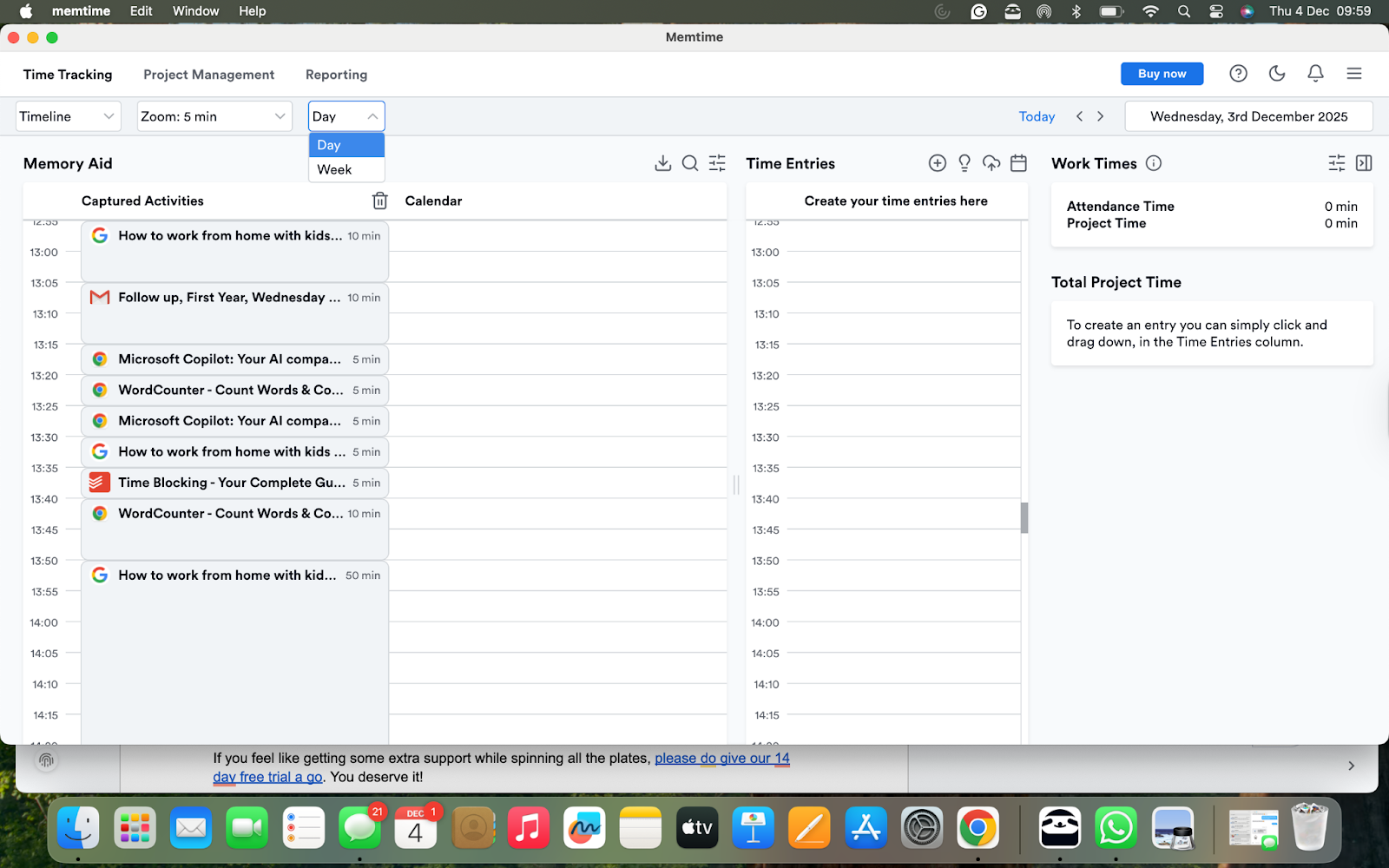
- Provides end‑of‑day review: Helps you spot helpful patterns, like when kids’ nap times align with your most productive work.
- Helps bring work‑life balance: By showing exactly how much time went to work vs. childcare, you can plan better and avoid burnout.
If you feel like getting some extra support while spinning all the plates, please do give our 14 day free trial a go. You deserve it!
FAQs
How can parents create a routine when working from home with children?
While buffers prevent meltdowns, a flexible schedule with snack, play, and screen times gives kids predictability.
What special challenges do toddlers present when working from home?
Toddlers are mobile, curious, and demand constant participation. Unlike babies who stay put, toddlers climb, dismantle, and resist routines, making focus nearly impossible without improvisation.
Why is guilt such a common challenge for parents working remotely?
Parents often feel torn between professional and family responsibilities. When work suffers, guilt sets in; when kids get less attention, guilt returns. The double bind is emotionally draining.
How can tools like Memtime support parents juggling work and childcare?
Memtime automatically keeps track of time, even when there are disruptions. Without the hassle of manual tracking, it helps parents see how their days are divided, identify productivity trends, and make better plans.

Sheena McGinley
Sheena McGinley is a columnist and features writer for the Irish press since 2008. She’s also a business owner that is conscious of how time tracking can foster progress. She wrote for SaaS companies and businesses that specialize in revenue optimization by implementing processes. She has the unique ability to digest complex topics and make them easy to understand. She shares this precious skill with Memtime readers. When she's not making words work for people, Sheena can be found taking (very) brisk dips in the Irish Sea.