How to Run a Successful Daily Debrief Based on Your Real Workday

A daily debrief only works when it mirrors the real shape of your workday, not the version of events you remember at 5 p.m. (because that's when we all stop working, am I right?!)
Unfortunately, however, memory is a notoriously poor narrator. It tends to tie a scattered day into a neat bow, forgetting the interruptions, handoffs, delays, and support work that quietly shape execution. That’s why most debriefs drift toward narrative instead of insight.
To make a debrief useful, it needs concrete examples of real activity, not reconstructed half-truths, and key questions designed to surface key signals highlighting what changed, or blocked your progress, alongside what needed reworking, and what unexpectedly consumed waaaay more time than expected.
When a debrief starts from an accurate activity timeline rather than a task list, it becomes a reliable tool for improving your focus, planning, and delivery. So, let's address the core problem behind ineffective debriefs, clarify what a daily debrief is meant to capture, and how to ground it in real activity rather than recollection.
Key Takeaways
- Daily debriefs are only effective when they document the actual sequence of your day, not the polished variation your brain wants to reconstruct when it’s home time.
- Effective debriefs rely on specific activity‑based questions that highlight what stalled, what required rework, and what unexpectedly expanded, rather than generic task‑completion check-ins.
- A timeline‑driven daily debrief template produces more accurate operational data, helping teams see progress, blockers, context switches, and hidden effort with more clarity.
- Accurate timelines improve planning, estimation, and workload decisions, especially when supported by tools that automatically capture real activity instead of relying on your memory.
Daily debrief meaning
The purpose of a daily debrief is pretty straightforward: document the actual events so that teams can see where time went, what ticked along nicely, what stalled entirely, and what unexpected turn of events diverted attention. Fundamentally, it's a fast way of shedding light on the day.
A decent debrief should outline the work as it happened rather than depending on end-of-day impressions, ensuring that patterns, pressure points, and emerging issues are not overlooked. It helps teams better understand how their time is being spent and what their environment requires of them.
When carried out regularly (and correctly), it serves as a stable benchmark for improved planning and more reasonable expectations.

Why memory alone can distort daily debriefs
Memory tends to be rose tinted. As such, left to its own devices, it can steer a daily debrief off course simply because we don’t mentally store our day in the order it happened. Instead, we remember what felt important (highlights, points of friction, etc), not what actually consumed time – those being the myriad of small shifts that actually shaped the day and thus our work.
Daily debrief questions that reveal real work
You don’t have to trek up a mountain at sunrise to ponder life, the universe, and everything to devise the necessary questions that are the key to revealing your actual work day. Simplicity is your key.

Pulling your focus back to the specific moments that shaped the day – especially the ones that are rarely documented – is the first step in a good daily debrief. In light of that, depending on what happened, consider these 10 useful questions to ask yourself as you reflect on your day:
- What did you do initially, and what immediately altered your plan?
- Which tasks involved unforeseen back-and-forth, clarification, or coordination?
- Where did you have to wait for decisions, tools, people, or information?
- How frequently did your flow get disrupted by context changes or other interruptions?
- Which pieces of work moved as a result of your direct action, and which did so because you were unblocked by someone else?
- What tasks that weren't on your list this morning (requests, fixes, or "quick help" tangents) arose out of nowhere?
- What caused it to balloon, and why did it take longer than necessary?
- Which handoffs took place today, and did any of them stall?
- What did you review, revise, or fix?
- What kind of support work did you perform that the system doesn't currently record?
Daily debrief template sample
Again, much like the debrief questions, daily debrief template can sound more convoluted than it needs to be. As you can see, it’s actually incredibly straightforward now that you’re armed with your debrief questions – assuming you have clarity surrounding what happened throughout your day, that is.
Your super easy daily debrief template:
The most dependable template reflects the chronology of your day. A template is only effective when it accurately depicts the flow of actual work, not an idealized task list. You can produce reliable time tracking data that enhances estimation, workload decisions, and future planning by grounding your responses in tangible activity rather than memory shortcuts.
How accurate timelines improve daily debrief accuracy
Daily debriefs are meant to capture what actually happened in an increasingly fragmented workday (impromptu meetings and All. The. Slack. Pings…), but because memory compresses and therefore simplifies the day, invisible coordination and support work (interruptions, waiting time, handoffs, rework, and follow‑ups) often disappear, and the debrief becomes a narrative rather than operational data.
This loss of execution signals produces poor debrief data and leads to bad decisions about workload, delivery, and estimation, which is why a useful daily debrief should start from an activity timeline rather than a task list.
You’ll never guess what I’m going to say next… Memtime automatically captures all computer activity throughout the day, reconstructs the real workday and removes any rose-tinted memory issues from the debrief process. It lets teams and individuals base their daily debriefs on actual activity data instead of loose narratives.
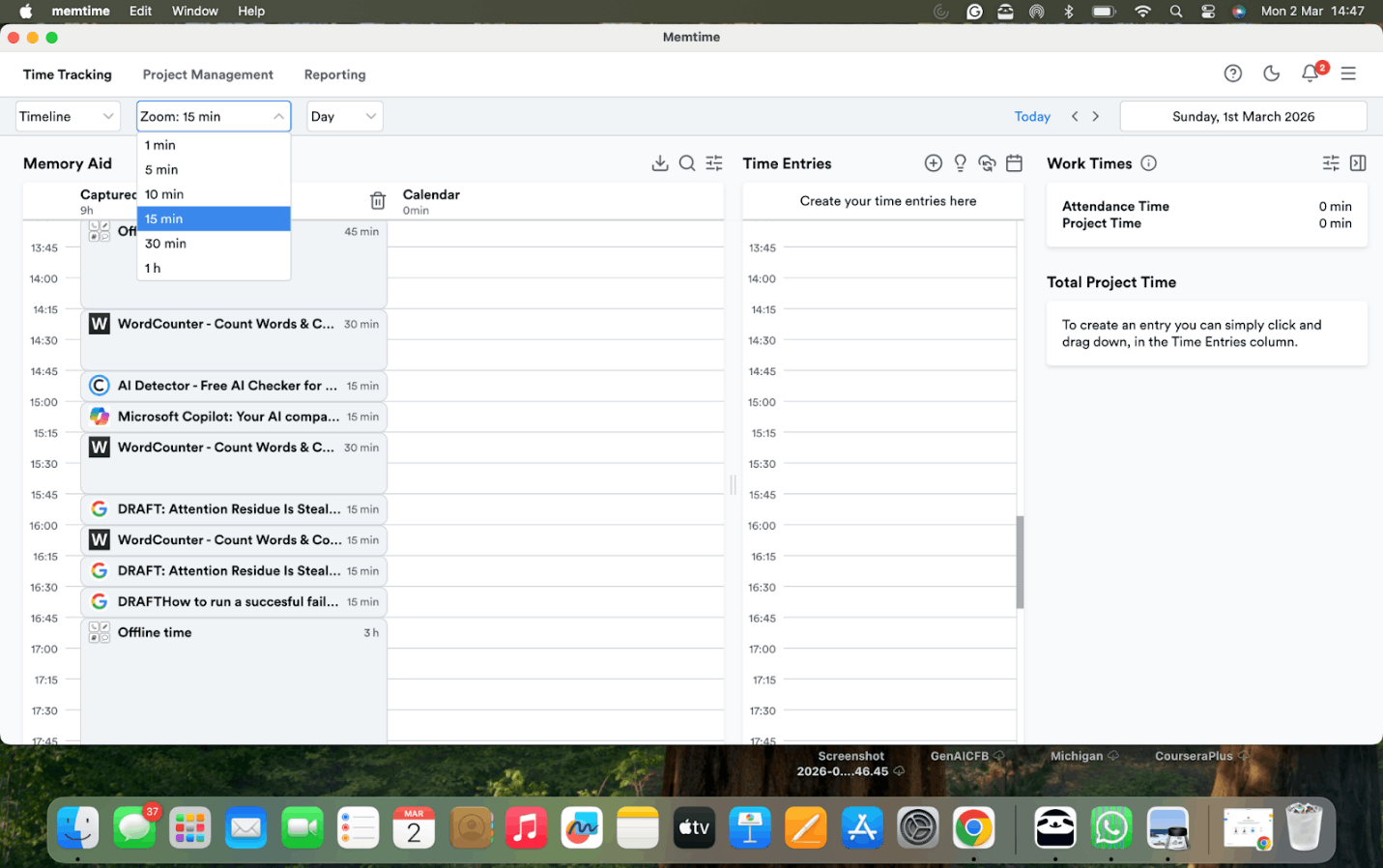
Consider Memtime your powerful partner helping you to make clearer decisions, protect your time, and keeping attention on the work that actually moves the needle. Try it for yourself with our 14‑day free trial and see how it can streamline your debrief sessions.
FAQs
What makes a daily debrief different from a status update?
A daily debrief focuses on the conditions that shaped the workday – interruptions, delays, context switches, and unexpected tasks – while a status update focuses on outputs. A debrief explains why progress looked the way it did, not just what was completed.
How long should a daily debrief take to complete?
A well‑structured debrief should take only a few minutes because it’s grounded in observable activity rather than memory reconstruction. The goal is quick clarity, not a reflective journal entry.
Who benefits most from accurate daily debriefs?
Anyone working in environments with high context switching, cross‑functional dependencies, or unpredictable requests gains the most – because these teams experience the largest gap between planned work and actual activity.
How does a daily debrief help with long‑term planning?
Consistent debriefs reveal recurring friction points, hidden workload patterns, and systemic delays. Over time, this creates a more realistic baseline for estimating effort, forecasting capacity, and identifying where processes need reinforcement.

Sheena McGinley
Sheena McGinley is a columnist and features writer for the Irish press since 2008. She’s also a business owner that is conscious of how time tracking can foster progress. She wrote for SaaS companies and businesses that specialize in revenue optimization by implementing processes. She has the unique ability to digest complex topics and make them easy to understand. She shares this precious skill with Memtime readers. When she's not making words work for people, Sheena can be found taking (very) brisk dips in the Irish Sea.