How To Overcome Task Paralysis and Move Your Work Forward
If you know that feeling, you know it only too well… From screen staring to mindless scrolling, task paralysis can be a huge time suck and, over time, demoralizing. My task paralysis manifests in rereading the same line of a paragraph (or, when it’s really bad, the same word of a sentence) over and over again.
But what exactly is task paralysis, and why does it happen? Do loads of people experience it, or is it just me? More importantly, how does one get over it – assuming it’s something you can even “get over?”
All these questions and more will be answered in the following blog post, which aims to highlight these frozen moments and why they happen. It's not about pushing harder; rather acknowledging the mental strain and cognitive hurdles that make beginning something seem unachievable – when all we really need is a bit more context.
Key takeaways
- Task paralysis is an involuntary “freeze” that results from cognitive overload rather than procrastination or laziness.
- Executive dysfunction, decision fatigue, fear of making mistakes, emotional strain, task complexity, and environmental distractions are some of the triggers that lead to paralysis.
- It affects both neurotypical and neurodivergent people, particularly those with ADHD, anxiety, or perfectionism, and is more prevalent than most people realize
- Executive dysfunction and ADHD paralysis are similar but distinct; dysfunction reflects a broader issue with prioritizing and planning, whereas paralysis is more of a situational freeze.
- Workplace paralysis frequently takes the form of excessive research, ongoing project revisions, or meticulously prepared meetings that are never shared. In other words, “busyness.”
- Finding patterns is essential; identifying instances in which "activity" conceals a lack of advancement aids in differentiating between overload and disengagement.
- Using tools like Memtime to restore clarity, normalizing struggles, setting realistic priorities, and breaking tasks into smaller steps are all practical ways to break the paralysis.

What is task paralysis?
You come to mid-scroll and have no idea how long you’ve been staring at the screen… You keep switching between tabs, not completing anything, and that’s assuming you’ve been able to start work in the first place…
This feeling of being mentally stuck when faced with a task, making it tricky to embark on even the simplest of endeavors, is known as task paralysis. In contrast to procrastination, which is often seen as a conscious choice to delay something, you can experience task paralysis as an involuntary freeze brought on by overload. In these moments, the brain interprets the task as too difficult or risky, triggering a mental shutdown similar to the body’s fight‑or‑flight response.
As a result, you may find it difficult to set priorities, take the initiative both singularly or in a group setting, or maintain focus. All of this can result in stress and missed deadlines, which then obviously begets more stress.
This is why task paralysis and anxiety often go hand-in-hand, making for rather dysfunctional and extremely frustrating bedfellows.
Is task paralysis common?
In a word, “yes”, task paralysis is common – particularly among those living with diagnosed (and undiagnosed) attention-deficit/hyperactivity disorder (ADHD), anxiety, or just that pervading sense of saturation.
You'll recognize task paralysis as it tends to go beyond mere dilly-dallying, reflecting this freeze response. The bottom line is this: your brain struggles to initiate action – despite knowing that the task still needs doing!
Important prevalence-related factors include...
- Being neurodivergent: Task paralysis is frequently reported among people with ADHD and/or executive dysfunction.
- Other psychological drivers: Anxiety, depression, and perfectionism can hinder progress in this regard.
- Experiencing everyday overwhelm: When confronted with lengthy to-do lists or intricate projects, neurotypical people can also suffer from task paralysis.
- Managing workplace pressures: High-stakes settings with hard deadlines or ambiguous expectations can exacerbate paralysis, making even routine tasks seem intimidating and therefore feel trickier to start.
- Being a young person: This can be a common occurrence in younger populations, especially when schoolwork or group projects feel overwhelming.
To put it briefly, task paralysis is a common occurrence that affects a variety of age and context groups. In addition to promoting useful coping mechanisms, acknowledging its prevalence and the high rates among ADHD populations helps people to perceive it as a surmountable thing, helped by having the right processes and tools in place.
What causes task paralysis?
Now that we know task paralysis affects a range of people, let’s look at the specific factors that cause it.
To clarify, task paralysis occurs when your mental load or emotional strain blocks your ability to begin something. Instead of moving forward, you shift into stasis. It's when your brain perceives a task as overwhelming or more daunting than it perhaps should be.
A range of factors contribute to the onset of this state:
- Executive dysfunction: This is when the typical systems for planning and prioritizing don’t work linearly, leading to struggles with starting or structuring tasks. More on this in the next section.
- Decision overload: Consider this the result of having too many options to choose from or simply not knowing what to do next due to the sheer level of abundance.
- Fear of making mistakes: Having high expectations or worrying about failing can impede progress. I mean, you can’t fail if you never start in the first place, am I right??!! *tumbleweeds*
- Emotional strain: The cognitive energy you need to begin a task is quashed by stress, exhaustion, or low motivation.
- Task complexity: Without a clear structure, large or unclear projects seem unmanageable.
- Environmental triggers: The feeling of being stuck is exacerbated by external distractions and clutter, or a lack of support systems.
When combined, these factors make even easy tasks seem near impossible.
ADHD paralysis vs executive dysfunction vs task paralysis
The ability to plan, organize, regulate one’s emotions, and make decisions is known as executive functioning, and ADHD frequently disrupts it. When these planning processes glitch, people with ADHD may experience what is commonly known as ADHD paralysis or shutdown. In these situations, the inability to decide where to begin or what to do next can completely stop action.

Are ADHD paralysis and executive dysfunction the same thing? No. While related, they’re also distinct. ADHD paralysis is one facet of executive dysfunction – that being this freeze that prevents task initiation or completion – while executive dysfunction itself refers to general challenges in the brain's management system. In other words, paralysis is one of the wider symptoms of executive dysfunction.
While each person's experience is unique, typical indicators of ADHD paralysis include:
- Overanalyzing or ruminating excessively
- Having trouble starting even urgent tasks
- Having trouble setting priorities
- Distractibility and inability to focus
- Inefficient time management (our friend time blindness plays a part here)
- Abrupt changes in mood or emotions
- Inability to make a decision
- Problems with attentive listening
- Quickly switching between tasks
- Losing one's focus
- Lack of clarity or “brain fog”
- Avoiding prolonged effort
Unlike executive dysfunction, task paralysis is situational; it occurs in particular moments — not all the time or across everything you do.
Real-world examples of task paralysis at work
Task paralysis shows up in different ways, depending on the role. Broadly speaking, however, it frequently takes the form of bustling activity that doesn't advance or produce any work.
Task paralysis is pervasive, from the manager who constantly rewrites a project plan but never feels "ready" to share it with the team, to the employee who spends an entire morning "researching" background material for a presentation. It can also be found in the all-too-familiar practice of yours truly: rereading the same email without devising a response.
Below are a few examples you may have personally encountered:
Administrative duties
Routine tasks are often where paralysis manifests itself. For instance, performance reviews can go unwritten despite obvious deadlines, or expense reports sit half-completed ‘cause the form feels overwhelming. When the next step seems uncertain, even simply following up on something can be put off indefinitely, turning easy tasks into sources of stress and inertia.
Project work
Knowledge workers frequently feel the paralysis when confronted with large-scale projects. Rather than addressing the first step, you let yourself become engrossed in a never-ending cycle of tab-switching, alternating between chat apps, spreadsheets, and dashboards without accomplishing anything.
A key report might sit untouched while hours are spent organizing folders no one sees, or perfecting a project plan. When a task is so big, it can be difficult to know where to start, which often results in this perpetual stalling.
Creative positions
Paralysis can present itself as “preparation” in creative contexts. Let’s take an advertising campaign as an example; while the campaign brief remains unchanged, designers might spend days needlessly adjusting templates or color schemes.
Another scenario might see a writer edit a single page indefinitely without making any progress (trust me, I've been there). This glaring lack of output is wrapped up in the appearance of activity.
Collaborative scenarios
Paralysis can also impact group dynamics. Employees might be reluctant to offer ideas because the scope is unclear, or meeting agendas are polished repeatedly but never finalized. Teams become frustrated and lose momentum when they spend time flip-flopping between chat apps and dashboards without generating actual deliverables.
How to deal with task paralysis
So, to recap: task paralysis isn’t laziness — it’s the result of emotional and cognitive pressure piling up at the same time. When you understand what triggers it, you can start using strategies that lower those pressures and help you move forward.
For example, you can start by:
- Dividing big projects into smaller, clearly defined steps and establishing sensible priorities.
- To reduce the burden of choosing what to do next, create external structures like checklists, shared planning tools, or fast accountability check-ins.
- Make these challenges commonplace in teams so that workers don't feel condemned when paralysis strikes.
- Encourage reasonable deadlines that ease stress and improve task management.
- Promote peer accountability by giving coworkers the chance to help one another advance.
- To garner confidence and momentum within the team, acknowledge any and all accomplishments, no matter how small.
When combined, these strategies lessen cognitive overload and assist workers in regaining momentum, transforming paralysis into brief pauses rather than protracted setbacks. At this juncture, I'm sure you're wondering how Memtime can help here… Welp, your wish is my command!
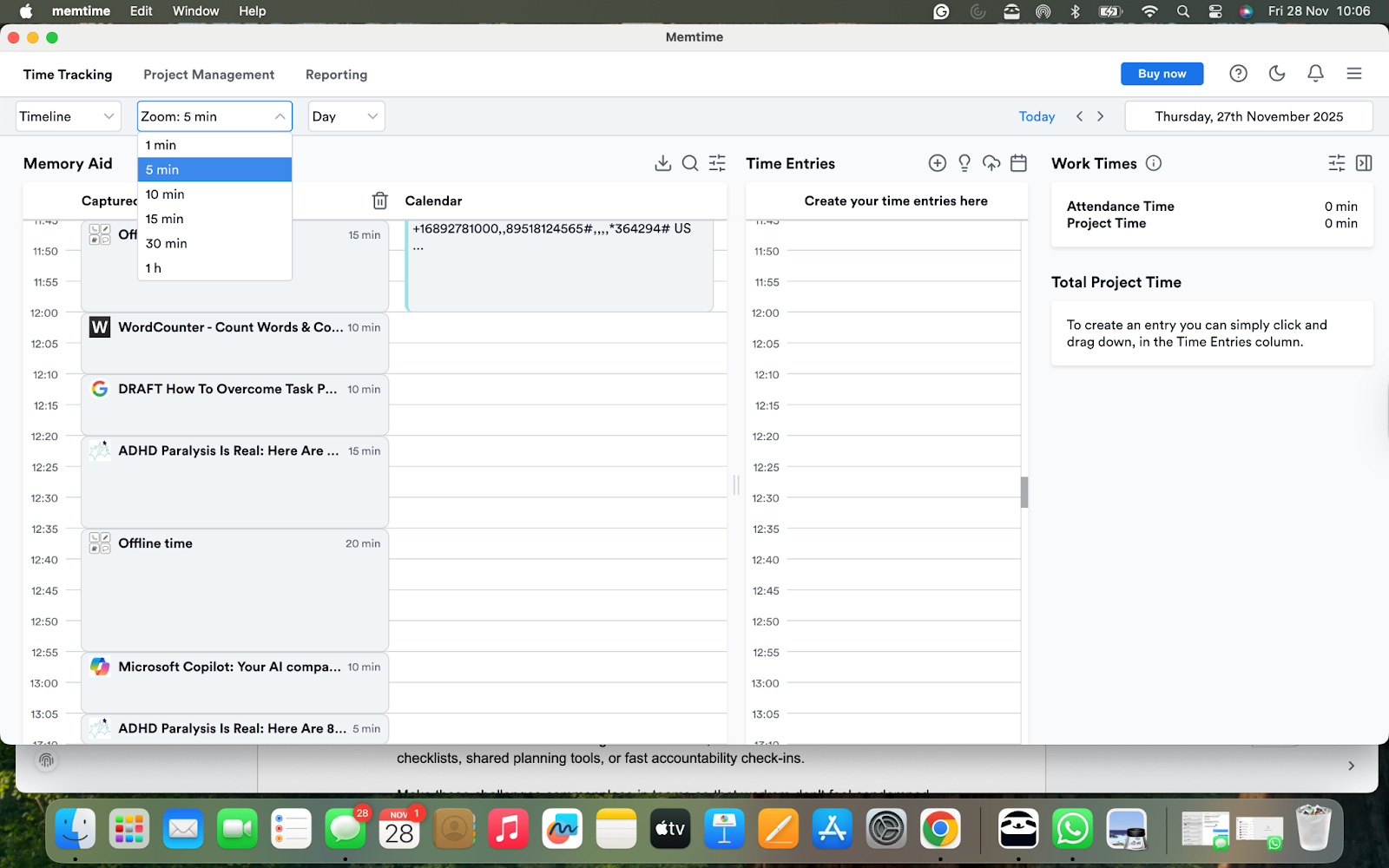
- Memtime helps reduce task paralysis by giving you clarity on how your day actually unfolds.
- The "I got nothing done!" guilt is lessened as it emphasizes how time is truly spent.
- It reveals frequent causes of paralysis, such as fragmented schedules and frequent context switching.
- By revealing natural focus rhythms, it assists workers in scheduling tasks at their most productive times.
- It relieves the strain of recall for overworked or ADHD brains by acting as an external memory aid.
- Its daily timeline gives immediate context for what will happen next, which facilitates the restart of stalled work.
- It’s free for the first 14 days, so you can give it a try for yourself with zero commitment.
While task paralysis is common, it doesn't have to last forever. With awareness, simple structures, and tools that offer clarity, these frozen moments can be transformed into manageable pauses, and productive progress can resume.
How does task paralysis look like in daily life?
Repeatedly starting a to-do list only to do nothing, reorganizing folders for no reason, or opening the same document only to then endlessly switch tabs without making any progress are all indications of task paralysis.
What is the connection between anxiety and task paralysis?
Anxiety and paralysis often reinforce each other: stress makes it harder to start, missed deadlines make stress worse, and so on. This cycle can eventually cause you to feel stuck in a state of perpetual stress, making even seemingly insignificant tasks seem more difficult than they actually are.
Is teamwork impacted by task paralysis?
When paralysis sets in, group collaboration can easily stall: team momentum wanes, agendas keep changing, and ideas go unaired. People are largely reluctant to contribute when there is uncertainty about the scope or the next steps, which hinders progress and irritates the group.
Why does task paralysis make creative roles particularly difficult?
In order to conceal a lack of output with traditional "busy" activity, writers may overedit a single paragraph, and designers may continuously alter templates, giving the impression of progress while avoiding the discomfort of beginning meaningful work.
What distinguishes task paralysis from ADHD paralysis?
While ADHD paralysis is a recurrent freeze linked to executive dysfunction in ADHD, anyone experiencing overload may be affected by task paralysis, which can occur during stressful, emotionally taxing, or decision-fatigued moments that momentarily impede progress.
How can tools like Memtime help with task paralysis?
By showing how time is spent, revealing context-switching patterns, and acting as an external memory, Memtime lessens overwhelm and gets people back on track without adding to their stress levels.

Sheena McGinley
Sheena McGinley is a columnist and features writer for the Irish press since 2008. She’s also a business owner that is conscious of how time tracking can foster progress. She wrote for SaaS companies and businesses that specialize in revenue optimization by implementing processes. She has the unique ability to digest complex topics and make them easy to understand. She shares this precious skill with Memtime readers. When she's not making words work for people, Sheena can be found taking (very) brisk dips in the Irish Sea.