Why You Keep Missing Deadlines, Even When Everyone Is Working Hard

Let me guess… When you repeatedly miss deadlines, a variation of the following runs through your mind: “You just have too much on your plate.” Every deadline sees you in a mad rush to finish, and every time one rolls around, you tell yourself, “This won’t happen next time. Next time, it will be different. We’ll have more time next time.” But how will that happen unless something changes?
I used to have a weekly deadline alongside a great writing team. We all knew the delivery time, and yet everyone was still scrambling in the wee hours to get stuff done. I used to think I could only fulfill a deadline in that heady environment, but that doesn’t always have to be the case. Yes, under pressure, diamonds are made, but – admittedly – it’s not a sustainable business model.
As such, in this here installment, we’re going to take a look at why you and your team keep missing deadlines, how the repetitious blindness around deadlines can relate to ADHD, and how to handle deadlines in a more self-sustaining manner.
Key Takeaways:
- Due to fragmented work, hidden tasks, and shifting priorities, it’s typically difficult to see where time truly goes, which leads to missed deadlines rather than low effort.
- Deadline slippage is primarily caused by scope creep, context switching, and invisible work, which increase workload without modifying deadlines or expectations.
- Uncertain ownership, unequal workloads, and communication gaps exacerbate team-level deadline problems, transforming deadlines into optimistic guesses rather than dependable commitments.
- Realistic planning, which includes segmenting work into specific steps, safeguarding focus time, limiting work-in-progress, and estimating based on actual data, is essential for effective deadline management.
- Predictability can be significantly increased by using tools that reveal real work patterns.

Help! I keep missing deadlines
I hear ya, buddy. If you or an employee keeps missing deadlines, it’s not a personal pitfall. It’s waaaaay more common than you think. In terms of fulfilling deadlines within the timeframe – or, dare I say it, even wiggle room to sit back and enjoy the feeling of completion, and multiple review opportunities – is visibility.
Alongside not having visibility across your day/week, some other common reasons behind why you keep missing deadlines include:
- Scope creep: Work expands beyond the original agreement, adding tasks, expectations, or deliverables without adjusting timelines.
- Fragmented work: Your attention is constantly split across competing tasks, making it harder to maintain momentum or finish anything on time.
- Invisible work: Planning, problem‑solving, context‑switching, and mental load take time but rarely get accounted for in schedules.
- Resulting estimation issues: Because your real workload isn’t fully visible or defined, your time estimates end up too optimistic, leading to missed deadlines.
Why your team misses deadlines
Now that we’ve looked at why you might be missing deadlines on an individual level, it’s worth acknowledging the obvious: Those same issues don’t magically disappear in a team setting – in fact, they tend to get amplified.
When a group as a whole operates without clarity, visibility, or reasonable expectations, deadlines become an exercise in optimism (i.e., guesswork). Additionally, it almost always concerns your workplace environment rather than anything involving your motivational levels. Behold a few of the main offenders when it comes to teams missing deadlines.
Uncertain ownership
Tasks stray when accountability isn't clearly defined. Everyone thinks someone else is handling the work, which leads to duplication, delays, or covert abandonment.
Continuous context switching
Teams juggling multiple priorities can lose hours every week attempting to refocus, which effectively throws the looming deadline under the proverbial bus causing momentum dips.
Uneven workload distribution
Some people can be overloaded while others have oodles of capacity – but without that key visibility, you’re unable to fully see the imbalance. Unsurprisingly, overloaded people tend to miss deadlines, and then the whole team feels the ripple effect.
Communication gaps
As a wise person once said to me, “Presumption is the mother of all f*** ups.” And they’re right. Assumption fills a void, emails get blanked, and updates get swallowed in Slack threads. Then, nobody notices when work stalls until the deadline is imminent.
Reactive firefighting
If your team spends the majority of its time handling urgent interruptions, then how can planned work ever receive the attention it requires? In this kind of chaotic setting, deadlines are unachievable.
However, for some people – particularly those with ADHD – these challenges are ingrained in the way one’s brain processes time. This brings us to an important layer of this conversation.
Missing deadlines and ADHD
Missing deadlines are irksome and deflating, but for anyone working with ADHD, it's frequently a recurring pattern influenced by how the brain handles time, focus, and task initiation. These are executive-function issues that directly conflict with the demands of contemporary, dispersed work. Below are just a few things that ADHD brains face when navigating deadlines.
Time blindness
This is a prevalent theme in ADHD. When tasks seem shorter than they actually are, you typically underestimate the necessary effort and run out of time.
Task initiation
Particularly with open-ended or ambiguous work, getting started can feel disproportionately difficult, even when the next step is clear.
Working memory limitations
Specifics, procedures, and follow-ups are easily forgotten, making it more difficult to maintain pace or resume a task without difficulty after a break.
Hyperfocus
When one's attention is focused on a single task to such an extent that time seems to vanish, other deadlines are overlooked.
Sensitivity to interruptions
Even minor disruptions can impede progress for much longer than anticipated, and context switching hits harder.
Deadlines become moving targets when you combine these ADHD-leaning traits with a workplace full of Slack pings, shifting priorities, and invisible effort. It's not about trying harder; rather, it's about identifying the discrepancy between how ADHD brains function and the way work is organized, and developing systems that promote visibility, clarity, and reasonable expectations.
Deadline management: How to prevent missed deadlines
Now, to the good stuff – how to handle deadlines. You can start creating systems that make deadlines feel attainable rather than anxiety-inducing once you comprehend the factors that are working against you (fragmentation, invisible work, shifting priorities, ADHD-related challenges).
Squeezing more hours out of the day or having superhuman discipline are not the keys to effective deadline management. It involves establishing circumstances that make the work visible, predictable, and realistically scoped.
The foundations that have the greatest impact include the following:
Divide the work into distinct, measurable steps
Deadline-killing tasks include arbitrary tasks like "finish report." You get a roadmap rather than a vague destination when you translate them into concrete actions.
Establish ownership early on
Knowing precisely who is in charge of what stops drift, duplication, and last-minute panic, whether you're working alone or in a team.
Safeguard focus time
Uninterrupted work periods are essential for meeting deadlines. Instead of reacting all day, you can actually make progress by blocking time and defending it.
Explain the invisible work
Context switching, research, administrative work, thinking time, and microtasks all take longer than you anticipate. Rather than acting as though they don't exist, incorporate them into your estimates. Estimate using actual data. You're already behind schedule if you're speculating about how long something will take.
You can get a much more accurate baseline by looking at how long similar tasks took in the past. Data, darling! Limit active work-in-progress. Everything moves more slowly when you’re juggling multiple tasks. Delivery is accelerated, and deadline slippage is reduced by focusing on fewer tasks at once.
Early and frequent communication is key
Deadlines don't just suddenly slide; it tends to be a gradual decline. As such, prioritizing the early communication of obstacles, delays, or scope modifications keeps things recoverable. In the end, avoiding missed deadlines comes down to honesty and visibility: Seeing the actual work, realizing your true potential, and making plans based on how people really work. Deadlines cease to be a source of anxiety and become something you can consistently meet when you create mechanisms that support that reality.
Wrapping up
Pings, meetings, and continual task switching have made modern work so fragmented that the true effort that goes into a day often goes unnoticed. When that happens, time estimates become optimistic wish-thinking rather than grounded in reality. The majority of people react by exerting more effort, but this only increases stress, rework, and burnout.
The issue is a system that hides the true nature of work, not a lack of discipline. You need a clear picture of where time is actually going and how your team's work patterns develop in order to make more accurate forecasts and set reasonable expectations.
And this is where Memtime sidles in to seamlessly bring visibility to your day-to-day and beyond. Memtime can help individuals and teams alike to hit deadlines as it:
- Automatically records fragmented work: It keeps track of every app, document, tab, and task change in the background, providing you with a comprehensive view of how work actually happens, even during hectic days.
- Reconstructs your actual day: It reconstructs your timeline so you can see precisely where time went and what was accomplished, rather than depending on memory, which is always more optimistic than reality.
- Reveals the hidden effort that goes into tasks: This includes thinking time, research, context switching, and microtasks. All of the invisible work that typically goes unnoticed is made visible and quantifiable.
- Increases estimation accuracy: When you have accurate information about how long tasks actually take, your future estimates become fact-based rather than speculative.
- Eliminates uncertainty from forecasting and planning: Teams can plan based on actual capacity rather than wishful thinking, resulting in fewer surprises, fewer bottlenecks, and much more predictable delivery.
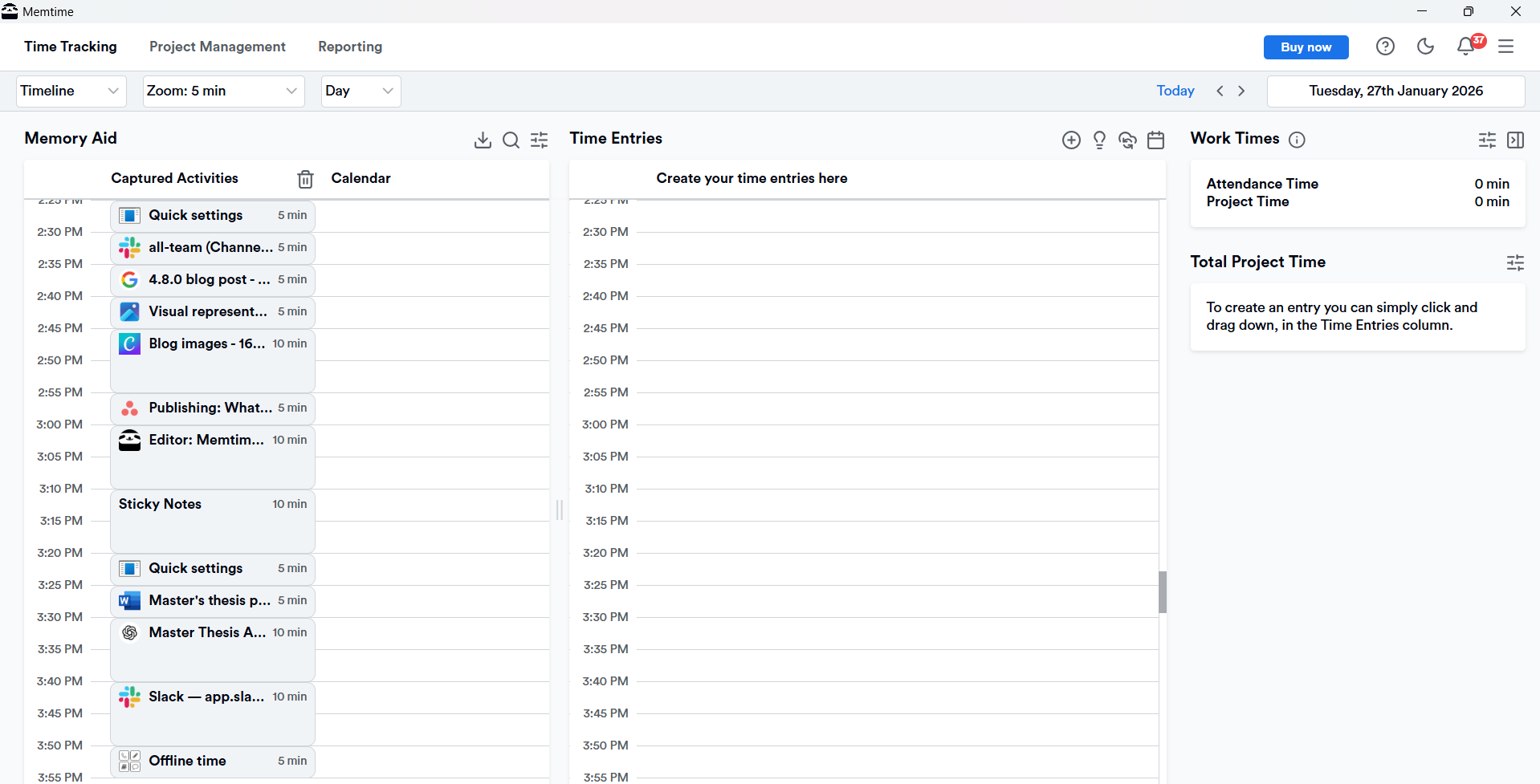
No motivational speeches. No, "just concentrate more." Simply put, improved data leads to improved estimates, which in turn result in significantly fewer missed deadlines. Heck, you can even build yourself some deadline buffer time!
So, if you want to experience how Memtime can streamline your day and free up your focus, you can jump into your 14‑day free trial – you don't even need payment details to hand!
FAQ
What’s the real difference between a workload problem and a workflow problem?
A workflow issue indicates that work is moving too slowly, whereas a heavy workload indicates that there is just too much to do. The latter – ambiguous procedures, frequent disruptions, and dispersed priorities – are the main causes of missed deadlines rather than the quantity of work.
How do digital tools and notifications contribute to missed deadlines?
Micro-delays caused by frequent pings, alerts, and app switching cause tasks to take much longer than anticipated. Significant deadline drift can result from even minor disruptions.
What role does mental load play in deadline performance?
Thinking and execution are slowed by cognitive overload, multitasking, and decision fatigue. Even basic tasks take longer when your brain is overworked, making deadlines unachievable.
Why doesn’t traditional time tracking help prevent missed deadlines?
Because manual time tracking depends on memory, it ignores research, thinking time, and microtasks. Estimates remain erroneous, and deadlines remain untrustworthy because the invisible work is not recorded.
How does team culture influence whether deadlines are met?
Workflow is shaped by norms pertaining to communication, responsiveness, prioritization, and ownership. Even the most competent team will find it tricky to deliver on time when expectations are unclear or when reactive habits prevail.
Why do unclear expectations make deadlines harder to hit?
When scope, goals, or success criteria aren’t defined, people work toward different interpretations of “done.” That misalignment causes delays, rework, and missed deadlines – even when effort is high.

Sheena McGinley
Sheena McGinley is a columnist and features writer for the Irish press since 2008. She’s also a business owner that is conscious of how time tracking can foster progress. She wrote for SaaS companies and businesses that specialize in revenue optimization by implementing processes. She has the unique ability to digest complex topics and make them easy to understand. She shares this precious skill with Memtime readers. When she's not making words work for people, Sheena can be found taking (very) brisk dips in the Irish Sea.