Hourly Billing vs Value-Based Pricing: Opportunities, Risks & Realities
If you work as a consultant, an agency owner, or a software dev and entrepreneur, I bet you have haunting thoughts about your pricing strategy. You know what I’m talking ‘bout—that awkward inner monologue that replays in your head, usually over a cup of coffee, making you grind your teeth and clench your jaw.
It goes something like this: Am I leaving money on the table? At the same time, am I charging too much and don’t know it? Also, am I fully delulu with my pricing?
All these questions can be summed up into a fundamental one: Am I pricing my work properly?
And that’s a hard question. ‘Cause everything can look good on paper, but you can still feel like your pricing isn’t quite right.
You’re probably not wrong for feeling that way. In fact, most pricing anxiety is rooted in people using the wrong model for their situation or not fully understanding the one they’re using.
Now, when it comes to pricing models, hourly billing and value-based pricing are the 2 dominant ones. Both come with real merit and real traps, and both look very different once you’re actually working with them.
So, let’s talk about your business and these 2 models: hourly billing vs. value-based pricing. Let’s look at the ups and downs of each, what you can expect from them and how to find the right model FOR YOU. And I mean it—we’re not leaving until you’ve got your answer.
Ready when you are. Just keep reading. 🖱
Key Takeaways:
- Hourly billing still has its place; it’s much easier to sell, works well for unpredictable scopes of work, and is a solid starting point for newer businesses.
- Value-based pricing can dramatically increase your effective rate without adding a single extra hour of work.
- Before picking a model, you should know what your time actually costs, so you avoid leaving money on the table.
- Manual time tracking is unreliable; research shows hindsight estimates are only 36–67% accurate, meaning you’re likely losing billable hours every week.
- Automatic time tracking gives you accurate time data, and tools like Memtime capture everything you do, passively, all day.
- Real time data is what makes confident pricing possible, no matter if you charge hourly, value-based, or both.

Hourly billing vs. value-based pricing: Definitions
Hourly billing is exactly what it sounds like: you charge a set rate for every hour you work, and the client pays for your time. Simple as that.
Think of a freelance developer who charges $120/hour to build new features for a client’s app; they log their hours, submit a timesheet, and invoice accordingly. Or a branding consultant who bills $200/hour for a brand audit, tracking every call, revision, and strategy session along the way.
Value-based pricing takes a different angle entirely. Instead of tracking hours, you price your services based on the outcome and impact you deliver to the client.
So, instead of billing 40 hours at $150/hour for a website redesign, you charge $25,000 because that redesign is projected to generate $200,000 in new revenue for the client. The hours it took you are almost beside the point, as what matters is the result. That’s why, technically speaking, for the same expertise and the same work, you can have a fundamentally different way of defining what it’s worth.
Now, both models have their place and look very different depending on where you are in your business, so let’s talk about the opportunities, risks, and realities of each.
Hourly billing
The opportunities
Hourly billing is usually the default pricing model, and for good reason. It’s clean, pretty transparent, and easy to sell. When a prospective client asks, “How much do you charge?”, saying “$175 an hour” is a straightforward sentence they can immediately process. There’s no ROI modeling, and no convincing them that your value is worth X dollars.
This pricing model works especially well for new consultants and agencies building their track record. It also works well for projects with unpredictable scope, like ongoing software maintenance, ad-hoc brand support, or research phases where neither you nor the client really knows how deep the research can go.
There’s also something to be said for flexibility. When scope creeps (and it almost always does), adding hours is a simple conversation. More hours equal more billing.

Also, for clients who are cost-conscious or just getting started with outsourced services, hourly billing lowers their perceived risk. They feel in control because they can see exactly what they’re paying for, and that sense of transparency builds trust early in a relationship.
The risks
The issue with hourly billing is that it punishes you for getting better at your job. Sounds ridiculous, but it’s the truth.
The faster and more experienced you become, the fewer hours a project takes, and the less you earn for the same (or better) outcome. Think of a consultant who once needed 20 hours to develop a brand strategy and now needs 9; they are essentially taking a pay cut for improving.
There’s also the issue with scalability. Your revenue is mathematically capped by the number of available hours in a week. Even at a premium rate, you depend on your calendar, so scaling hourly-based revenue actually means hiring more people to sell more hours, which is a different growth path than simply scaling your skills and expertise.
Plus, you can expect to have some bumpy dynamics with clients. Some clients will review your timesheets line by line, questioning every 15-minute increment, and when they do, you’ll realize they look at you more like a vendor (who’s being audited) than a strategic partner. Talk about building trust.
The realities
Now it’s time we look at some actual numbers.
A 2023 study surveyed 1,000 consultants across 75 countries and found that 29% still charge by the hour. The rest of them, those using value-based pricing, are pulling significantly higher project values: 51% of value-based pricers land average projects of $10K+, compared to only 39% of hourly billers hitting that same mark.
Here’s one that hits close to home for agencies. The agency consulting firm Move at Pace, which works with branding and design agencies, documented a pattern that plays out constantly in the industry: a logo that takes 20 hours in year 1 takes just 5 hours in year 5. The designer’s skill has grown dramatically, but under hourly billing, their revenue per project has dropped by 75%. The agency improved, became faster and more efficient, and the pricing model punished them for it. That’s the hourly trap we discussed before.
So, be very aware: every improvement in your internal process lowers your revenue per project. You build something in 8 hours instead of 20, and congratulations, you just cut your own invoice.
Value-based pricing
The opportunities
Value-based is all about understanding how you (and your business) can solve the client’s problem and what solving this problem is actually worth to the client.
Consider a consulting firm doing process optimization. Exactly 200 hours of work. At $215/hour, that’s a $43,000 engagement. But reframed as value-based, like “we’ll be saving you $600K per year, so our fee is $90,000”, your effective rate jumps to $450/hour without adding an extra hour of work.
How magical is that?! 🪄
That’s the power of value-based pricing. Your expertise and the outcomes it generates determine the price, not your time. If you have built real methodologies, repeatable frameworks, and a track record of delivering great results, this model rewards everything you’ve ever built.
It also changes how clients perceive you. An hourly rate framed too low positions you as a commodity; a value-based fee elevates you into the role of strategic partner (that sounds super profesh). It’s not something clients will come out and say, but they’ll subconsciously feel it.

For software dev firms, this model works well for product-type engagements, like building something that generates revenue or saves costs at scale. For marketing and branding agencies, it works well for campaigns, rebrands, or conversion optimization work where the ROI is measurable.
The risks
Value-based pricing comes with its own set of *real* challenges.
First, you need to be able to quantify the value, and that’s no joke. You need to find clients who are willing to share their numbers and a project scope where outcomes are actually measurable. You also need to be fully confident in your ability to make credible projections. Not every client engagement will provide you with that clarity, and not every client is ready for that conversation.
Second, there’s scope management, which is critical under value-based pricing. If you’ve priced a project based on a defined outcome and the goals shift mid-engagement, you need strong contract language and the discipline to enforce it. Scope creep can ruin everything.
At last, you have to be prepared for serious client resistance. Many clients have been trained on hourly billing and will push back on any model they can’t break down into a time-and-rate calculation. It’s up to you to decide if educating those clients is worth your time, as it takes patience, confidence, and proof. Proof especially; you need a strong portfolio of results to point to when you’re asking clients to take your word for it.
The realities
It’s time we check the data.
One example comes from Martin Krumbein, founder of OnTarget Consultancy in Germany. His hourly rate was capping his growth, so he transitioned to value-based pricing. He doubled his consulting revenue within a year. As he put it himself, “I doubled my turnover and income compared to last year. So I grew my business about 100%.”
On the agency side, the results can be mind-boggling. A Melbourne-based design agency documented its transition away from hourly billing toward impact-based pricing. They combined value-based pricing with specializing in a specific niche and measuring every engagement. The outcome was that they doubled revenue over 2 years, profit margins climbed from 11% to 20%, and average project value increased by 65%.
The owners are candid that pricing wasn’t the only factor; of course, niching down and tracking outcomes played an equal role, but the shift away from hourly billing made the biggest change.
So, which pricing model should YOU choose?
Well, it’s not that simple. And it’s not always one or the other.
You can begin with hourly billing and transition to value-based billing as your authority and client base mature. You can also choose a hybrid approach: charge hourly for discovery, then switch to value-based fees for execution.
But before you decide whether to choose between hourly vs. value-based pricing or combine them, you need to know what your time is actually worth.
Think about it. Even if you go full value-based and never mention an hourly rate to a client again, your time still has a cost. Every project you take on has hours behind it, and if you don't know how many, you’re essentially pricing blind. You might land a $20K project and feel great about it, only to realize you put in 200 hours and your effective rate was $100/hour. That’s why, no matter which model you choose, you need real data on your own time:
- What’s your actual effective hourly rate on fixed-fee projects?
- How many hours does each project type really take?
- Where are you burning non-billable hours?
- Where are you underestimating?
You need time data.
Now, the real challenge is getting that time data, since manual time tracking is notoriously unreliable. We at Memtime often cite a Harvard Business Review study that found manual hindsight estimates are often wrong, with accuracy ranging from 36% to 67%. By the end of the week, if you’re reconstructing your time from your memory, you’re losing billable hours you actually worked.
This is why we’re big on automatic time tracking. With it, you don’t need to rely on memory or discipline; automatic tracking captures everything you do, all day, passively.
Meet Memtime
Memtime is our automatic time tracking software for Windows, macOS, and Linux that passively records your time across all apps, meetings, calls, docs, and web. It creates a private, chronological timeline (Memory Aid), allowing you to review your day minute by minute.
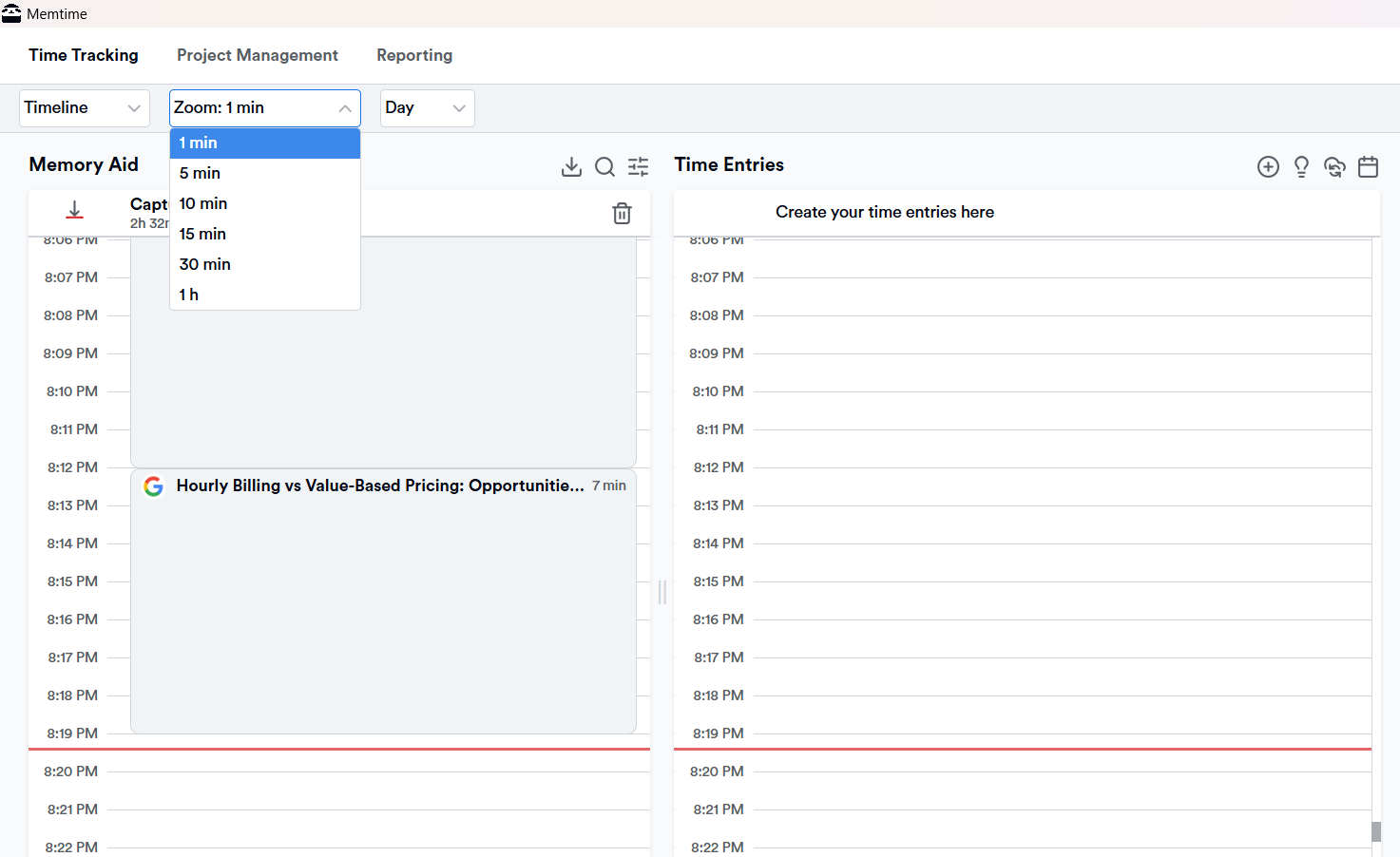
The core concept is pretty simple: you install it, forget about it, and let it run in the background. As long as your computer is turned on, Memtime runs in the background and automatically captures your activities while you work.
How can it do that?
Well, Memtime follows your mouse movement and keyboard input to identify the program running in the foreground. Your automatically captured activities are then displayed in a chronological timeline.
Now, based on your activity log, you can create exportable time entries. You check your Memory Aid—that’s the automatic activity log—to see what you worked on and log hours right next to it. Click and drag to create time entries calendar-style or let Memtime do it AI-style (no AI, though).
Memtime can then sync your time entries with over 100 project and billing software and mirror your project and task structure.
You can also generate reports and export data to share with clients, attach to invoices, or simply export in CSV, PDF, or Excel format.
Here’s what else Memtime does:
- Keeps ALL your data private. All tracked activities are stored locally on your device, so only you can view your tracked data. Your activity history is not shared or uploaded anywhere (no cloud syncing), and tracked activities are not shared with anybody else.
- Gives you granular detail. Memtime tracks time in small increments, giving you data down to the second. That’s why legal professionals often use Memtime to reconstruct the day in 6-minute intervals.
- Calendar syncing. Memtime mirrors and displays your scheduled calendar events next to automatically recorded activities. You can connect Google Calendar, Microsoft Calendar, macOS Calendar, etc., to get an easy side-by-side view of what you planned vs. what actually happened.
Not bad, huh?
As you can see, if you are in the pricing model limbo, Memtime gives you the honest data to get out of it.
You’ll be able to see exactly how long different project types take and calculate your true effective rate on past projects. That’s the data that tells you whether your current pricing is working and what you should charge going forward.
If you like how that sounds and want to give Memtime a go, just click the button below to start your 2-week free trial. No credit card needed.
Wrapping up
Hourly billing is okay, and so is value-based pricing, and you don’t have to choose one or the other. Combine them, swirl them, whatever works for your business.
But before you do anything with your pricing strategy, take the time to understand what your time costs, what your work delivers, and where the gap between the 2 is. Most people skip this step and wonder why their pricing never feels right.
Don’t be like most people. Do the work, look at the numbers, and charge what you’re actually worth.
And may the data be with you! 🤖
FAQs
Is value-based pricing only for experienced businesses?
Not exclusively, but having a track record does help. Value-based pricing requires you to confidently quantify the outcome you’re delivering, which is easier when you have past results to point to. That said, if you’re new to the business but working on a project with clear, measurable ROI, like a campaign or product build, it’s worth exploring. You should be able to back up your fee with proof.
What’s the biggest mistake people make when switching to value-based pricing?
Skipping the discovery work. Value-based pricing only holds up if you truly understand what solving the problem is worth to the client, and that means asking the right questions upfront. Many consultants and agency owners set a value-based fee based on gut feel rather than actual client data, which makes it hard to defend. You need a strong contract and well-defined outcomes.
How do I handle a client who only wants to pay by the hour?
Many clients have been trained on hourly billing and feel much safer with a model they can audit. You have 2 options: educate them on the value-based approach and show them your past results, or decide whether the engagement makes more sense on an hourly basis. Not every client or project is the right fit for value-based pricing.
When does a hybrid pricing model make sense?
The simplest answer is when the scope is partly unpredictable and partly outcome-driven. A common approach is to charge hourly for discovery, like when you’re still figuring out the problem, and then switch to a value-based fee for execution once the outcome is clearly defined. This approach protects you during the early stages and lets you price the delivery based on the value you’re creating.
How do I calculate my effective hourly rate on fixed fee projects?
Divide the total fee you charged by the actual number of hours you put in. The tricky part is knowing the real hours, and I mean not your estimate, but the actual time. That’s where automatic time tracking comes in handy.
Can automatic time tracking work if I juggle multiple clients and project types?
Yes, of course! It’s actually where it’s most useful. Memtime, for example, captures everything you do across all apps, meetings, and docs, and you can then assign time entries to specific projects or clients. Over time, this builds a clear picture of how long different project types and their tasks actually take, which is the data you need to price properly (no matter which model you’re using).

Aleksandra Mladenovic
Aleksandra Mladenovic is a copywriter and content writer with six years of experience in B2B SaaS and e-commerce marketing. She's a startup enthusiast specializing in topics ranging from technology and gaming to business and finance. Outside of work, Aleksandra can be found walking barefoot in nature, baking muffins, or jotting down poems.