The 5-Minute Rule: Why It Works (and What Most People Miss)

Greetings, my seasoned fellow procrastinators and undiagnosed ADHD-adjacent avoiders. I’m guessing that you’re here because you can’t motivate yourself to start a task. You just can’t consume that proverbial frog. Me neither. So, let’s give this 5-minute rule a whirl.
Although the 5-minute rule is one of the most straightforward productivity strategies available, its effectiveness stems from what takes place during those initial minutes. It’s meant to cut through procrastination, lower friction, and help your brain gain momentum before it has a chance to resist. How? By simply reducing the pressure to "start." When used effectively, it can transform all those avoided tasks into small, achievable victories.
However, nothing's perfect, so just like any other methodology, it has flaws that can reduce its effectiveness. But knowledge is power, so read on to find out how to tackle its one glaring productivity blind spot!
Key Takeaways
- The 5‑minute rule works by lowering the psychological toll of starting. By limiting your time to just 5 minutes, you avoid the mental strain that typically causes procrastination and make the initial step seem more manageable.
- The secret force behind the rule's efficacy is momentum. Your brain automatically continues the task once you start with a small, tangible action because it no longer feels abstract or overwhelming. Why? Because it’s already in motion.
- The rule is particularly effective for tasks that seem too big or too ambiguous to put off. It helps students, writers, and knowledge workers overcome their avoidance of assignments, emails, planning, and documentation.
- The most frequent way people undermine a method is by selecting the wrong starting point. You wind up recreating the barrier you were attempting to remove if your first step requires planning, indepth thinking, or decision-making.
- The rule has a built‑in blind spot: If you choose to work beyond 5 minutes, this work is almost never tracked accurately. As such, it becomes invisible. Automatic time tracking tools like Memtime fill this gap by capturing what happens after you start.

What is the 5-minute rule?
The 5‑minute rule is a simple and immediately accessible way to break the deadlock on tasks you keep putting off. And we know you have tasks you keep putting off; we're all human. The reason why the 5-minute rule is so accessible is that you only commit to working for just five minutes, no more. It’s intentionally small, so the task feels easier to start, regardless of what it is. It could be a quick, minute‑long chore or a bigger project you’ve been swerving for various reasons.
The psychology behind the 5-minute rule
The 5‑minute rule works because it changes the starting conditions of a task. Instead of committing to the full scope of the work, you only commit to a small, time‑limited action. That reduces the mental friction that usually leads to procrastination.
Five minutes also feels manageable, which lowers the pressure that can make knowledge‑work tasks feel heavier than they are. And once you begin, the next step is usually obvious, whether that be…
- Replying to the next email
- Drafting the next sentence
- Outlining the next point of a project
- Reviewing the next file
- You get the picture...
With the work already in motion, continuing becomes a simple extension of what you’ve already started.
As for the 5-minute concept itself? It isn’t new. Versions of the 5‑minute rule have circulated for years in productivity and behavioral‑psychology circles, all rooted in the same principle: start small enough for your brain to accept it and not scarper off screaming into a dark corner.
Knowledge workers, writers, students, and anybody else dealing with tasks that seem too big or too unclear to start tend to favor using it. It’s appealing because it doesn't require a system or tool; all you really need is a commitment to five minutes, which is often enough to overcome initial resistance and begin productive work.
How to use the 5-minute rule at work (for tasks you keep avoiding)
The 5‑minute rule works best when a task feels overwhelming, unclear, or (somewhat ironically) so simple that you keep postponing it anyway. So, here’s what you do: simply decide to work on it for a paltry five minutes rather than attempting to "finish" or tackle it all in one sitting.
Choose a small entry point (you’ll know it as it’ll seem the most obvious/easiest place to start), then set a timer, before solely concentrating on what you can do within that brief window. Again, the overall objective is not to finish the entire task, but to lower the barrier to beginning.
As for how it may present in your day-to-day? Let's say you haven't been updating a project brief. Here’s how you can start:
- Minutes 0–1: Skim the most recent version you saved and open the document (the most difficult part).
- Minutes 1-3: Update one specific section; for instance, substitute the current dates for the out-of-date timeline.
- Minutes 3–5: Include the next necessary detail that you already know (such as the confirmed deliverable, the updated budget amount, or the new stakeholder name).
- After 5 minutes: Even if you choose to stop working, you've lowered your barrier to continuing as the task is now smaller, clearer, and simpler to finish. Yay, you!
Equally, when your inbox seems overwhelming, you can use the same strategy for a spot of email triage:
- Minute 0–1: To reduce visual noise, sort your inbox by "Unread" or "From the lastFrom last 7 days."
- Minutes 1-3: Respond to one message that you already understand by either forwarding it to the appropriate person or responding with the status you are aware of.
- Minutes 3–5: To make the important messages stand out, archive or file a small batch of low-stakes emails (such as newsletters, confirmations, and FYIs).
Again, you can stop after five minutes – but your inbox is lighter, more streamlined, and no longer feels like something that has you foetal under your desk.

Common mistakes that can make the 5-minute rule less effective
While straightforward, certain habits can subtly compromise the 5-minute rule. Treating the five minutes as a covert pledge to "keep going" is one of the biggest errors. This undermines the psychological safety that underpins the rule's effectiveness and adds additional pressure to the task. For this to work, you really have to give yourself permission to stop after 5 minutes if you’re not feeling it.
You can also run into trouble when you apply the rule to unclear tasks rather than avoiding them. If you don’t know what the task actually is, 5 minutes won’t fix that – clarity has to come first.
Other potential pitfalls include:
- Multitasking or context switching during your 5 minutes. This can distract you and lessen the impact.
- Choosing assignments that require outside assistance makes you stop right away.
- Inconsistently applying the rule, which undermines the process's credibility.
Simply put, when used properly, the 5-minute rule can reduce resistance to commencing a task. However, when used improperly, it simply becomes yet another thing to avoid.
The 5-minute rule productivity blind spot: Why you rarely notice it
The 5-minute rule is a great way to get started, and once you start, those precious minutes often turn into actual work. However, you seldom realise how much time you spend after the initial push, which is also where its biggest blind spot appears.
The majority of people believe they only worked "a few extra minutes," but in fact, those sessions can frequently result in concentrated progress lasting far, far longer.
The issue is that this time is rarely recorded precisely. Even the most disciplined knowledge workers forget to start or stop a timer, and manual tracking disrupts your workflow. This makes the work you did accomplish invisible, particularly in positions where capacity planning, billing, and time are important. In other words, you don’t need help starting anymore; you need visibility into what happens after you start.
This is the part of the blog where I suggest you consider trying Memtime to see how much those “five minutes” actually add up to!
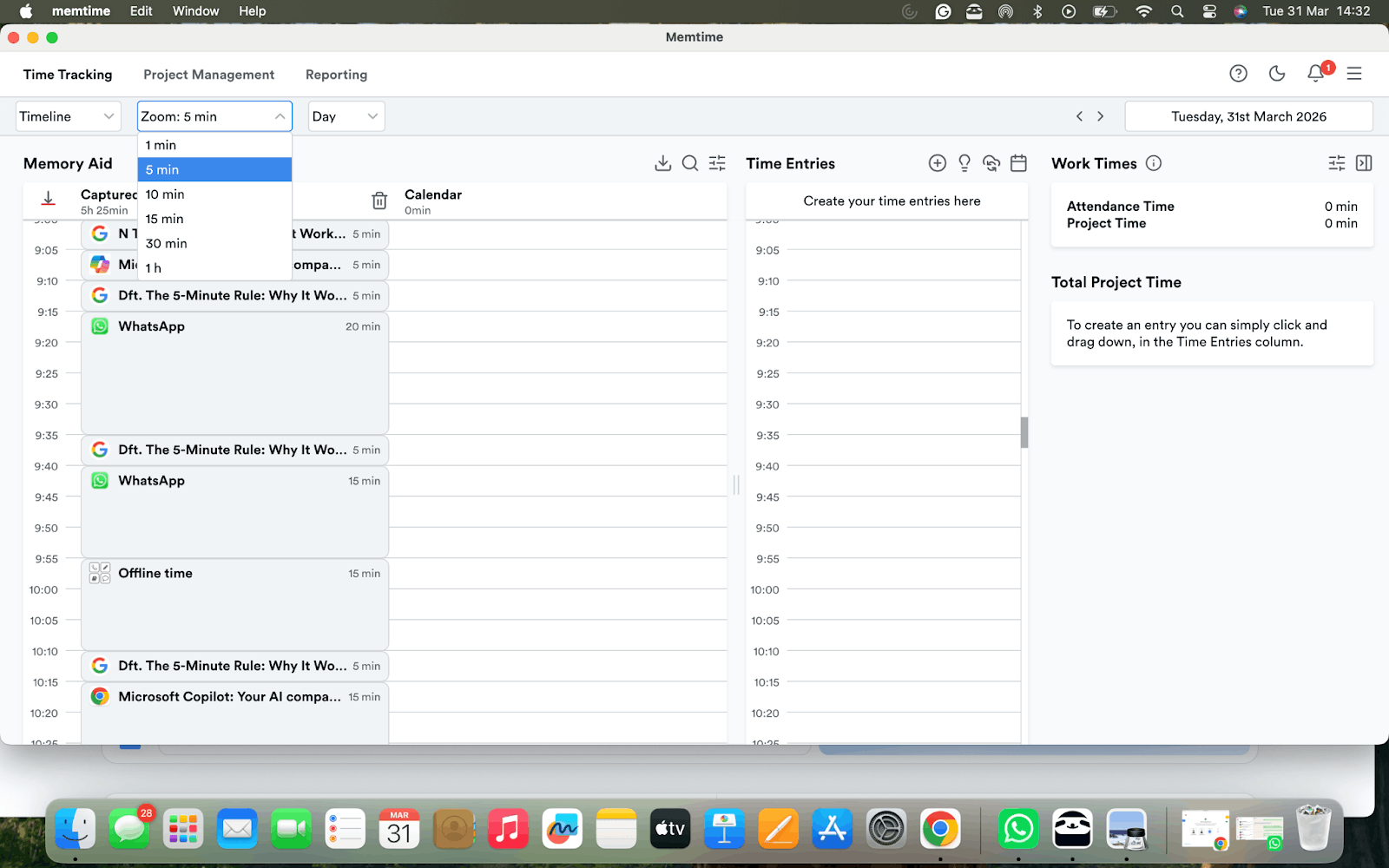
Automatic tracking tools like Memtime run quietly in the background, capturing what happens after you start: the documents you worked on, the emails you handled, the apps you used, and how long each session actually lasted.
FAQs
Is the 5‑minute rule the same as the Pomodoro Technique?
Not quite. The Pomodoro Technique divides your work into predetermined 25-minute chunks with scheduled breaks. The 5-minute rule is intentionally shorter and more accommodating; it is meant to help you get started rather than oversee an entire work session. Many people start with the 5-minute rule and, once they're moving, move on to longer focus techniques.
Does the 5‑minute rule work for creative or deep‑focus tasks?
Yes, provided that the initial step is small and tangible. To get past the "blank page" barrier and move into more in-depth work, it's often sufficient to open the draft, review the final paragraph again, or add one idea to the outline.
Can the 5‑minute rule help with task overwhelm or decision paralysis?
Of course. Reducing the commitment to five minutes helps you avoid the "where do I even start" spiral and lessens cognitive load when a task feels too large or unclear.
How often should I use the 5‑minute rule during the day?
As frequently as necessary. Some people use it once to overcome a significant obstacle, while others use it repeatedly to tackle several tasks they have been putting off. The rule is intended to be simple and repeatable, so there is no limit.
What should I do if five minutes isn’t enough to make progress?
If you run into trouble right away, the task probably requires clarification rather than effort. Take a step back and specify the next tangible action. The 5-minute rule is only effective when the beginning point is clear and achievable without further consideration.

Sheena McGinley
Sheena McGinley is a columnist and features writer for the Irish press since 2008. She’s also a business owner that is conscious of how time tracking can foster progress. She wrote for SaaS companies and businesses that specialize in revenue optimization by implementing processes. She has the unique ability to digest complex topics and make them easy to understand. She shares this precious skill with Memtime readers. When she's not making words work for people, Sheena can be found taking (very) brisk dips in the Irish Sea.