Productivity Theater at Work: Why Teams Fake Productivity

Doesn't it sound exciting? A productivity theater, where everyone bustles about, seamlessly getting their work totally done, with added showmanship to boot! But, of course, nothing productive happens here. It's all entirely performative.
Modern workplaces might be humming with activity, but that doesn’t quite translate into proper progress. Across a variety of teams, the pressure to look productive has quietly become more important than the goal of getting stuff done.
This, dear reader, is productivity theater, which we've all found ourselves partaking in at some point. It’s appearing busy even when the actions we take do not advance the work; a pattern in which employees, subconsciously or otherwise, engage in what I call “value signaling.”
Knowing why this happens and how to move away from it is important. Otherwise, how can you build more effective teams? So join us as we explore how productivity theater sets in, why it’s adopted by well-meaning employees, and how clocking the early signs of fake productivity can help shift workplaces toward more sustainable work practices.
Key Takeaways
- Productivity theater is when visible activity is valued over quiet progress. That breeds an employee culture more concerned with being responsive, available, and present online than with proper results.
- Today’s workplaces are built to nudge people toward performative productivity. It’s exacerbated by some of our perennial enemies: fragmented days, fast-moving priorities, and a lack of time for protected deep work.
- "Fauxductivity," where digital presence substitutes for contribution, is magnified by remote and hybrid settings.

Understanding productivity theater in the workplace
We are products of our respective environments. In many workplaces, productivity theater appears when the signs of activity are noted before the results of any work.
Over time, employees learn to pick up on these cues from management, often without realizing it. They’re working off feedback that certain behaviors are considered a form of commitment or competence.
Surrogates for reliability include rapid replies, working late, and being omnipresent “online.” These cultural cues shape behavior, leading people to:
- Multitask during calls
- Jump between tasks
- Attend every meeting/workshop simply to stay visible
- You more than “get the picture”, you’ve lived it
If you want to explore this idea further, our piece on realistic productivity reporting breaks down why traditional activity metrics miss so much invisible work. We’re helpful like that 🤓
Why performative productivity happens in modern teams
Performative productivity tends to manifest thanks to the way modern work is organized; it leaves very little room for consistent, uninterrupted progress. This doesn’t mean teams are grappling in the motivation department; they’re struggling with environments that make real work hard to protect.
When days are diced into short increments, and priorities shift before tasks can be properly established, people naturally fall back on whatever feels achievable in that moment.
A few forces can push teams in this direction:
- Workdays broken into fragments: Constant interruptions make deep work rare, so quick, surface‑level actions fill the gaps.
- Competing demands with no clear hierarchy: When everything feels imminently urgent, people default to the tasks that are easiest to demonstrate and usually low risk.
- Pressure to appear fully utilized: Again, full calendars and stacked time logs become something of a safety blanket in these uncertain environments – if only in the short term.
Most employees are not trying to put on a show or get away with not doing real work. Not at all. They’re working in systems where it’s easier to be seen than to make real progress. And it’s in that space – between what teams mean to do, and what their day actually allows – that the earliest signs of “Fauxductivity” start.
Signs of fake productivity or “Fauxductivity” in remote/hybrid work
The signs of productivity theater inside an office are easy to pinpoint – you can see the rushing between meetings and the movement of multitasking. Remote and hybrid work, however, creates another pressure point. When no one can see you working, the instinct shifts from looking busy in person to being hyper-present online.

Fauxductivity (pronounced foe-duct-ivitee, for anyone who didn’t take French at school) is a purely digital phenomenon. It’s the practice of doing work that looks productive from afar.
A set of behaviors begins to emerge – again, not from a place of bad intent, but from a need to look connected despite not being in the office. So, with that in mind, some of the more common remote‑specific patterns that you’ll invariably recognize include:
- The rapid messaging: You instantly respond to every ping to show you’re available.
- Going to ALL the meetings: You join video calls “just in case,” even though you have nothing to add.
- Regular status updates: You constantly update your Slack/Teams status with what you’re doing during the day – creating an unintentional time suck in the process.
- Thread-hopping: This is when you repeatedly leap from one channel/platform to another to appear active in several places at once.
- Performative check-ins: Posting micro-updates or protracted emails that give the impression of momentum.
- Neatly rounded time logs: Ramming hours into neat blocks that make the day seem more structured than it was in actuality.
- An “always-on” mentality: Being online across different time zones to avoid being seen as tardy or checked out.
Again, these behaviors aren’t indicators of disengagement. They’re the tweaks people make when digital presence becomes the primary way their effort is observed/interpreted.
How productivity theater undermines planning and outcomes
Productivity theater doesn’t just distort how work looks; it quietly rejiggers how it functions. One of the ways in which to see this is to distinguish between busywork and productivity theater.
Busywork is a low‑value operational activity. Productivity theater, as I said, is performative behavior driven by cultural incentives (pressure to look fully utilized and perfectly plumped timesheet).
Both may create the illusion of momentum, but productivity theater is unique in how it shapes understanding of progress and capacity. How? Because it generates activity that looks more meaningful without actually furthering the work.
That distortion can show up in three areas:
- Planning: Responsiveness, online presence, and full calendars are often proxies for workload, so capacity planning is unreliable. Teams may seem fully loaded, but the activity you see does not match the focused time it takes to make high-value progress.
- Prioritization: Performative behaviors (immediate replies on Slack, attending too many meetings, sharing constant status updates) rob your opportunities for deep work. These actions are easier to see and therefore get attention at the expense of tasks that are important but showcase less visibility.
- Delivery: You wind up with fragmented focus, mental toggling, and the need to explain every minute of slow progress. Teams are busy, but the work is inconsistent, resulting in leaders losing clarity on what is really moving forward.
Moving beyond productivity theater toward real work
Productivity theater doesn’t simply come into being or disappear of its own accord; it only goes away when managers and teams as a whole stop rewarding the behaviors that support it.
Many managers unwittingly reinforce the patterns they are trying to solve for – activity over outcomes, responsiveness over focus, and utilization perfection over realistic workloads.
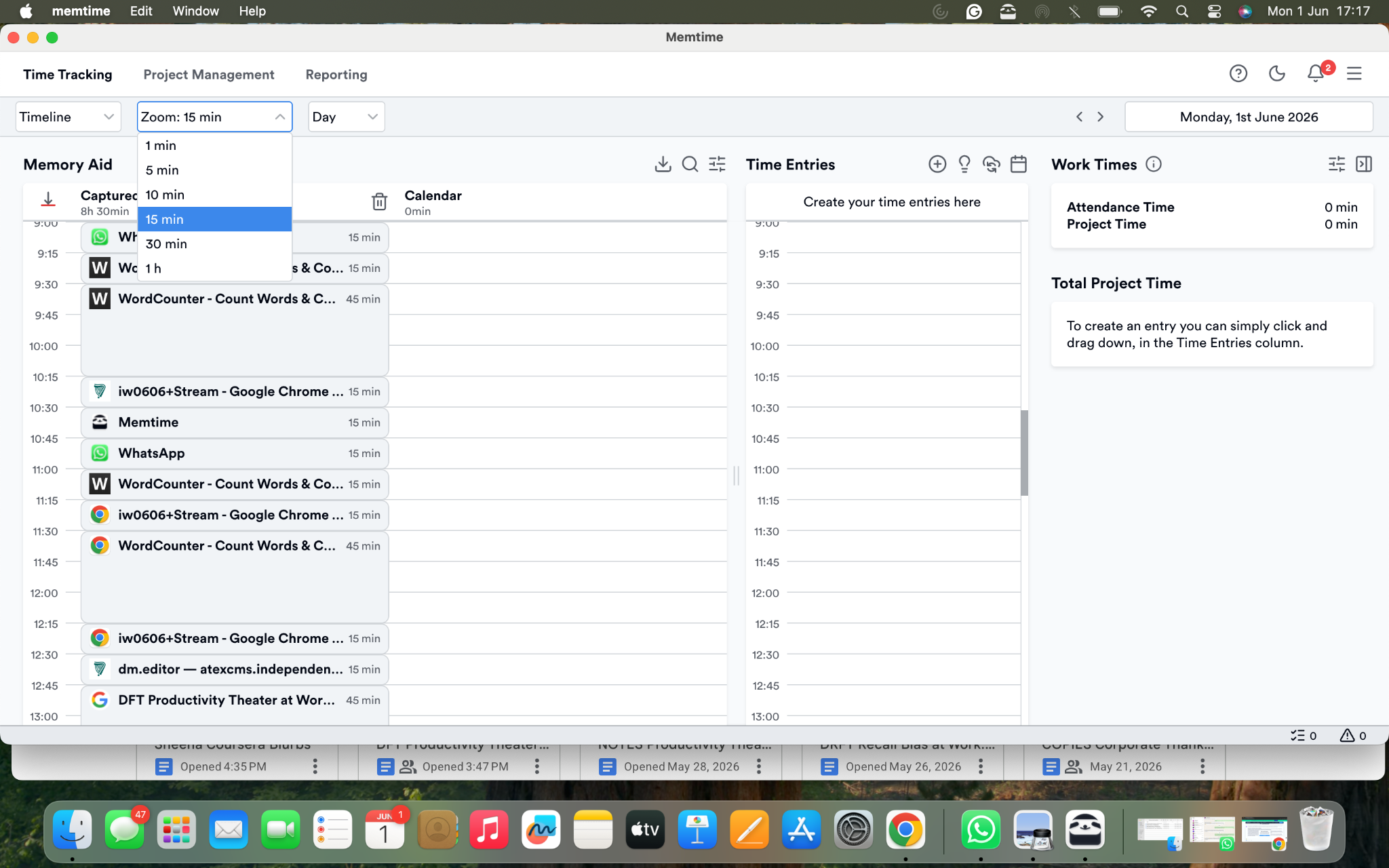
To move beyond this, we need to shift the conversation from how busy someone looks to how work actually happens. That’s where Memtime comes in, not as a tool to catch people “pretending” to work, but as a way for individuals and teams to get a real sense of what their workday looks like.
Memtime surfaces the knowable patterns that would otherwise remain unknowable, namely:
- undocumented interruptions
- instances of context switching
- pesky fragmented work
- unacknowledged invisible effort
- general loss of focus
For managers, the takeaway is straightforward: promote sustainable focus, clarity, and outcomes, not performative busyness or the kinds of micromanagement that push people toward visibility over value.
When teams are enabled to do work that matters, not to show they are working, productivity theater is so much less powerful, and real progress is so much easier to make!
So, if you want to give Memtime a try today, you can access a 14-day free trial to see for yourself how it can transform your workweek and that of your team.

Sheena McGinley
Sheena McGinley is a columnist and features writer for the Irish press since 2008. She’s also a business owner that is conscious of how time tracking can foster progress. She wrote for SaaS companies and businesses that specialize in revenue optimization by implementing processes. She has the unique ability to digest complex topics and make them easy to understand. She shares this precious skill with Memtime readers. When she's not making words work for people, Sheena can be found taking (very) brisk dips in the Irish Sea.