How to Price Creative Services and Charge What Your Work Is Worth

Most creatives (myself included!) are terrible at pricing their work.
Not because we’re bad at math. But because pricing creative work feels awkward and emotional.
You’re not selling screws by the pound; you’re selling ideas. Your taste. Judgment. The thing in your head that lights up at 3:16 AM, and suddenly you know exactly why the headline isn’t working.
And yet, clients still ask you about your hourly rate, as if you’re driving a forklift for a living. And you have to give them an answer.
So, to make pricing creative services a bit easier, we at Memtime decided to write a guide on the topic. Hopefully, after the end of this short post, you’ll learn how to price your creative work in a way that reflects the actual value of what you do. We don’t want you to be punished for your efficiency or go bankrupt thanks to endless revisions.
We’ve got no time to waste, so let’s roll.
Key Takeaways:
- Creative work involves judgment, taste, problem-solving, and decision-making, most of which clients never visibly see.
- Clients aren’t really paying for your time; they’re paying for relief, clarity, and confidence that the problem is finally handled.
- Hourly pricing often backfires for creatives because it punishes efficiency and ignores how unpredictable creative thinking really is.
- Every pricing model has trade-offs, but scope, revisions, capacity, and unpaid work must be priced intentionally, or your margins disappear quietly.
- Automatic time tracking (hello, Memtime) reveals the reality of your work, from revision overload to energy-draining clients and unprofitable projects.
- When you understand where your time and energy actually go, pricing stops being awkward and starts reflecting the real value you bring.

What counts as “creative services” (and what actually creates value)
Creative services usually include things like copywriting, design, branding, marketing strategy, UX/UI, content creation, creative direction… and so on, and so forth. You get the idea.
And as a creative, you know that these services are not just doing a thing. They’re not typing words, moving pixels, opening Figma or Photoshop, filling space on a page. If that were the case, da Vinci could’ve outsourced the Mona Lisa to someone with a steadier hand and more expensive brushes.
In reality, creative work is the combination of creativity (duh!), experience, pattern recognition, taste, judgment, context, problem-solving, and execution.
And out of all these, execution is the only visible part to clients. The rest is somehow swept under the rug.
What truly goes into creative work
In this section, I really want you to feel the value of your work. So here’s a little story I’m sure you can relate to.
It goes like this: a company hires a graphic designer to redesign its logo. Let’s call him Gary.
On the surface, it sounds simple. “We just need a cleaner, more modern logo. Nothing crazy”.
The brief is two paragraphs long. The timeline is “flexible”. The budget is… there.
From the client’s perspective, this looks like a few hours of work. Open Illustrator. Move some shapes around. Pick a font. Maybe add a new muted color. Done.
What actually happens is this:
- Day 1: the thinking phase. Before a single shape is drawn, Gary starts learning about the client. He looks at the company’s industry, competitors, audience, pricing, and tone. He notices that every competitor’s logo is blue and very tech‑y, even though the client sells something emotional. So, he makes decisions in his mind, not visually, just strategically.
- Day 2: playing with ideas. Gary sketches 5 concepts. Three of them are technically fine, but feel wrong. One seems too clever. The last one feels obvious, but right. The client will eventually see 1 or 2 polished options. They will never see the internal debate on how the clever concept would age, or whether the obvious one will scale better in 5 years. Gary debates taste.
- Day 3: the rebuild. The client asks for a quick tweak, like “Just make the logo pop a bit more”. So, Gary adjusts the typography, which throws off the spacing, affects the icon, and changes how the design works at small sizes. Black and white testing also doesn’t go well, as the clever negative space no longer reads clearly. The client sees: one small change, and Gary gets a full creative rebuild.
- Day 4: context switching. While all this is happening, Gary isn’t working in isolation. He’s answering emails, jumping into meetings, and switching between this logo and 2 other projects. Reloading the context each time he comes back to it. And every switch leaves a mark on the brain, and none of this shows up in the final logo file. Days go by.
- Day 7: the final logo is approved. The client is surprised by how fast the redesign went. And truly, the file didn’t take long to produce, but clarity and confidence did. The client paid for Gary’s ability to transform chaos into a decision.
When all this is wrapped up, the invoice goes out, and none of the specific creative work is visible.
There’s no line item for taste or judgment. No column for “mentally rebuilding the entire concept because a quick tweak broke everything”.

All the client sees is a logo file and a number at the bottom of the page.
Which leads to the real problem you, as a creative, run into: if this is what creative work actually looks like, how are you supposed to price it without undercutting yourself?
That’s where things get interesting.
What clients actually pay for
Here’s the part clients don’t say out loud, but absolutely believe: they’re paying you so the problem stops being their problem, and becomes yours.
They’re buying relief, not necessarily your time.
Think of it this way. When a client hires a copywriter, they’re not paying for 10 hours of typing. They’re paying to stop staring at a blank Google Doc.
Creative work turns uncertainty into well-thought-out decisions. That’s where your value hides. ✨
Common pricing models for creative services
And how do you charge your value?
Well, there’s no single correct pricing model. There is a correct model for your type of work and clients. So, choose wisely.
Here are the most common pricing models with their pros and cons.
The realities you MUST price for
All this talk about creative work and its pricing, and here’s the gist of it.
There are 6 principles you need to keep in mind when pricing your work (and, TBH, one tool):
- Creative work isn’t repeatable. Creativity isn’t a vending machine; you can’t just press a button and get a result. Each project has different constraints, personalities, and problems, and your pricing must absorb uncertainty.
- Clients don’t pay for minutes. They pay for your taste, judgment, and ability to cut through the noise.
- There’s no such thing as quick tweaks. A tiny copy change can break the original hierarchy, affect tone, and force a redesign (I know this too well). If revisions aren’t priced in, your profit goes out the window pretty quickly.

- Creative output is volatile. Some weeks are brilliant, and others feel like your brain is running Windows 95. Your pricing has to average that volatility, not pretend it doesn’t exist.
- You’re charging for capacity, not just output. When a client books you, you block mental bandwidth, and you can’t sell that same attention twice. That’s why opportunity cost is real, and pricing should reflect it.
- Your rate must include unpaid work. All the emails, admin, proposals, thinking time, etc. If you don’t price for it, you’re donating it.
If you read that list and thought, “Ok, but how am I supposed to account for all of this?”, I completely understand.
Taste doesn’t have a timer. Context switching isn’t billable on paper. Volatility, unpaid work, and mental bandwidth don’t announce themselves while you’re in the middle of a project; they just happen.
So, technically, by now you understand what needs to be priced, but you don’t have visibility into where your time and energy actually go.
And that’s exactly where automatic time tracking enters the picture.
How automatic time tracking helps price creative services
Time tracking—when done properly—is extremely useful because it helps understand your reality, habits, and patterns.
Automatic time tracking shows you:
- How long projects actually take. Tracking automatically captures the full timeline, making your estimates more realistic and helping you avoid underpricing yourself.
- Which clients drain energy. Automatic tracking shows patterns in cognitive energy each client actually demands.
- Where revisions eat time. Automatic tracking reveals how much additional work and time it really triggers.
- Which work is profitable. Automatic tracking quantifies your work, showing you where your profit is and where it’s being eaten by invisible labor.
- How you actually spend your day. Automatic tracking can show you patterns in your workflow, like how much time goes to email, admin, research, or creative deep work.
And once you get data, you get freedom.
Meet Memtime
Memtime is our fully automatic, privacy-first time tracker built for creative work.
No start/stop timers. No babysitting. No “let’s prove you’re working”.
You get an app and your own, private timeline.
Memtime runs silently in the background and remembers what you worked on throughout the day. Apps, documents, browser tabs, meetings, it’s all captured so you can look back and reconstruct your day with 100% accuracy.
A few of Memtime’s features creatives tend to love:
- Fully automatic tracking. From the second you turn your computer on, Memtime tracks apps, files, browser tabs, meetings, and calls. All passively, without breaking your flow mid-idea.
- The Memory Aid timeline. You get a clean, zoomable timeline of your day, broken into 1-60 minute chunks. See exactly what you worked on and turn that into accurate time entries in seconds.
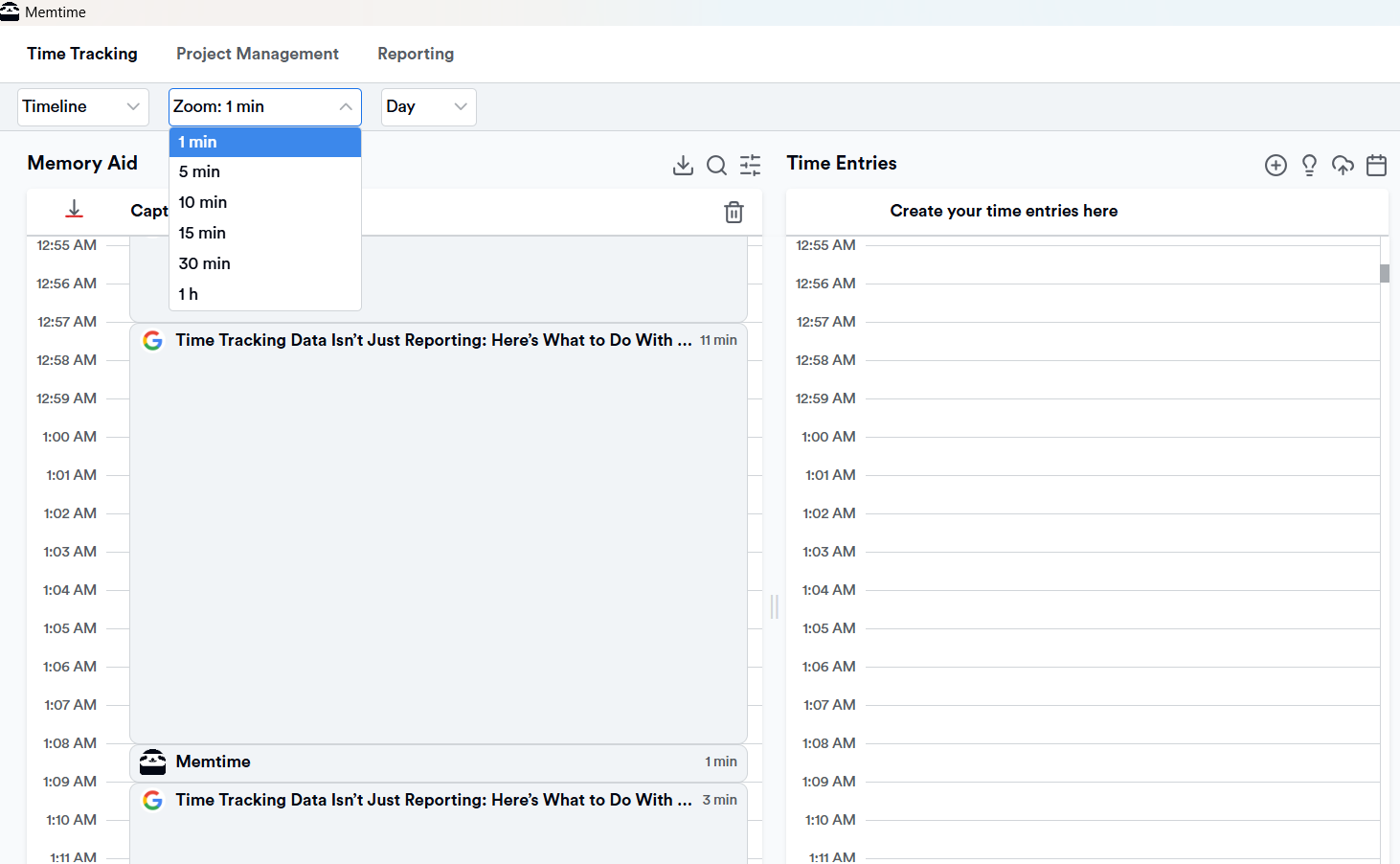
- Smart time entry suggestions. Open a certain Figma file? Work from a specific folder? Visit the same URLs? Memtime offers the option to provide time entry suggestions by creating rules based on your activities… so you don’t have to piece things together from memory.
- Calendar tracking. You can sync Google Calendar, Outlook, iCloud, or CalDAV to compare what was planned with what actually happened. Because meetings always run long, and now you’ve got the data to back it up.
- 2-way sync with 100+ tools. You can pull projects and tasks from your project management or billing tools into Memtime, track time automatically, then send time entries back for invoicing. No retyping.
Shortly put, Memtime gives you time data you can actually trust, without changing how you work or think. With Memtime, you can price better, scope smarter, and protect your margins.
Pricing is a creative skill, too
Pricing creative services is about being honest with yourself and your clients.
Honest in regards to what your work really takes, what it really costs you, and the value it creates. Because when pricing works, you do better work, clients get awesome outcomes, and everyone enjoys the process.
So, start by tracking your time to see the truth behind your work. Like where your energy goes, where revisions pile up, which projects are quietly profitable, and which ones only look good on paper.
Once you see that reality, pricing becomes defensible and intentional. You’ll stop apologizing for your rates and start charging in a way that finally reflects the value you bring.
Good luck! 🍀
Why does pricing creative work feel so tricky?
It’s because clients usually only see the final product, not all the thinking, experimenting, and tiny decisions. That mental work doesn’t show up on a spreadsheet, so pricing it can feel awkward. Once you start thinking of your work in terms of value, not hours, it gets way easier.
Is hourly pricing really a bad idea for creatives?
It’s not terrible, but it can be sneaky. Great ideas don’t follow a clock, and being faster at your craft can actually hurt your earnings if you charge by the hour. That’s why lots of creatives end up switching to project, value, or retainer pricing.
Which pricing model should I use?
There’s no one-size-fits-all. Project pricing is great when the scope is clear, retainers work for ongoing support, and value-based pricing is perfect when you’re advising or leading strategy. The trick is picking a model that actually matches the effort, thinking, and impact your work delivers.
How do I stop underpricing myself?
Start by figuring out where your time and energy really go. Revisions, mental context switching, research, it all counts. Using automated tools like Memtime helps you see the full picture without having to manually track every minute. Once you know the reality, you can price confidently rather than guess.
What are clients really paying for?
Well, not for your hours. They’re paying for clarity, problem-solving, and peace of mind; basically, for you to turn chaos into a decision. Your taste and judgment are the secret sauce they can’t get anywhere else.
Can time tracking actually help me price better?
Yes, absolutely! When you see how long projects actually take, which clients drain your energy, and where revisions pile up, you can make smarter pricing decisions. Tools like Memtime quietly capture all that without interrupting your creative flow. Knowing your real numbers gives you confidence to charge what you’re truly worth.

Aleksandra Mladenovic
Aleksandra Mladenovic is a copywriter and content writer with six years of experience in B2B SaaS and e-commerce marketing. She's a startup enthusiast specializing in topics ranging from technology and gaming to business and finance. Outside of work, Aleksandra can be found walking barefoot in nature, baking muffins, or jotting down poems.